DON’T let AI write the doc!

(This is a follow-up post to “Let Them Review the Doc“)

If you’re typing up a document for your meeting attendees to review…

Or God forbid you’re responding to the meeting doc with AI…

You will get nothing out of the meeting, and no one will be any better off for having spent one of their precious hours talking to you.

I know for many people, this is akin to me asking you not to breathe, but it’s so important.1

The meeting doesn’t need to know what Claude thinks. It needs your brain’s input, your imperfectly formed ideas, your sloppy wording.

Meetings need your humanity.

If you’re going to have AI write your pre-meeting doc or your response to said doc, you might as well just have AI bots hold meetings without you.


  1. I’ve been pushing for this in my work, and every single document I’ve looked at before a meeting was very obviously written and formatted by Claude.

    Why is this a problem? Because when I go into the meeting, the person holding it has no idea what’s written on the document, and it’s obvious. It completely defeats the purpose. ↩︎

AI, politics, and your health

Several people have sent messages to me over the last year asking why I talk about politics or artificial intelligence if I’m “just trying to be a health coach…” The implication (or outright criticism) is, “You should focus on exercise and nutrition because that’s what health is, not AI or politics.”

As someone trained in the Deep Health model of coaching (thanks, Precision Nutrition!), I respectfully disagree.

Human health is multidimensional. It’s not weight loss, V02 max, bench press numbers, meal plans, or whatever “maxxing” fad happens to be circling the web right now (in fact, it’s almost never those things). It’s a holistic combination of numerous facets of your life that all influence each other.

Your health is a system, and like any system, a change in one part affects the whole.

The Deep Health model has six dimensions:

  1. Mental: How focused are you? How well can you learn? Are you so overwhelmed you can’t get anything done?
  2. Emotional: Are you in control of your emotions? Can you express them well?
  3. Existential: Do you have a sense of purpose or meaning in your life? Do you feel fulfilled most days?
  4. Environmental: Is your environment safe and secure? Is it clean and sanitary? Do you have what you need to survive and thrive?
  5. Relational: Do you have rich, rewarding relationships in your life you can rely on? Or are you lonely? Being abused?
  6. Physical: How well do you eat and move? How do you feel day-to-day? Are you chronically ill (as I am)?

Notice I saved physical for last—not because it’s less important, but because I want to emphasize how important the other aspects are. All these dimensions are interconnected, which means that they can all influence your physical health.

Which brings me back to why I talk about AI and politics.

If you worked for the federal government in the United States and were unceremoniously fired by DOGE in 2025, this affects your health. Lack of income, loss of meaning (a lot of which comes from our work), the uncertainty of how you’ll pay your bills or feed your kids—just like that, you’ve had your mental, emotional, existential, and environmental health negatively affected.

If you had your health benefits slashed by cuts to Medicaid or the Affordable Care Act, your physical, environmental, and emotional health have been negatively affected.

If you’re constantly being bombarded by the bullshit scare-marketing coming from the AI CEO tech bros telling you they’re going to kill off the human race, but they can’t do anything to stop it…

Or if your boss drank the AI Kool-Aid and is hounding you to ship more work, faster, with less care or craft, you’ll be incredibly stressed mentally, emotionally, and probably environmentally (because you’re constantly worrying about your job).

I could give you several dozen more examples, but you get my point.1 Each of these “non-health” issues affects your well-being, and they can all affect your physical health.

You might not be able to eat well, or get to a gym, or go for a walk, or do anything “healthy” after being mentally and emotionally (or God-forbid, physically) assaulted all day.

If you believe health is only about how much you lift in the gym or how much protein you get each day, then yeah, I’m out of line.

But that’s not what health is, and that’s not how I coach. You are a multi-dimensional, incredibly complex creature whose physical health is affected by so many things outside of nutrition and exercise. A good coach (which I like to believe I am) recognizes that and works with you to manage all aspects of your health, not just the physical.

So I’ll keep writing about AI and politics—and all sorts of other things too—as long as they keep affecting your health.


  1. And that doesn’t even include our Health Department cutting programs to keep us physically healthy, a decision that has led to viral outbreaks, explosive diarrhea, and death. There’s politics affecting your health again! ↩︎

Just because you can doesn’t mean you should

It’s one of my favorite lines from Jurassic Park, and it applies in just about every situation imaginable.

via GIPHY

In my case, it’s on my mind daily as I watch the L&D industry, of which I’m a part, rapidly adopt AI for anything and everything that it possibly can.

The biggest victim of this is video creation. There are now approximately 7 trillion companies that all offer some form of talking-head, AI-avatar video-generating software that’s supposed to make video creation fast, simple, and easy for practitioners.

The problem is, most of it is awful. At least, if you care about your craft and the quality of your output.

The videos are generic. They don’t actually “TEACH” you anything. They simply come across as informational videos, which ironically is what people constantly complain about in corporate training. “It’s too boring. Not actionable. Just random information that I don’t know what to do with.”

So it’s great if you want to do more of the same stuff that doesn’t work, but you want to do it quickly, cheaply, and efficiently.

However, if you ACTUALLY want to create learning that matters, you might be better served doing it without AI. Or at least learn best practices for making learning stick or making it applicable, then work that into your AI-generated videos.

As always, it comes down to design thinking: Who’s it for and what’s it for?

If you know the answer to those questions, you can make quality content. Maybe with AI, or maybe not.

Just because you can do it with AI doesn’t mean you should.

What skill have you developed in the last five years?

For most of us, I’d bet it’s something like this:

“In the last five years, I’ve gotten really good at reading and sending emails and instant messages. But also, I’m really good at going to meetings.”

Not exactly skills you can sell when you’re looking for your next gig, are they?

For those of us who don’t make or sell tangible products for a living, skills are all we have to trade for money. But the nature of knowledge work means more of us are developing fewer skills the longer we’re in our careers.

We’re spending more and more of our time talking about work rather than doing work. We’re building fewer things and completing fewer projects.

AI is only exacerbating the problem, as we outsource more of our making and thinking to AI chatbots (and getting worse outcomes as a result).

Without projects that we do ourselves—without making things that challenge us to learn—we’re deskilling ourselves. And as a result, we’re making ourselves less marketable in the workforce.

The best time to develop a new skill was five years ago. The next best time is today.

We’re disconnected from work because work is disconnected from life

One reason I think so many of us are feeling disconnected from work is that work itself is disconnected from our lives.

For most of human history, work was literally and directly tied to living our lives. We hunted and gathered to feed ourselves, our families, and our tribes.

After the Agricultural Revolution, we worked the fields and raised animals to directly support how we lived. At the same time, the idea of markets developed, and we began selling the surplus and byproducts of our work. But the selling itself was still directly tied to the work we’d done previously.

Then the Industrial Revolution hit, and humans went to work in factories. And for the first time in our history, our work was separate in every way from our lives.

We left our farms and our cottage industries (aptly named). We stood at assembly lines for 10 or 12 hours a day, away from our “tribe,” moving or assembling widgets that had nothing to do with our day-to-day.1 We didn’t make the parts, build the factory, or come up with the ideas for what we were making.

But it was also physically separate from the rest of our lives. No longer did we work fields on or near our homes or in little shops in the town square.

Instead, we commuted away from home to work in an alien environment in the most anti-human way possible, literally putting our lives on hold for our shift. And the only things we had to show for it were little bits of paper or metal at the end of the week.

And once the Information Age hit, the disconnect became absolute. Now, most of us are completely disconnected from production altogether. We often don’t “make” things anymore. We administer, we meet, we talk about work through digital (no longer tangible) communication methods. And occasionally, we do something like sort of feels like actual work.

Few of us are close enough to the end product of what’s made, sold, and consumed to actually feel what it is we’re doing.

And now we have generative AI, and we’re steadily offloading what’s left of our work to a little homunculus that does everything for us.

So where does this leave us?

We’re heading toward another revolution, but I think it’s different from what all the AI pundits predict.

I think this disconnect is going to become so severe that we’ll push back and seek to return to the roots of human production.

More of us will step out on our own, or join together in small groups to make things that matter for people who care.

I think this AI revolution will end up becoming a revolution of meaning.


  1. Sure, Ford made sure that every American eventually had an automobile of their own. But it’s highly unlikely that you would have made the very same car that you, yourself, were driving. ↩︎

Remember: there are humans involved

There’s one train of thought in discussions about AI that aggravates me the most.

The conversation inevitably, yet casually, turns to when it will be time to eliminate job roles and pass the work off to AI.

I hear it all the time, and there are several problems with it. The least of which is the belief that an AI agent, in the current state of the field, can actually replace a human expert in a field or subject simply because it’s fast and efficient at doing similar work.1

It can’t, at least not yet. And when it’s used as such, the results are often banal (AI slop is aptly named).2

But the issue with these conversations that bothers me the most is the nonchalance with which these comments are made.

We’re talking about people here. Human beings with hopes, dreams, and worlds as rich as those having the conversations. People with families, children, parents, and friends who rely on them.

And we reduce them to job roles?

I’m no Luddite. I know that technology changes the world of work. The steam shovel got rid of ditch diggers, and email eliminated the secretary pool.

AI will eventually have a major impact on the job market: it will change which jobs are available and, for those that remain, what they look like.

But in the meantime, let’s remember that we’re talking about people. And our decisions need to be made with empathy and understanding for the impacts they’ll have on them.


  1. If you actually think that AI is replacing human beings, you need to check out the addendum at the bottom of Cal Newport’s latest blog post. ↩︎
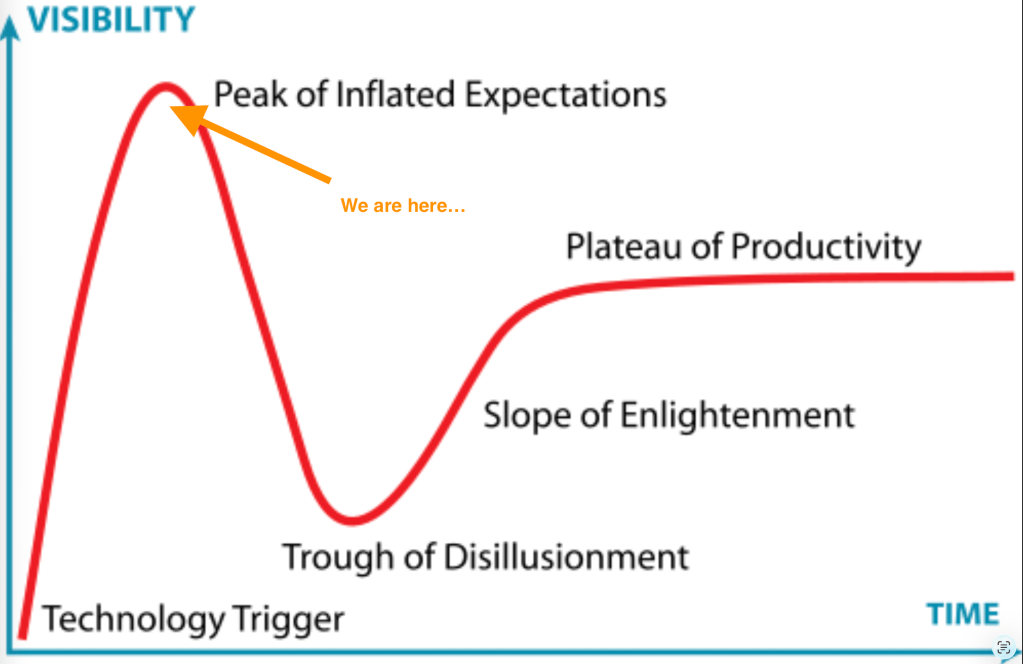
  2. I assert that companies that make these decisions to eliminate jobs and outsource everything will thoroughly regret them in the next few years when the limits of these tools are exposed, and we enter the “trough of disillusionment.”

    The Gartner Hype Cycle is proven and applies to these AI companies as much as they have to every other culture-changing technology we’ve experienced.

    After the hype dies down, most things will go back to normal, except that people will use AI for things that it’s actually good at. ↩︎
By Jeremykemp at English Wikipedia, CC BY-SA 3.0, https://commons.wikimedia.org/w/index.php?curid=10547051

Why I still write a blog in the age of AI

Blogs are dead. They were at peak relevance about 15 years ago.

Then, algorithmically-driven social media platforms ruined them by providing perfectly curated, mind-numbing entertainment any time you need it.

Now we’re living through another significant moment for tech innovation and the internet.

When AI can write everything for us, why bother writing in a medium that hasn’t been relevant in more than a decade?

Because I refuse to offload my thinking to artificial intelligence.

I use AI every day to help me with work, complete minor tasks, and even sharpen my thinking. But I will not let it think for me.

So I write this blog. It’s not because I have a huge audience. There are only about 300 subscribers, and of those, only a third of you read it regularly.

So it’s definitely not because I’m reaching millions of people or making my living writing here. It’s because I need to do it for my own mental acuity.

It helps me crystallize ideas, expose gaps in my knowledge and logic. It makes me assert, which means I have to consider counterarguments and be okay with potentially being wrong.

So I continue to write. According to my WordPress dashboard, this is my 500th published blog post. That feels like a pretty significant milestone.

And if you’re reading this—thank you. From the bottom of my heart, I am truly grateful.

The em dash exists for a reason

And I’ll be damned if I stop using them now. I’ve been using em dashes since I started writing—because they work.

They do things that other parenthetical devices like commas or parentheses don’t do.

They add force to your arguments. They separate potentially unrelated but still relevant or useful thoughts—have you ever noticed this?—from the point you’re making.

And for those of you who say that there’s no way to recreate them on a computer keyboard…

Shift + Option + – (for Mac users) gives you —.

Here are 11 of them: — — — — — — — — — — —

Also, there are two other types of dashes.

– (press only the dash key) is a hyphen most often used to separate compound words.

– (made by pressing Option + – on a Mac) is called an en dash and can be used to separate things like dates (April 20–23).1

And then you have the glorious em dash.

Why do they show up so often in AI writing? It’s simple: most of the best writers in history made (and still make) liberal use of it—because it works! And because AI has imbibed all the writing ever written, it also uses it quite often.

Does AI use them too much? Absolutely.

Does that mean we should stop using them? Absolutely not.

So what’s the solution? You get really damn good at writing.

Develop a style of your own, a voice, a way of writing that sounds like you—and only you. So when people read your writing, they know that you did it, not an AI.

And you’ll be able to use fifty em dashes in a single piece if you wanted to, and no one would care because they would know, simply because of your personal style, that you were generous enough to take time out of your day to share something worth reading.

If you write well—and like yourself—you’ll be fine.

(Ann Handley actually beat me to this a long while back. But I was so incensed by no less than 7 posts about this yesterday that I had to say something.)


  1. Unfortunately, there is a feature in WordPress’s code that prevents the three different dashes from rendering properly. I didn’t realize this until after I publish. So if you’re reading this on my site instead of in email, you won’t be able to see the difference between them.

    You can test this for yourself: pull up a blank document somewhere on your computer and try all three keystroke combinations.

    Also, this is a great reason to subscribe to my email newsletter, so you’ll see it rendered the way it’s supposed to. ↩︎

The thing about AI (no thanks, Claude)

It makes bad stuff better.

It makes poor writers better. So too for unskilled graphic designers or amateur financial analysts.

But also spam, scams, and cyber threats. It used to be easy to see a phishing email for what it was, but the Nigerian princes are gone.

At the same time, it also makes the great stuff worse.

Great writing becomes banal and repetitive. AI art looks like… AI art (or the boring stuff you see in hotels).

It brings the good stuff down while bringing the bad stuff up. In short, it averages it out.

And that makes sense because LLMs imbibe everything that exists—the great, the good, the average, and the bad.

And in most subjects, the bad always outnumbers the great (or even the good). This lowers the average.

The key is to know what to use it for.

If you’re bad at something, AI will make you better at it. So use it.

But if you’re good (or especially if you’re great) at something… Think twice before handing it off to AI.

I ran this post through Claude and, based on its knowledge of my style, asked it for feedback. Claude told me the post had great bones, but it also told me to remove certain items and phrasing… Precisely the same things that make my writing style what it is.

It told me to remove a tiny explanatory sentence as well (do you know which one?). And I refused to do it, because there are plenty of people who still don’t know how this stuff works. That knowledge is central to the premise of this post.

It also recommended that I end the post with something like, “Average is the enemy of excellence.” How many times have you heard that before? It felt too much like a motivational poster for me—I can already see the kitten attempting pullups with that as the headline.

So, I think I should actually end this post by saying, “Claude, your suggestions were appreciated, but wrong.”1

And that is precisely my point.


  1. I did make a couple of tiny grammatical changes it suggested, which did actually improve the post. And sometimes, Claude’s recommendations actually do improve my writing.

    And, somewhat ironically, Claude did improve this post by giving me feedback, even though the feedback turned out to be flawed. It proved my point in real time. So I must give credit when it’s due.

    But more often than not, Claude’s suggestions make my writing worse because it no longer sounds like me. ↩︎

AI isn’t taking your job

…at least not yet.


I use AI almost every day to assist with work and learn new topics (as part of my job) that I’m unfamiliar with. I read diligently to stay up-to-date on the latest developments, so I can learn how to use it more effectively.

AI will become (if it hasn’t already), and continue to be, a large portion of all of our lives.

However, we’re receiving a significant amount of misinformation about what’s happening and the effects it’s having on workers. Some of it is outright deception, while some is simply lazy reporting.

First, the deception.

The CEOs of these massive tech companies (e.g., Dario Amodei, Sam Altman) are brilliant business people who’ve created mind-boggling products. But they’re hemorrhaging cash trying to make their programs more powerful…

And after years of unbelievable growth and progress, they’re failing. The scaling law on which they used to project LLM growth is slowing down, and the improvements are now incremental, rather than exponential.

This is a serious financial problem for them. They need to keep their current investors engaged, and they need new investors to infuse them with additional capital. So what do they do?

They go on cable news shows or podcasts and claim that their AI software will replace all entry-level workers (10-20% of the workforce) within a matter of months.1 It just isn’t true.

But you wouldn’t know that from the news you’re consuming. They’ve bought into this story hook, line, and sinker.

Which brings me to my accusation of lazy reporting. Headlines like “Goodbye, $165,000 Tech Jobs” and “AI is Replacing 10 million Workers” (I made that one up) are attention-grabbing… But untrue.

These media companies, like the AI companies they write about, need to make money. They do that by getting as many eyes on their work as possible. And the best way to do that is to scare people into giving them attention… Even if the claims are untrue or misleading.

To paraphrase Ryan Holiday, who warned us about this years ago: “Trust them… They’re lying.”

It is true that computer science graduates are having a much harder time finding jobs at the moment. And it’s true that there have been massive layoffs in the tech sector.

It’s also true that the companies doing these layoffs are investing more of their money and efforts in AI. But AI is not the cause of this, nor is it replacing those who’ve been laid off.

Here’s what’s actually happening:

During the pandemic, these tech companies went on a massive hiring spree—they simply overhired. Now they’re bloated, and the quickest way to reduce the bloat and (temporarily) increase shareholder value is to shed programmers left and right.

At the same time, the tech sector itself is contracting, which means there are fewer jobs for all the newly minted computer science graduates.

This has historical precedence. The same thing happened in 2008 during the financial crisis. And it happened before that during the dot-com bust at the turn of the century.

The number of people entering the computer science field fluctuates in response to the economy. There’s a tech boom, prompting more people to enter the field. Then the sector contracts, and all those people get laid off, which in turn reduces the number of people entering the field.

Until the next boom.

Contrary to what many journalists have written, these people aren’t being replaced by AI. They’re simply being let go because companies overhired during the pandemic or because the companies are refocusing on AI.

However, that refocus, coupled with layoffs and fewer job openings, has led them to conflate the two, concluding that these computer science graduates are being replaced by AI.

This simply isn’t true. That may happen in the 2030s, but it’s not happening right now.

I’ve been guilty of buying into this hysteria too, as you can see in my piece on job hunting in 2025. And I’m here to tell you I was wrong in what I wrote about AI replacing workers in that piece.

All that to say this: Read AI journalism with a healthy dose of skepticism right now. And take any apocalyptic predictions with a grain of salt.


  1. Dario Amodei actually said this in an interview with Anderson Cooper and, ironically, claimed to be worried about it… Which begs the question: if you’re worried about it, why do you continue to do it?

    Why doesn’t he just stop if it actually worries him? It’s his company. ↩︎