Remember: there are humans involved

There’s one train of thought in discussions about AI that aggravates me the most.

The conversation inevitably, yet casually, turns to when it will be time to eliminate job roles and pass the work off to AI.

I hear it all the time, and there are several problems with it. The least of which is the belief that an AI agent, in the current state of the field, can actually replace a human expert in a field or subject simply because it’s fast and efficient at doing similar work.1

It can’t, at least not yet. And when it’s used as such, the results are often banal (AI slop is aptly named).2

But the issue with these conversations that bothers me the most is the nonchalance with which these comments are made.

We’re talking about people here. Human beings with hopes, dreams, and worlds as rich as those having the conversations. People with families, children, parents, and friends who rely on them.

And we reduce them to job roles?

I’m no Luddite. I know that technology changes the world of work. The steam shovel got rid of ditch diggers, and email eliminated the secretary pool.

AI will eventually have a major impact on the job market: it will change which jobs are available and, for those that remain, what they look like.

But in the meantime, let’s remember that we’re talking about people. And our decisions need to be made with empathy and understanding for the impacts they’ll have on them.


  1. If you actually think that AI is replacing human beings, you need to check out the addendum at the bottom of Cal Newport’s latest blog post. ↩︎
  2. I assert that companies that make these decisions to eliminate jobs and outsource everything will thoroughly regret them in the next few years when the limits of these tools are exposed, and we enter the “trough of disillusionment.”

    The Gartner Hype Cycle is proven and applies to these AI companies as much as they have to every other culture-changing technology we’ve experienced.

    After the hype dies down, most things will go back to normal, except that people will use AI for things that it’s actually good at. ↩︎
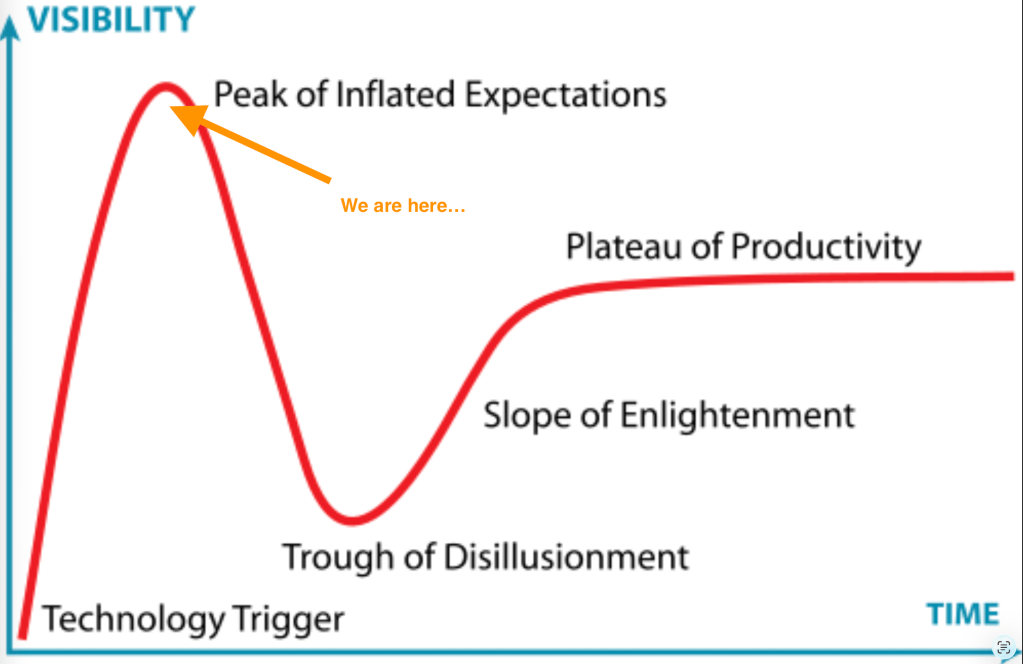
By Jeremykemp at English Wikipedia, CC BY-SA 3.0, https://commons.wikimedia.org/w/index.php?curid=10547051

Digital dementia

Psychologists also call it digital brain rot.

It describes the forgetfulness, the inability to focus on anything meaningful, the brain fog, and the mental fatigue caused by our chronic overuse of smartphones, digital devices, online games, and social media.

It’s even been shown to reduce the gray matter in our brains associated with emotional regulation, decision-making, and creativity.

The good news is that it only takes a few days to bounce back, but it can be a tough few days.

Try a digital declutter or the phone-foyer method. Find something that works for you, but for your sake and that of future generations, do something.

Everyone worried TV would rot our brains, but smartphones actually are. We know these devices are purpose-built for addiction and harm.

Now is the time to break the cycle.


H/t to Brad Stulberg.

Bringing about our own extinction

David Meerman Scott published a fascinating article a few days ago. It compares modern AI companies to Enron and that company’s financial scandal that broke in 2001. 

But one paragraph in particular stood out to me that warrants quoting in full:

Altman says there’s a chance that so-called Artificial General Intelligence (which is still years or decades away) has the possibility of turning against humans. “I think that whether the chance of existential calamity is 0.5 percent or 50 percent, we should still take it seriously,” Altman says. “I don’t have an exact number, but I’m closer to the 0.5 than the 50.” (Source)

Terrifying, right?

I would argue that if you are creating something that has anything other than a 0% chance of wiping out humanity, you probably shouldn’t do it. 

For example: marketing Pepsi to be consumed in massive amounts, while definitely bad for humans, doesn’t run the risk of causing mass extinction.

On the other hand, bringing Tyrannosaurus rex back to life definitely has a greater than 0% chance of doing just that.

Now, I’m not a doomsday prepper by any stretch of the imagination… But when someone tells me there’s even a small chance that what they’re making could turn out like The Matrix, I start to worry. 

It’s as if they never watched I, Robot or read Jurassic Park (which is actually about runaway technology, not dinosaurs). 

These companies have a responsibility to guarantee that this doesn’t happen. We already made this mistake with nuclear weapons. And that threat still looms large over our heads, especially right now during the Russo-Ukraine War. 

We have enough threats to deal with. Let’s not create more of our own volition.

I’ll leave you with my favorite quote from Jurassic Park:

“Your scientists were so preoccupied with whether or not they could that they didn’t stop to think if they should.”

For more daily musings like this, subscribe below:

Discovering a new passion!

I always believed that I was creative in only one realm, that realm being music. I have since discovered that I was wrong. Who would have thought that a musician and amateur historian would fall in love with computer programming and web development?

I began working for a very large tech company in 2017 which required learning countless new skills. One of those many skills was learning the basics of computer coding so that I might teach others in a rudimentary fashion. I quickly discovered that I had a knack for solving problems and puzzles with these languages. Not only was I good at it, I was enjoying it! It was the first thing since my days of practicing music for hours on end that caused me to lose track of time while I worked.

After a while, I decided to explore this area further and see what coding could do in the real world. I came across Codecademy.com thanks to my wife, Theresa; she is a brilliant mathematician and wonderful teacher who has had to learn coding for her master’s degree. I worked through the Code Foundations plan, then picked up the Web development plan. The results are below:

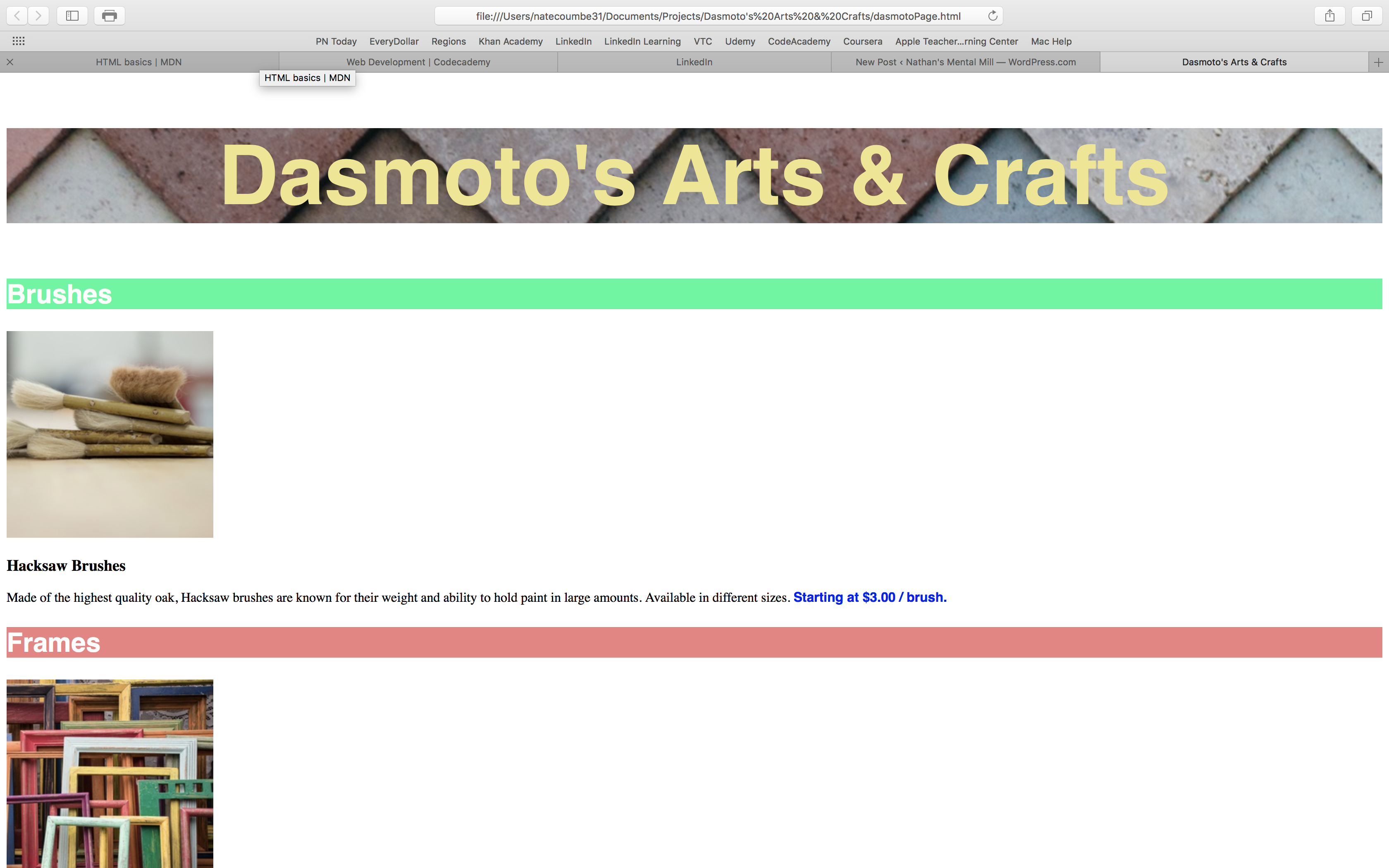
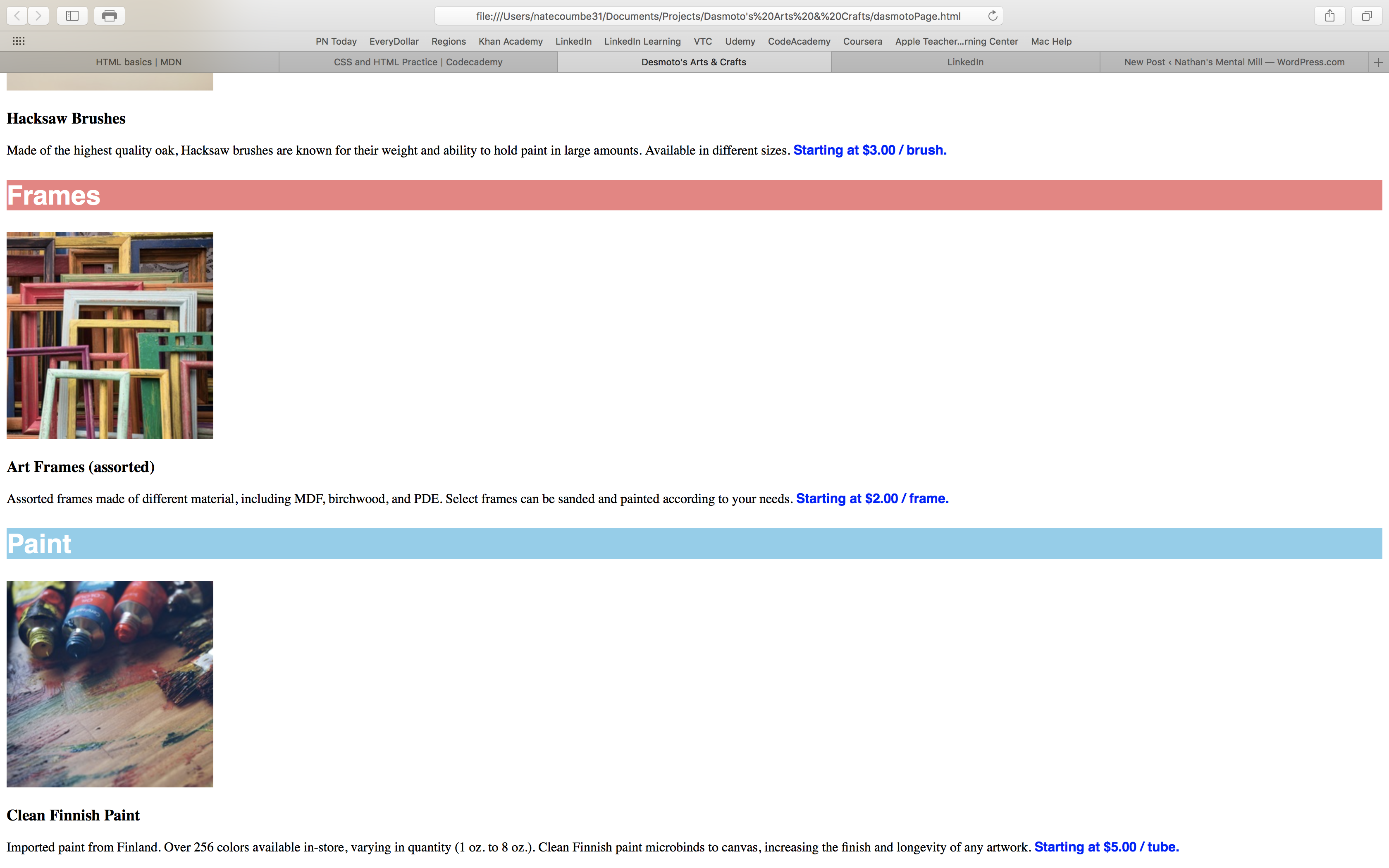
My first little webpage! A HUGE thanks to all of the people working at Codecademy.com for their awesome instructional materials, of which this was a part!

There isn’t much to it, I know, but I am thrilled! I haven’t felt this excited in a long time; I built, from scratch, a simple arts & crafts website today! Using nothing but a “spec sheet” given to me by Codecademy.com, which told me what the desired appearance of the page was to be, and one quick Google search for the answer to a question, I went to work. I programmed my own HTML and CSS code into my new text editor from Atom, linked the files together, inserted pictures, and built a simple, attractive little home page within an hour. I never dreamed I would be doing this, and yet here I am. This has been scratching my creative itch like I never thought possible. 

What begins as a collection of symbols, words, and at times what appear to be indecipherable hieroglyphics comes together in a web browser to show the reader the pictures you see above. It is simply miraculous! Creating physical art by hand is not something at which I have ever been skilled, but by using my newfound computer skills, I think I will be making my own type of art.

I am not finished learning; my skills are still in their infancy, and there are coding languages which I have not yet touched. But the fire which I thought only responded to music has again been lit. Now if you’ll excuse me, I have more work to do!