
I’m signing up for cold calls

Every week, I sign up for several webinars or other educational opportunities. And every time I do so, they ask for my phone number (always required, never optional).

Several years ago, I noticed that I was getting dozens of unsolicited phone calls each week from people and companies I’d never heard of.

I couldn’t figure out why, until I realized that most of these people worked for companies that sponsored (overtly and sometimes covertly) the events I attended.

It’s obvious now that the events weren’t just for me: they were pipeline-building opportunities for organizations to grow their businesses.

If this sounds annoying, it is. But I’ve come to terms with it.

I realized that, unlike telemarketers interrupting me at dinner, I was getting calls from professionals who were just trying to make a living at the same time they were offering me something that by my own admission—I signed up for their webinar, right?—might benefit me.

Most of these calls go nowhere because they’re for businesses or services I either can’t afford, don’t need, or don’t have the authority to decide on for my job.

But the person on the other end of the phone is a professional. She’s doing her job, and I will respect that by treating her with decency rather than contempt.

Because I might be that person on the other end of the line someday. Whether it’s making contacts for a new job, selling a service I created, or raising funds for a cause I care about, I might be that person making calls.

And I hope the person on the other end sees it as a generous act on my part, not a self-serving one that benefits only me.

So my mantra, when I’m typing my information into a sign-up form, is, “I’m signing up for cold calls.”
Remember: there are humans involved

There’s one train of thought in discussions about AI that aggravates me the most.

The conversation inevitably, yet casually, turns to when it will be time to eliminate job roles and pass the work off to AI.

I hear it all the time, and there are several problems with it. The least of which is the belief that an AI agent, in the current state of the field, can actually replace a human expert in a field or subject simply because it’s fast and efficient at doing similar work.1

It can’t, at least not yet. And when it’s used as such, the results are often banal (AI slop is aptly named).2

But the issue with these conversations that bothers me the most is the nonchalance with which these comments are made.

We’re talking about people here. Human beings with hopes, dreams, and worlds as rich as those having the conversations. People with families, children, parents, and friends who rely on them.

And we reduce them to job roles?

I’m no Luddite. I know that technology changes the world of work. The steam shovel got rid of ditch diggers, and email eliminated the secretary pool.

AI will eventually have a major impact on the job market: it will change which jobs are available and, for those that remain, what they look like.

But in the meantime, let’s remember that we’re talking about people. And our decisions need to be made with empathy and understanding for the impacts they’ll have on them.


  1. If you actually think that AI is replacing human beings, you need to check out the addendum at the bottom of Cal Newport’s latest blog post. ↩︎
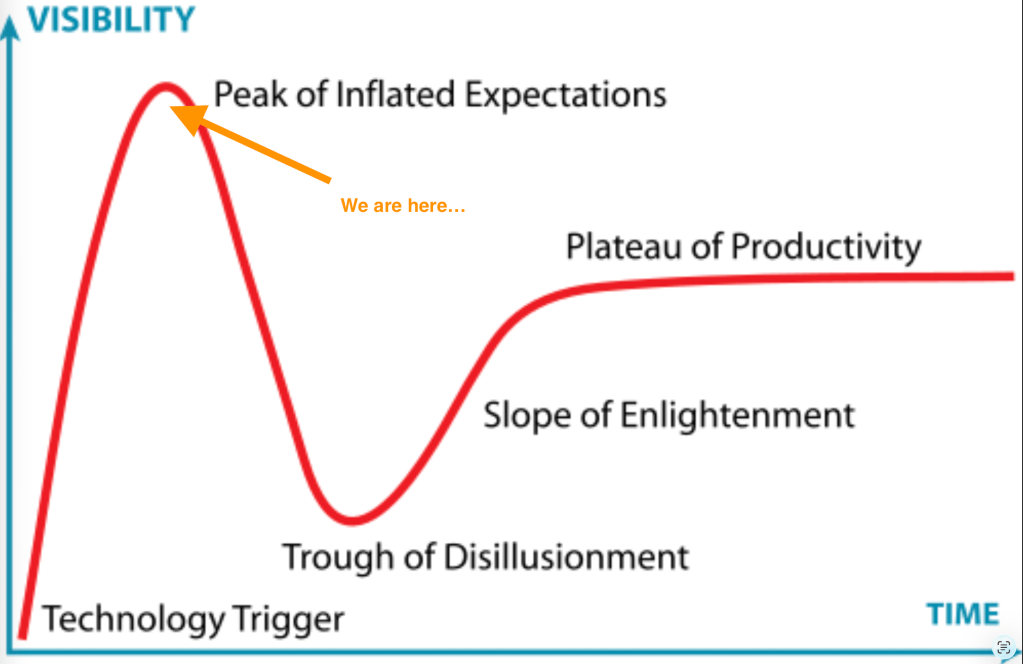
  2. I assert that companies that make these decisions to eliminate jobs and outsource everything will thoroughly regret them in the next few years when the limits of these tools are exposed, and we enter the “trough of disillusionment.”

    The Gartner Hype Cycle is proven and applies to these AI companies as much as they have to every other culture-changing technology we’ve experienced.

    After the hype dies down, most things will go back to normal, except that people will use AI for things that it’s actually good at. ↩︎
By Jeremykemp at English Wikipedia, CC BY-SA 3.0, https://commons.wikimedia.org/w/index.php?curid=10547051

Why would they do this?

There’s a line in Crucial Conversations worth memorizing:

“Why would a reasonable, rational, and decent person do what this person is doing?”

Most of our behaviors aren’t irrational. Some of them are unconscious, but people rarely do things for “bad” reasons.

Everyone sees themselves as the “good guy” in the story. This means they must be doing this action for a rational reason. It’s solving a problem for them. It’s in service to something they value.

And it might be completely and totally awful to a great many other people. But the first step in fixing something is to understand it.

You might not know why right away, but it’s worth sitting with the question. It might help you find the solution to irrationality.

Fairness is based on expectations

If we don’t know what we mean when we talk of fairness, we can’t make informed decisions on whether something is fair or not.

The first step is to set an agreed-upon expectation of what fairness means to the group.

Love thy neighbor as thyself

Hillel the Elder was once asked to explain the Bible’s teachings as succinctly as possible.

He stood on one foot and made the following statement:

“Love thy neighbor as thyself—all the rest is commentary.”

This statement keeps going through my mind as I read the news each day. As I see what certain people are doing to others, on camera, in broad daylight.

I just want them to answer a question like: “How would you feel if you were the one being wrongfully arrested by New York police officers while on vacation?”

We are losing our humanity. We are losing our ability to empathize.

I have no positive words of encouragement today—only a reminder to love thy neighbor.

How would you coach them?

Pretend for a moment that you’re a coach and someone approached you with an issue.

How would you help them? What would Coach You tell that other person?

Now, with that same mindset, imagine that you are the client with the same problem. Why would you tell yourself anything different?

Be the same coach for yourself that you would be for others.

Subscribe below to get the blog directly in your inbox!

Change your story, change your results

Each of us has an internal narrative constantly chattering about who we are. 

But what we don’t always realize is that internal narrative influences how we behave.

If you tell yourself the story that, “Overeating makes me feel happy,” that story might be a stand-in for the real story—“I’m unhappy with different aspects of my life and overeating gives me a small dose of pleasure.”

Until you realize this, you’ll continue to overeat and live on greasy fast food multiple times each week.

(I know this because it’s a story I’m trying to rewrite myself). 

If you tell yourself a story that says, “I’m not skilled at sales or business,” you might never realize your unresolved dream of starting your own venture and working for yourself. 

The first step to overcoming many of our chronic issues is to start telling ourselves a different story. 

Changing what you do starts by changing your identity—who you believe yourself to be. 

Change the story, change the person.

“That’s not the right way to do that…”

Have you ever looked at someone and said to yourself, “That’s not the right way to do that…”

Maybe you were watching someone do an exercise at the gym. And you just couldn’t figure out why their pushup form was so different from yours.

Your first thought probably goes to their ignorance: “They just don’t know the right way to do it. I could show them how…”

The thing is… You have your own lens through which you look at the world. You have your own experiences, education, and biases that dictate the “right” and “wrong” way for you. 

And they have theirs too. 

Even when it comes to something as simple as a pushup. And even when there might be an objectively “right” way to do something.

But there might be a specific reason they’re doing their pushups in that way. 

Maybe they have an injury that prevents them from using “proper” form.

Or maybe they read a new study that taught a different way of doing it—one that helps them meet a different need.

Or maybe it really is simply ignorance of what’s right. 

But the fact remains, you don’t know why they’re doing it. 

Perhaps a better thing to do, instead of jumping to conclusions about right and wrong, would be to change the statement to a question.

“I wonder why they’re doing it that way?”

At that point, you have the basis for empathy and understanding.

And those qualities give you a much more stable platform to engage in dialogue… Or even enact change.

The correct thing? Or the right thing?

Sometimes we have a choice between what is correct and what is right.

What’s “correct” is often bureaucratic or compliant with rules and regulations. Often those same rules and regulations fly in the face of common sense, decency, and the dignity we owe others.

When a customer’s computer catches fire with no fault on their part, obviously due to a manufacturer’s defect, we have a choice. We can do the correct thing: quote the manual and say there’s nothing we can do. Or worse yet, we can say:

“You should have bought the warranty.”

Or we can do the right thing: acknowledge the problem and take responsibility. We can help the person who put her faith in us and our product or service.

Correct or right—it’s a choice.

We must improve our ability to make the proper choice when the time comes.

Don’t forget to subscribe!

Why Would You Intentionally Confuse Them?

If your goal is to get someone to buy from you (or trust, believe, understand, or empathize with you), why would you intentionally confuse them?

Why make it harder than necessary to get the information they need to make a decision?

Why use confusing phrases or vague points in an attempt to hide the cost of your product?

Do you think it makes them more likely to take action? Really it will frustrate them, damage any trust that’s already been built, and push them away.

“If you confuse, you lose.”

Donald Miller

Make things direct and clear, especially prices. Don’t hide the truth because you’re worried about sticker shock or how someone will react.

If you feel the need to hide it, you might need to rethink what you’re doing. That goes for everything you do, not just selling.

Get daily insights delivered directly to your inbox. Subscribe today!