What skill have you developed in the last five years?

For most of us, I’d bet it’s something like this:

“In the last five years, I’ve gotten really good at reading and sending emails and instant messages. But also, I’m really good at going to meetings.”

Not exactly skills you can sell when you’re looking for your next gig, are they?

For those of us who don’t make or sell tangible products for a living, skills are all we have to trade for money. But the nature of knowledge work means more of us are developing fewer skills the longer we’re in our careers.

We’re spending more and more of our time talking about work rather than doing work. We’re building fewer things and completing fewer projects.

AI is only exacerbating the problem, as we outsource more of our making and thinking to AI chatbots (and getting worse outcomes as a result).

Without projects that we do ourselves—without making things that challenge us to learn—we’re deskilling ourselves. And as a result, we’re making ourselves less marketable in the workforce.

The best time to develop a new skill was five years ago. The next best time is today.

How to get a job in cybersecurity

I went to pick up a friend for lunch a while back, and while I was waiting, I struck up a conversation with one of his coworkers. The young man asked me about my job, and when I told him I worked for a cybersecurity company, he got excited!

“That’s what I’m studying in school,” he said. “Would you mind telling me how you broke into the cyber job market? It would really help me out.”

Here’s what I told him, tongue-in-cheek the entire time:

Step 1: Decide you want to be a physical therapist and spend the first couple of years of college studying biology, human anatomy, chemistry, and exercise science while working in the university’s gym.

Step 2: Realize how much you hate chemistry and biology, then switch your major to jazz studies because you’ve been a musician all your life and want to make a go of it as a drummer.

Step 3: Spend the next 3 years questioning every decision you ever made about becoming a musician and changing your major between history and music every semester until your wife-to-be says, “Why don’t you just double major?!”

Step 4: Graduate with a double major in history and music, then take a job working as an ophthalmic technician for two eye doctors because it’s the first job someone offered you that didn’t pay minimum wage.

Step 5: Become a banker after your wife graduates college because you have to move, and your boss’s daughter just happens to be hiring, and you’ve got a recommendation.

Step 6: Demote yourself to teller (seriously, I willingly took a demotion) because you hate putting people in debt and cold-calling people over dinner to sell them credit cards.

Step 7: Get recruited by Apple on the recommendation of a friend, and learn how awesome you are at teaching. Then spend the next two and a half years honing that craft.

Step 8: Go to work for a child support agency to develop your writing and marketing skills… Because yeah, that tracks.

Step 9: Watch the world go to hell during a global pandemic, lose your job, flounder in unemployment for 8 months, and nearly die from COVID at 30 years old.

Step 10: Find a way to combine your teaching and marketing skills by becoming a content developer for an online business education company

Step 11: Get laid off from that company for no reason at all, only to have a conversation with a former coworker from said company who gets you an interview with your future boss at the cybersecurity company.

There you have it: in just 11 easy steps, you, too, can get a great job in cybersecurity!

He got the joke, and he knew I was trying to be helpful even though I really had no idea how it happened.

But I ended my advice with an offer: if he wanted a job at my company, or any other company where I knew someone, I would give him a recommendation and make an introduction.

Because that’s how I got every single job I’ve ever had. I knew someone (or someone knew me and my work); that led to a conversation where we genuinely connected. That connection often led to a job offer.

I’ve (most likely) applied to more than 1,000 jobs since I started working at age 16. And the only way I ever got an interview was because someone treated me like a human being, had a conversation with me, and made a connection I needed to get my foot in the door.


Speaking of helping other people get their foot in the door, two of the best people I’ve ever worked with (Joe Charman and Rebeca Leininger) are looking for their next roles.

If you need hardworking, technically savvy, AI-fluent, customer-focused, cybersecurity and threat intelligence experts, you’d be extraordinarily LUCKY to have them on your team.

Reach out and connect with them on LinkedIn.

We’re disconnected from work because work is disconnected from life

One reason I think so many of us are feeling disconnected from work is that work itself is disconnected from our lives.

For most of human history, work was literally and directly tied to living our lives. We hunted and gathered to feed ourselves, our families, and our tribes.

After the Agricultural Revolution, we worked the fields and raised animals to directly support how we lived. At the same time, the idea of markets developed, and we began selling the surplus and byproducts of our work. But the selling itself was still directly tied to the work we’d done previously.

Then the Industrial Revolution hit, and humans went to work in factories. And for the first time in our history, our work was separate in every way from our lives.

We left our farms and our cottage industries (aptly named). We stood at assembly lines for 10 or 12 hours a day, away from our “tribe,” moving or assembling widgets that had nothing to do with our day-to-day.1 We didn’t make the parts, build the factory, or come up with the ideas for what we were making.

But it was also physically separate from the rest of our lives. No longer did we work fields on or near our homes or in little shops in the town square.

Instead, we commuted away from home to work in an alien environment in the most anti-human way possible, literally putting our lives on hold for our shift. And the only things we had to show for it were little bits of paper or metal at the end of the week.

And once the Information Age hit, the disconnect became absolute. Now, most of us are completely disconnected from production altogether. We often don’t “make” things anymore. We administer, we meet, we talk about work through digital (no longer tangible) communication methods. And occasionally, we do something like sort of feels like actual work.

Few of us are close enough to the end product of what’s made, sold, and consumed to actually feel what it is we’re doing.

And now we have generative AI, and we’re steadily offloading what’s left of our work to a little homunculus that does everything for us.

So where does this leave us?

We’re heading toward another revolution, but I think it’s different from what all the AI pundits predict.

I think this disconnect is going to become so severe that we’ll push back and seek to return to the roots of human production.

More of us will step out on our own, or join together in small groups to make things that matter for people who care.

I think this AI revolution will end up becoming a revolution of meaning.


  1. Sure, Ford made sure that every American eventually had an automobile of their own. But it’s highly unlikely that you would have made the very same car that you, yourself, were driving. ↩︎

Remember: there are humans involved

There’s one train of thought in discussions about AI that aggravates me the most.

The conversation inevitably, yet casually, turns to when it will be time to eliminate job roles and pass the work off to AI.

I hear it all the time, and there are several problems with it. The least of which is the belief that an AI agent, in the current state of the field, can actually replace a human expert in a field or subject simply because it’s fast and efficient at doing similar work.1

It can’t, at least not yet. And when it’s used as such, the results are often banal (AI slop is aptly named).2

But the issue with these conversations that bothers me the most is the nonchalance with which these comments are made.

We’re talking about people here. Human beings with hopes, dreams, and worlds as rich as those having the conversations. People with families, children, parents, and friends who rely on them.

And we reduce them to job roles?

I’m no Luddite. I know that technology changes the world of work. The steam shovel got rid of ditch diggers, and email eliminated the secretary pool.

AI will eventually have a major impact on the job market: it will change which jobs are available and, for those that remain, what they look like.

But in the meantime, let’s remember that we’re talking about people. And our decisions need to be made with empathy and understanding for the impacts they’ll have on them.


  1. If you actually think that AI is replacing human beings, you need to check out the addendum at the bottom of Cal Newport’s latest blog post. ↩︎
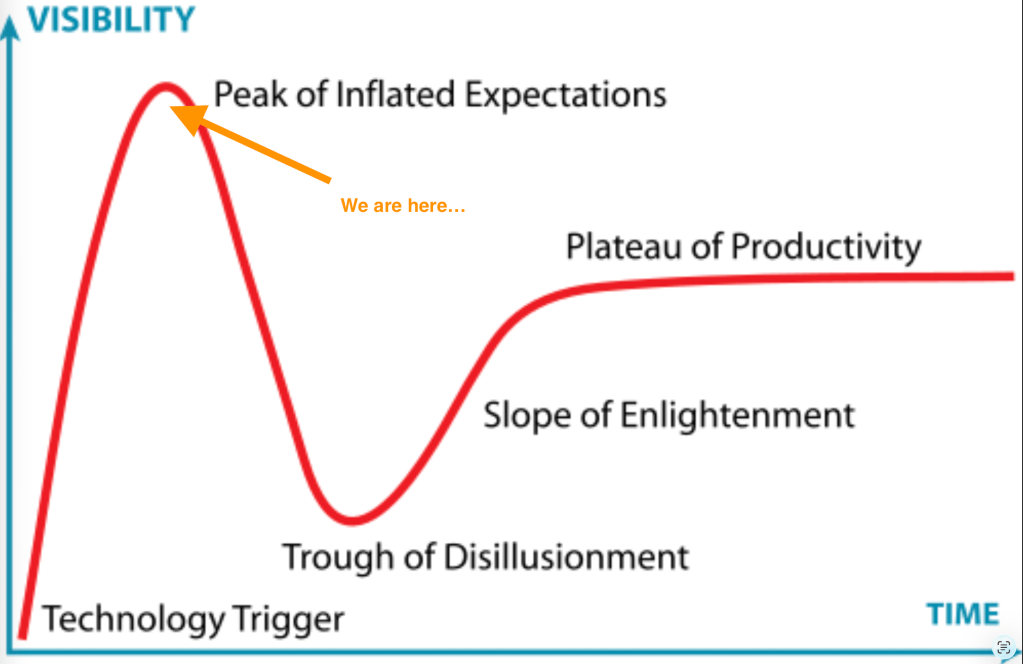
  2. I assert that companies that make these decisions to eliminate jobs and outsource everything will thoroughly regret them in the next few years when the limits of these tools are exposed, and we enter the “trough of disillusionment.”

    The Gartner Hype Cycle is proven and applies to these AI companies as much as they have to every other culture-changing technology we’ve experienced.

    After the hype dies down, most things will go back to normal, except that people will use AI for things that it’s actually good at. ↩︎
By Jeremykemp at English Wikipedia, CC BY-SA 3.0, https://commons.wikimedia.org/w/index.php?curid=10547051

AI isn’t taking your job

…at least not yet.


I use AI almost every day to assist with work and learn new topics (as part of my job) that I’m unfamiliar with. I read diligently to stay up-to-date on the latest developments, so I can learn how to use it more effectively.

AI will become (if it hasn’t already), and continue to be, a large portion of all of our lives.

However, we’re receiving a significant amount of misinformation about what’s happening and the effects it’s having on workers. Some of it is outright deception, while some is simply lazy reporting.

First, the deception.

The CEOs of these massive tech companies (e.g., Dario Amodei, Sam Altman) are brilliant business people who’ve created mind-boggling products. But they’re hemorrhaging cash trying to make their programs more powerful…

And after years of unbelievable growth and progress, they’re failing. The scaling law on which they used to project LLM growth is slowing down, and the improvements are now incremental, rather than exponential.

This is a serious financial problem for them. They need to keep their current investors engaged, and they need new investors to infuse them with additional capital. So what do they do?

They go on cable news shows or podcasts and claim that their AI software will replace all entry-level workers (10-20% of the workforce) within a matter of months.1 It just isn’t true.

But you wouldn’t know that from the news you’re consuming. They’ve bought into this story hook, line, and sinker.

Which brings me to my accusation of lazy reporting. Headlines like “Goodbye, $165,000 Tech Jobs” and “AI is Replacing 10 million Workers” (I made that one up) are attention-grabbing… But untrue.

These media companies, like the AI companies they write about, need to make money. They do that by getting as many eyes on their work as possible. And the best way to do that is to scare people into giving them attention… Even if the claims are untrue or misleading.

To paraphrase Ryan Holiday, who warned us about this years ago: “Trust them… They’re lying.”

It is true that computer science graduates are having a much harder time finding jobs at the moment. And it’s true that there have been massive layoffs in the tech sector.

It’s also true that the companies doing these layoffs are investing more of their money and efforts in AI. But AI is not the cause of this, nor is it replacing those who’ve been laid off.

Here’s what’s actually happening:

During the pandemic, these tech companies went on a massive hiring spree—they simply overhired. Now they’re bloated, and the quickest way to reduce the bloat and (temporarily) increase shareholder value is to shed programmers left and right.

At the same time, the tech sector itself is contracting, which means there are fewer jobs for all the newly minted computer science graduates.

This has historical precedence. The same thing happened in 2008 during the financial crisis. And it happened before that during the dot-com bust at the turn of the century.

The number of people entering the computer science field fluctuates in response to the economy. There’s a tech boom, prompting more people to enter the field. Then the sector contracts, and all those people get laid off, which in turn reduces the number of people entering the field.

Until the next boom.

Contrary to what many journalists have written, these people aren’t being replaced by AI. They’re simply being let go because companies overhired during the pandemic or because the companies are refocusing on AI.

However, that refocus, coupled with layoffs and fewer job openings, has led them to conflate the two, concluding that these computer science graduates are being replaced by AI.

This simply isn’t true. That may happen in the 2030s, but it’s not happening right now.

I’ve been guilty of buying into this hysteria too, as you can see in my piece on job hunting in 2025. And I’m here to tell you I was wrong in what I wrote about AI replacing workers in that piece.

All that to say this: Read AI journalism with a healthy dose of skepticism right now. And take any apocalyptic predictions with a grain of salt.


  1. Dario Amodei actually said this in an interview with Anderson Cooper and, ironically, claimed to be worried about it… Which begs the question: if you’re worried about it, why do you continue to do it?

    Why doesn’t he just stop if it actually worries him? It’s his company. ↩︎

Some ideas on hiring (Part 3 of “Same job, different pay”)

(This is part 3 in a rant on hiring, salaries, and job postings. You can read part 1 here and part 2 here.)

If someone with less experience than I, who didn’t attend college like I did, started today at the company I currently work for, in the same role I hold now—do I think she should be paid the same salary as me?

Absolutely, I do.

The work is the work, and if she is doing the same work as me, to spec, she should earn the same amount I do. My years of experience and educational background do not entitle me to a higher salary if we’re doing the same work.

Can she do the work as is expected of her? That’s all that matters.

And for someone looking for a job like mine, if they can learn how to do it well, then why does it matter how they learned?

So if I’m against education as a prerequisite for entry, how should we go about hiring people?

I have two ideas, and the first is simple: more companies should adopt open hiring practices.

There’s a factory in New York that makes the brownies for Ben & Jerry’s Ice Cream. If you want to work at the factory, you put your name on a list.

When a job opens at the factory and you’re next on the list, you get a call asking if you’re still interested in the job. If you are, you report to training, and if you can pass the training, you’re hired.

They don’t care about education, criminal backgrounds, living situation, previous employment, or current skills. If you can learn how to do the job, you get the job at the wage they pay everyone else.

Keep a list of applicants, hire them in order when jobs open up, and train them to do the work.

Why doesn’t every restaurant, coffee shop, and retail establishment in the world already do this?

Simple: They’re scared of making a bad hire. They worry that they’ll hire someone who doesn’t show up to work, arrives late, has a bad attitude, or struggles to perform.

Well… what happens when those same people are hired through traditional (i.e., shitty) job search qualifications?

They get fired.

And if you implement open hiring practices, you spend a lot less money on the recruitment process than you otherwise would, so you lose out on a lot less if you must fire someone.

The absurdity of hiring people through traditional methods of posting job openings, soliciting hundreds of résumés, and holding interviews gives companies a sense of control over who they hire.

But it’s an illusion: either the person will work out or they won’t. And interviewing people with the “right” background on paper isn’t a guarantee that they’re a good hire.


Now, I already know that this idea is so radical for people in knowledge work that it won’t happen anytime soon, even though I firmly believe many companies can hire and train people to perform a significant percentage of the available office jobs out there.

So, what if you’re absolutely certain that you can’t use open hiring due to the nature of the work your company does? Let’s say, because you don’t have the time or resources to train a person to the level you need quickly enough to make it worthwhile.

That’s where my second solution comes into play: contingency hiring.

Time for a story: I was laid off a few months after the COVID-19 pandemic began (from a job I had held for only a few months).

My job search lasted nearly a year (no one was hiring). It was excruciating and terrifying.

But one of the best things that ever happened to me in terms of my career happened near the end: a CEO took a chance on me in an unconventional way.

I’d been studying (and, to some small extent, practicing) marketing for a couple of years before the layoff. I’d spent a lot of time during my unemployment talking to people in the field to get a sense of the jobs available. I wanted to know what skills and knowledge they required so I could make myself more appealing to employers.

A former classmate from university recommended me for her role at a marketing agency when she left to take another job. I went into the interview feeling woefully underqualified, but I knew I had a decent foundation of self-study to build on and could learn the rest of what I needed to know on the job.

The CEO agreed, but was still somewhat reluctant to fully commit to this neophyte in the marketing world (and who wouldn’t be?). So he offered me a deal:

He said that he would let me work for the agency for four weeks in exchange for a single lump-sum payment to see if I could do—or learn how to do—the work required for the role.

After that, we would reconvene, and depending on the results, either he would hire me full-time, or we would part ways with no hard feelings and gratitude for giving the company my time and skill.

It was one of the most generous and thoughtful offers I’d ever gotten.1

If I were starting my own business today, this is exactly how I would hire someone. I’d post a job opening, and then I would select an applicant to work with me on a contingency basis.

Rather than conducting an interview (which only tells me if she’s good at interviewing), I would work on a project with her that I already needed to complete for the business, and I would pay her for her time.

If, at the end of the project, we found it was a good fit (and she still wanted to work for me, because she would also get to try out the business), I would extend a full-time offer to her.

Why doesn’t every company do this all the time? They get work done, can assess whether the person is a good fit for the role (which isn’t always apparent from an interview), and the applicant not only gets paid but also gets to test whether it’s a role they actually want.


I can’t fix the hiring process simply by writing and ranting about it. But I do know that it’s 100% broken right now.

Social media (LinkedIn) has made it worse, not better.

AI and ridiculous job requirements for college degrees and 30 years of experience have reduced the job search to months or years of misery, frustration, and indignity.

But these simple tweaks—from removing degree requirements to contingency hiring—could go a long way to fixing a broken system.


  1. I didn’t end up accepting his offer. I asked him to give me a day or two to think about it and discuss it with my wife, which he happily agreed to.

    Literally, that same day, after I got home from the interview, I got a call from another company I’d had a few interviews with. They had a firm offer for me for full-time remote work with benefits.

    I called him that evening to let him know I was taking the other job offer, which he completely understood. But he also let me know that the offer was still on the table if it didn’t work out. ↩︎

On the frivolousness of educational requirements in job postings (Part 2 of “Same job, different pay”)

I anticipated some of the pushback I’d receive from yesterday’s post, and I wanted to address it here.

Some might argue that certain jobs require graduate or other advanced education to obtain them. And I agree some should: I’d much rather have a surgeon who went to medical school operate on me than one who learned from YouTube.

And we’re all better off with engineers who went to school for the subject than relying on amateurs to build our bridges.

But doctors, engineers, nurses, and other “professional” roles all require specialized education simply to learn and carry out the basics of their jobs.1

This isn’t the reality for many knowledge or service sector jobs, which comprise a significant portion of our modern workforce. However, you might point out that many of these jobs require a college or even graduate education, as indicated in their job postings. Isn’t that at odds with what I’m saying?

No—because these jobs don’t actually need you to have a degree. It’s a tool to keep you from applying for them.

Hiring managers simply use that to make their lives easier and weed out 90% of otherwise qualified applicants without ever having to look at their applications. It reduces their workload.

For the vast majority of us working in the knowledge sector, a college education neither prepares us for specific jobs, such as those professional jobs listed previously, nor does it actually equip us with most of the skills required for knowledge work. We learn on the job and through self-education.

You don’t need a master’s degree in computer science from MIT to work as a software developer. You simply need to know how to program (and be damn good at it). You can learn on Codecademy or attend a bootcamp, gaining enough knowledge to get a job. You’ll have to learn the specifics of the role when you start working, anyway.

I work in learning and development, so I’m somewhat biased in my thinking on this. The shift in L&D now is toward skills-based training and qualifications. Essentially, we’re trying to answer this question:

Leaving aside formal education, what specific skills does a person either need to possess—or need to learn—to be qualified for this specific job?

You don’t consider their past college education (or lack thereof); you only consider what they’re capable of. This approach doesn’t harm people who attend school for specific fields because, as long as they’re qualified by their skills, they can still get the job. However, it also doesn’t prevent those who didn’t attend a formal school, but who do possess the necessary skills, from securing work for which they’re qualified.

Again, why do we need someone who is applying for a job in marketing or customer success to have a college degree? If they have the skill, or can learn it outside of a university, shouldn’t that be enough?

For most knowledge work jobs, it’s simply ridiculous to require a college degree (and I have two of them, neither of which I’ve ever used in my knowledge work jobs).

So I suppose I’m arguing two things:

  1. Eliminate degree requirements for most jobs.
  2. Pay the same wages (and good ones) for the same work, regardless of educational background or years of experience.2

Only the quality and the results of the work should matter. Not how much education someone has.

And for God’s sake, not based on how good someone is at negotiating. Not everyone is comfortable negotiating salaries or demanding raises, especially when they think their boss will just fire them and hire someone cheaper if they try.

We are obsessed with meritocracy in this country, often to our detriment. And we obsess over it in such a way that it harms people who may be just as capable at a job as someone else, but who don’t have the courage or the skills to negotiate with someone in a position of power above them.


Does this mean that I think another L&D specialist at my company who hypothetically started today should make the same amount of money I make after nearly four years of raises?

Absolutely, I believe that. But I’ll save that rant for Part 3 tomorrow.


  1. I have a holdup about including lawyers in this list for one very specific reason: Until sometime in the 20th century, you did not have to go to law school to practice law. You simply needed to pass the bar exam for the state(s) in which you intended to practice.

    Walter Gordon, a native of my home state of Mississippi (who was one of the main characters in Band of Brothers), passed the bar exam after the war while still in law school and was allowed to practice even without his diploma.

    At some point, law schools realized they could make a lot more money if they collaborated with the American Bar Association to require would-be lawyers to attend their schools, thereby creating a somewhat arbitrary barrier to entry into the field.

    Are lawyers who attend law school objectively better off? I don’t know, nor do I feel qualified to say. However, it does seem similar to what we encounter in knowledge work job searches.

    Are all hiring managers part of some cabal to make it difficult to get jobs? No. It’s simply easier for them and also just “how things are done around here.” The status quo is the status quo for a reason. ↩︎
  2. What if someone in the same role as someone else is objectively better at the job than the other person? Personally, I believe this issue can be easily resolved with bonuses or commissions.

    I don’t mean paying people crappy wages and hoping that they’ll make it up in bonuses (looking at you, restaurants paying servers $2.13 an hour). I mean that if two people are doing the same job, but one of them has been outstanding for just one quarter or year or whatever, pay that person some sort of bonus to show your appreciation.

    But don’t punish the other person who is doing good work—to spec, doing what needs to be done and is asked of her—by paying her less for arbitrary reasons. ↩︎

Same job, different pay

I saw a job posting’s salary description the other day that gave me pause.

The salary was dependent on three things:

  1. The number of courses taught (yeah, that makes sense. More work = more pay)
  2. The type of courses taught (More advanced courses = more difficulty = more pay. Also makes sense)
  3. The educational level held by the instructor…

That third item is the one that gave me pause. Here’s why:

If two people are doing the exact same type of work at the exact same level of quality, why should one with a higher-level degree be paid more than the person with a lower-level degree?

You might say, “Well, they went to school longer. They have more education. They’re more qualified.”

So what? Does that degree automatically mean that the person is more skilled at the job? No, not at all. 1

More education does not automatically confer a higher level of qualification or suitability for a job. The skill of the person, and nothing else, does that.

If the person with the higher degree actually delivers more or better work than the other, then I understand receiving more pay. They are arguably more valuable. But that has nothing to do with the degree and everything to do with the output of the worker.

Additional education might enable that higher quality, but then again, it might not. There are countless MBA graduates out there who are suitable for little more than responding to email or working in middle management. They would flounder trying to run a small business.

Perhaps changing the nature of the work in question would make this make more sense:

Let’s say Person A has a master’s degree in burger-flipping, and Person B has a bachelor’s degree in burger-flipping. But both workers flip the same number of burgers each hour at the same level of quality expected of anyone on the line.

Should Person A be paid more money simply because they got a master’s degree in the subject? I would argue no, because the quality of the output and the nature of the work are the same.

You might think I’m stretching this a bit, but I’m not. It’s the work that matters, the output, the results.

A person’s demonstrable skill determines their qualifications, not a piece of paper. That paper is often a false proxy for genuine qualification, a stand-in for real value.

But we buy into it because we’ve been trained to believe that more is better, higher is better. We must stop this.

We have to start measuring the proper targets and rewarding the right things appropriately.


  1. I’m aware that teachers are paid at different salary levels based on their educational levels (e.g., a master’s degree earns more income than a bachelor’s degree. However, just because that’s the case doesn’t make it right.

    Teachers should not be paid based on how much schooling they received, but on how good they are at schooling others. If someone with a master’s degree is educating students in a way that they outscore everyone else, then I can understand paying that teacher more (and she should share her secrets with everyone else so they can level up their students and make more money too!).

    Also, teachers should simply be paid substantially more than they currently earn, but that’s a topic for another day… ↩︎

How Do You Get a Job in 2025?

The answer is… You might not.

At least, not through any of the methods that career experts have been recommending for decades. The entire job search ecosystem seems fundamentally broken, leaving millions of qualified people trapped in toxic jobs or endlessly unemployed despite following all the “right” advice.

The Old Methods That Used to Work

For years, Stephen Covey advocated researching companies and reaching out directly to offer to solve their problems, whether they had job openings or not. Richard Bolles, author of What Color Is Your Parachute?, recommended informational interviews and networking conversations. Dan Miller, who wrote 48 Days to the Work You Love, championed the “direct marketing” approach of sending out bundles of résumés to companies, then following up with a phone call to ask to speak with decision-makers.

All of this advice made sense in 2006. It worked because the business and hiring infrastructures supported it.

Companies listed real phone numbers that connected you to actual humans. Public mailing addresses ensured your résumé landed on desks where people opened letters. Receptionists knew who handled what, and would transfer your call to the right person. Business publications provided genuine insights into company challenges and growth plans.

Most importantly, the volume was manageable. A hiring manager might receive a few thoughtful letters each week, not 200 LinkedIn messages per day.

What Broke the System

I believe two things destroyed this approach: digital saturation and corporate gatekeeping.

Digital Saturation

LinkedIn turned networking into spam. Everyone started sending copy-pasted connection requests and robotic “value-add” comments on posts. What began as genuine relationship-building became a numbers game where people blast hundreds of identical messages, hoping for a 2% response rate. The volume of unsolicited pitches for jobs exploded, right alongside the never-ending stream of sales pitches from SDRs and companies trying to find an “in” with decision makers.

Corporate Gatekeeping 

Companies systematically eliminated direct access points. Phone numbers now route to labyrinthine phone trees intentionally designed to prevent human contact and eliminate the need to have real people on the other end of the phone. 

Websites list only generic 1-800 customer service numbers or P.O. boxes that feed into administrative voids. The friendly receptionist who knew everyone in the company has been replaced by automated systems programmed to deflect.

Modern Methods That Don’t Work

Online Job Applications 

The black hole of HR systems that filter out qualified candidates based on keyword algorithms. Apply to 100 jobs, hear back from zero. It’s not that you’re personally inadequate; you simply don’t line up perfectly with the job description. (And by the way, that job description doesn’t actually describe what they need, only what the person who had the job before you did or the certifications she had.)

LinkedIn Networking

The platform is saturated with desperate job seekers sending identical messages to overwhelmed professionals who’ve decided to ignore most outreach. Even thoughtful, personalized messages disappear into the noise. Part of this is the generic nature of the requests, but part of it, too, is that we’re all just exhausted from digital communication. Email, Slack, Teams, text messages, DMs on Instagram… Our brains eventually tune most of it out.

Informational Interviews

Nobody has time anymore. Everyone is drowning in their own work, managing their own career anxiety, and can’t spare 30 minutes for a stranger, no matter how politely you ask.

Social Media Engagement

The advice to “engage authentically” with LinkedIn content falls apart when half of the posts are AI-generated engagement bait and the other half are bloviating nothings designed solely to catch eyeballs, garner Likes, and generate comments. Forcing yourself to fake enthusiasm for vapid content isn’t networking—it’s performance theater.1

Trade Organizations and Professional Associations

Career experts love recommending these for “networking opportunities.” The reality? Membership fees run hundreds or thousands of dollars annually, and virtual “networking” really doesn’t work. If you actually want to benefit from these, you’ll need to go to their live, in-person events. So you need to factor in conference costs, travel expenses, and time away from work. 

And God forbid you’re out of work and worried about money! For someone already struggling financially, these are luxury expenses you can’t afford. And even if you can afford them, the promised networking often amounts to standing around awkwardly at cocktail receptions where everyone else already knows each other.

The AI Revolution Eliminates Entry Points

Meanwhile, artificial intelligence is systematically destroying the entry-level positions that once served as career launching pads. Companies have discovered they can “hire” AI at a fraction of the cost to handle the exact work that new college graduates used to do: data entry, basic research, simple writing tasks, customer service, and administrative functions.

The numbers are staggering. Recent research indicates that Big Tech companies reduced their hiring of new graduates by 25% in 2024 compared to 2023. Venture capital firm SignalFire found a 50% decline in new role starts by people with less than one year of post-graduate work experience between 2019 and 2024. Nearly 80% of hiring managers predict AI could eliminate internships and entry-level positions entirely.

Just as personal connections have become more crucial for career success, AI has eliminated the stepping-stone jobs that once helped people build those connections in the first place. One CEO told the Wall Street Journal that he decided not to hire a summer intern, opting instead to run social media copy through ChatGPT. Why hire an undergraduate when AI is practically free, does a “good-enough” job, and works around the clock?

Even more perversely, the supposed “safe” STEM fields are getting hit hardest. Computer engineering majors now face a 7.5% unemployment rate, while art history majors—long mocked for their “impractical” degrees—enjoy just 3% unemployment. The technical skills that students spent years learning in college are being automated away faster than they can be applied.

What We Lost Along the Way

There’s another piece to this puzzle: the collapse of genuine community networking. Previous generations built “networks,” as we now know them, through local business associations, service clubs, and community organizations. Remember the Rotary Club, Lions Club, Kiwanis, Chamber of Commerce, Jaycees, Elks Lodge, or the American Legion? These groups created natural opportunities for professionals to meet and build real relationships over time.

These weren’t networking events designed for career advancement. They were community service organizations where business relationships developed organically through shared projects and regular interaction. The local banker sat next to the insurance agent and the small business owner at weekly breakfast meetings, working together on charity drives and community initiatives.

But younger generations have largely abandoned these organizations. Membership has plummeted as people have shifted social interaction online. The infrastructure that once supported genuine professional relationship-building has withered.

The Cruel Catch-22

The only thing that actually seems to work is personal connections. Having someone who already works at a company vouch for you. Getting referred by a friend of a friend who knows you’re competent.

But what if your network consists entirely of retail workers and you don’t want to work retail? What if you’re trying to transition from one field to another, where you have no existing professional connections? You feel trapped.

The system favors people who are already part of professional networks, while excluding everyone else. It’s a closed loop that’s making career mobility nearly impossible for anyone starting from the outside.

The Psychological Toll

Meanwhile, career coaches and job search experts continue to sell the same outdated advice, blaming individuals for “not networking effectively” or “not standing out enough.” And job-seekers remain trapped in an endless cycle of resume optimization and LinkedIn engagement strategies that, statistically, don’t work.

The damage is both professional and psychological. When you follow expert advice faithfully for years and still don’t get results, you start to believe you are the problem. Your confidence erodes. You question your qualifications, your worth, and your ability to contribute anything meaningful.

But it’s not you. The gatekeeping mechanisms are broken.

What Now?

I don’t have a solution. That’s the point of this article. The people selling job search courses and career coaching services want you to believe there’s a secret method you haven’t discovered yet. To the best of my knowledge, there isn’t.

The system just seems broken. It works perfectly for companies, the ones that are actually in control of the situation. It fails catastrophically for individuals trying to build careers or escape bad situations.

Maybe the answer lies in rebuilding what we lost: returning to genuine community involvement through local organizations where real professional relationships can develop naturally over time. But that’s a longer road, and probably doesn’t help you right now if you’re desperately looking for your next gig.

Recognizing this doesn’t make finding a job easier. But at least you can stop blaming yourself for the failure of methods that were never going to work in the first place.

The question isn’t “What am I doing wrong?” It’s “How do we survive in a system that’s broken?”

Unfortunately, I don’t have an answer to that one either.


Notes

  1. Yes, you can argue that this is exactly what I’m doing with this article… But I can promise you that isn’t the case. I’m simply venting because of how absolutely dreadful modern job-searching is for people I care about. ↩︎

It’s not the job

It’s the ambiguity. It’s not knowing what you’re doing or what’s expected of you. Uncertainty about the next right thing.

It’s the feeling of incompetence, not being sure that it’ll work or if you’re even capable of it.

Most jobs can be quite fulfilling, but not knowing what needs to be done, or how, robs us of that satisfaction.

And in the Information Age, with ever greater numbers of bullshit jobs and technology advancing faster than ever, that uncertainty becomes more prevalent each day.