
How to get a job in cybersecurity

I went to pick up a friend for lunch a while back, and while I was waiting, I struck up a conversation with one of his coworkers. The young man asked me about my job, and when I told him I worked for a cybersecurity company, he got excited!

“That’s what I’m studying in school,” he said. “Would you mind telling me how you broke into the cyber job market? It would really help me out.”

Here’s what I told him, tongue-in-cheek the entire time:

Step 1: Decide you want to be a physical therapist and spend the first couple of years of college studying biology, human anatomy, chemistry, and exercise science while working in the university’s gym.

Step 2: Realize how much you hate chemistry and biology, then switch your major to jazz studies because you’ve been a musician all your life and want to make a go of it as a drummer.

Step 3: Spend the next 3 years questioning every decision you ever made about becoming a musician and changing your major between history and music every semester until your wife-to-be says, “Why don’t you just double major?!”

Step 4: Graduate with a double major in history and music, then take a job working as an ophthalmic technician for two eye doctors because it’s the first job someone offered you that didn’t pay minimum wage.

Step 5: Become a banker after your wife graduates college because you have to move, and your boss’s daughter just happens to be hiring, and you’ve got a recommendation.

Step 6: Demote yourself to teller (seriously, I willingly took a demotion) because you hate putting people in debt and cold-calling people over dinner to sell them credit cards.

Step 7: Get recruited by Apple on the recommendation of a friend, and learn how awesome you are at teaching. Then spend the next two and a half years honing that craft.

Step 8: Go to work for a child support agency to develop your writing and marketing skills… Because yeah, that tracks.

Step 9: Watch the world go to hell during a global pandemic, lose your job, flounder in unemployment for 8 months, and nearly die from COVID at 30 years old.

Step 10: Find a way to combine your teaching and marketing skills by becoming a content developer for an online business education company

Step 11: Get laid off from that company for no reason at all, only to have a conversation with a former coworker from said company who gets you an interview with your future boss at the cybersecurity company.

There you have it: in just 11 easy steps, you, too, can get a great job in cybersecurity!

He got the joke, and he knew I was trying to be helpful even though I really had no idea how it happened.

But I ended my advice with an offer: if he wanted a job at my company, or any other company where I knew someone, I would give him a recommendation and make an introduction.

Because that’s how I got every single job I’ve ever had. I knew someone (or someone knew me and my work); that led to a conversation where we genuinely connected. That connection often led to a job offer.

I’ve (most likely) applied to more than 1,000 jobs since I started working at age 16. And the only way I ever got an interview was because someone treated me like a human being, had a conversation with me, and made a connection I needed to get my foot in the door.


Speaking of helping other people get their foot in the door, two of the best people I’ve ever worked with (Joe Charman and Rebeca Leininger) are looking for their next roles.

If you need hardworking, technically savvy, AI-fluent, customer-focused, cybersecurity and threat intelligence experts, you’d be extraordinarily LUCKY to have them on your team.

Reach out and connect with them on LinkedIn.
If you don’t know, it helps to ask

I was roasting alive at a book festival last week. 100º temps, no cloud cover, no breeze. 

I needed to know why! WHY, when Mississippi has such mild autumns and winters, did the organizers insist on hosting the festival in the hottest part of the year? Every year for 9 summers.

In sheer agony and frustration, I said aloud, “Why do they do this?”

And I got an answer from someone much more knowledgeable and pain-tolerant than me:

This is the only time when the Mississippi Congress is on vacation during the year. The State Capitol is empty and available for use.

I asked and got a reasonable answer. Of course there was a good reason for the decision they made.

Most things aren’t done as mindlessly as we might assume. When you feel that way, it helps to ask some questions.

For more daily musings like this, subscribe below:

Stories sell

No one cares about the features of anything. What they want to know is how it helps them.

“What do these features do for me?”

A friend of mine was asking about the internet provider we use in our home. Naturally, I wanted to sell him on the service that we use because I think it’s the best.

So I told him, “You get up to one gig upload and download speeds.’

Then I thought about it for a second and realized this: most people don’t know what that means. More importantly, they don’t care. 

So I changed up my approach and told a story instead.

I told him that some of the projects I do each week for work have to be uploaded to Vimeo. “With our old Internet provider, I explained, “it would take me between 15 and 20 minutes to upload a single video. Now, with this new provider, it only takes me about 20 to 30 seconds to do the same thing.”

He was sold, right then and there.

Stories are how we humans make sense of the world. Stories are also what sells—anything and everything.

No matter what you’re trying to persuade someone to do, find a way to tell them a story about it.

We Are All Liars

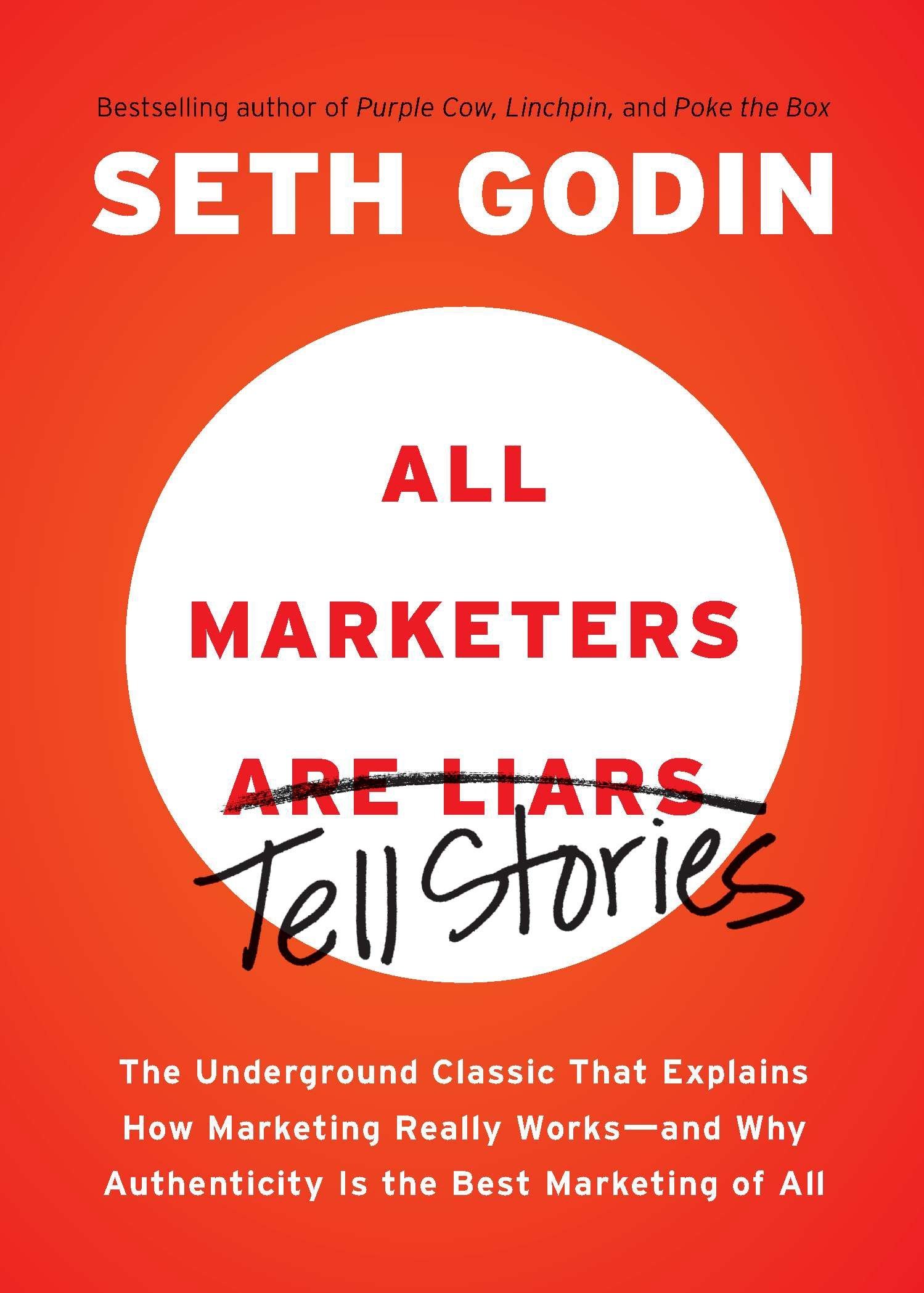
I was flipping through books in a bookstore the other day on an Artist Date. While there, I came across one by my favorite marketing teacher Seth Godin.

Seth boldly claims that all marketers are liars because their jobs are to tell stories. As I thought about it, I realized we’re all liars.

Stories are how humans make sense of the world. It’s been that way since we were sitting around campfires, boasting about the Mastodon we brought down on the plains.

Our stories are never accurate. Our memories are fleeting, piecemeal images we try to put together into coherent statements. It’s why you can ask multiple eyewitnesses what happened at the scene of an accident and get four versions of the same crash

This does not mean there are no true stories, no facts. It just means the stories we tell ourselves and others are never the whole truth.

Fish Stories

How many times have you heard the same fish story from a relative? Did the fish get bigger with every telling?

I remember as a child sitting in the living room with my older brothers, sides splitting from tales of their recent exploits and the ridiculous shenanigans they got up to.

And I remember feeling a sense of jealousy afterwards. “Why couldn’t I tell stories like that?” Stories that were as humorous, grandiose, and absolutely ridiculous.

One reason was I had not mastered telling stories (read: changing details ever so slightly to make the stories better). Another reason was I had not lived long enough to collect interesting stories.

Of course, as I got older and my contact with other strange characters in this world increased, I collected my own fair share of comedies. And now, each time I retell one, I find myself questioning the details.

Did that really happen? Did I add that tiny detail to make the story more cohesive? More enjoyable? Am I remembering it the way it really happened?

The answer, of course, is no. We never do.

We humans like stories, but the stories we tell ourselves change. They’re imprints of what actually happened, not what actually happened.

I guess that makes us all liars.

But it also makes story time much funnier.

Get more daily insights into the human condition. Subscribe below!