
We Are All Liars

I was flipping through books in a bookstore the other day on an Artist Date. While there, I came across one by my favorite marketing teacher Seth Godin.
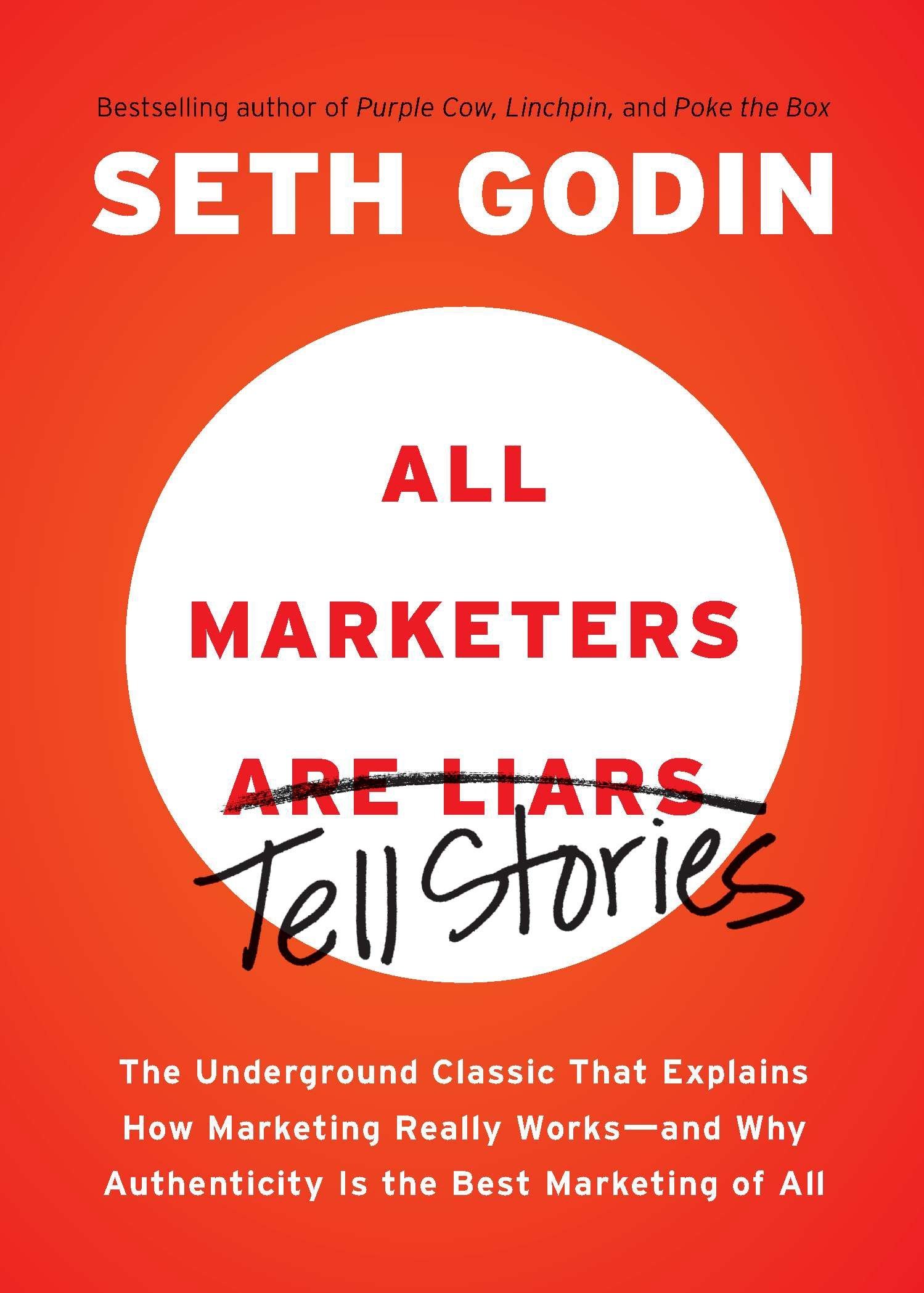
Seth boldly claims that all marketers are liars because their jobs are to tell stories. As I thought about it, I realized we’re all liars.

Stories are how humans make sense of the world. It’s been that way since we were sitting around campfires, boasting about the Mastodon we brought down on the plains.

Our stories are never accurate. Our memories are fleeting, piecemeal images we try to put together into coherent statements. It’s why you can ask multiple eyewitnesses what happened at the scene of an accident and get four versions of the same crash

This does not mean there are no true stories, no facts. It just means the stories we tell ourselves and others are never the whole truth.

Fish Stories

How many times have you heard the same fish story from a relative? Did the fish get bigger with every telling?

I remember as a child sitting in the living room with my older brothers, sides splitting from tales of their recent exploits and the ridiculous shenanigans they got up to.

And I remember feeling a sense of jealousy afterwards. “Why couldn’t I tell stories like that?” Stories that were as humorous, grandiose, and absolutely ridiculous.

One reason was I had not mastered telling stories (read: changing details ever so slightly to make the stories better). Another reason was I had not lived long enough to collect interesting stories.

Of course, as I got older and my contact with other strange characters in this world increased, I collected my own fair share of comedies. And now, each time I retell one, I find myself questioning the details.

Did that really happen? Did I add that tiny detail to make the story more cohesive? More enjoyable? Am I remembering it the way it really happened?

The answer, of course, is no. We never do.

We humans like stories, but the stories we tell ourselves change. They’re imprints of what actually happened, not what actually happened.

I guess that makes us all liars.

But it also makes story time much funnier.

Get more daily insights into the human condition. Subscribe below!

Should You Get Paid Every Time You Send an Email?

Wouldn’t it be great if you got paid every time you sent an email? I dunno about you, but I’d love to live in that world. 

I send hundreds each week. If I earned the price of a postage stamp on each one, I could make a pretty easy living.

Am I Devaluing Myself?

I’m an up-and-coming copywriter. To make a living, I spend several hours each week reaching out to potential clients, offering them my services as a writer and marketer. I do this because I’m a salesperson. And if you’re trying to make a living in a similar way, so are you. 

I recently came across a Twitter post telling me that I was devaluing my work by selling myself. To sum it up, the writer said I should either:

  1. Have clients beating a path to my door willing to pay me, OR 
  2. I should get paid every time I send an email, proposal, or pitch to a potential client before any work is done. 

I understand the author’s point. My time is valuable, and it stinks when I feel I’ve “wasted” my time pitching to someone who doesn’t buy. But I 100% disagree.

Sales Professionals Don’t Get Paid to Prospect

How do professional salespeople get paid? They sell a product and get paid a commission. They don’t get paid when they prospect or send proposals to customers. The only way they make money is by closing a sale. 

I sell a service, and I only get paid if I provide that service. And that service is not pitching ideas. If it was, I’d be a billionaire right now because I have a few thousand ideas each day, and most of them are awful.

Selling Your Service Is Like Applying for a Job

Each time I pitch a client, I’m putting in a job application. Think about all the jobs you’ve applied for in your adult life. What if you got paid for every job application you ever completed? Wouldn’t that make for an awesome career?

Often we don’t have a lot of experience for the jobs we are applying for, especially if we are new to the workforce or a field. When asked what a beginner should do, the Tweeter said, “get paid to pitch.”

We’ve all gotten those phone calls from sleazy salespeople. Does this sound familiar?

“I’ve got this great new system that will keep you from paying any taxes this year. But I can only tell you what it is if you sign a non-disclosure agreement and pay me $2,000 upfront.”

You know you’re losing money and going to jail if you get in bed with that guy. You don’t want to have anything to do with an idea you can only hear after signing an NDA and paying upfront.

How to ACTUALLY Get Paid to Pitch 

There are two parts to this tactic:

  1. Charge higher prices to compensate for the inevitable rejections you’ll get.
  2. Overdeliver to your clients and customers so it’s worth paying you higher prices!

One of my favorite phrases comes from the marketing genius Seth Godin:

“You’ll pay a lot, but you’ll get more than you paid for.”

That is the only way this guy’s Tweet works. 

Selling Is Tough

I get it. Creating proposals, pitching to customers, and facing possible rejection—it really stinks. It takes a lot of time and hard work. It’s frustrating. 

But let me be clear: THAT DOESN’T MEAN ANYONE OWES YOU ANYTHING!

The world doesn’t work that way. We are all in sales, and much of that involves reaching out to others. It means facing the very real possibility of rejection coupled with no monetary gain. 

So go ahead and pitch. And if you want to get paid for that, build the cost into your pricing structure. 

But make sure you overdeliver on that promise to your customer. 

Feeling inspired? Like, comment, and share so others can benefit! And subscribe below!

Art and plumbing are more similar than you think

Zig Ziglar relates a story in one of his talks about a man traveling through Native American tribes early in the 20th Century. What the man discovered was not a single person he encountered in those tribes stuttered. 

This phenomenon fascinated him, but he could never find a reason why. Finally, he asked one of the elders in the tribe why this was so. The elder informed the man there was no word in their native language for “stutter.” 

No label, no problem. 

In a fantastic article in The New Yorker, the author writes about the phenomenon known as “writer’s block.” What’s most interesting is this problem is not world-wide. The idea did not penetrate Europe until the 1800s, and even today, most Europeans don’t know what it is. It seems to be almost strictly an American issue. 

No label, no problem. If you don’t have a way to identify something as a problem, it can’t be a problem. 

We are all creative at something. We don’t get blocked: we get scared that what we create isn’t good enough. We feel there is some ethereal muse that must speak to us before we can make anything worthwhile. 

That’s crap.

Seth Godin has, what I believe to be, the most profound podcast episode I’ve ever listened to called “No such thing (as writer’s block).” One of my favorite sayings in the episode is this: “plumbers don’t get plumber’s block.” No plumber says he’s feeling too overwhelmed or uncreative enough to fix a pipe. They just fix the pipe. Surgeons don’t wait until they hear the muse speak to them to operate – they practice their craft every day and perform when it’s time to perform. 

Your art, whether it’s writing, music, painting, communicating, or leading people, is a craft – it’s a trade! Like blacksmithing, welding, or some other trade, it’s something that you learn, practice each day, and use to make something. 

If you’re a writer – write! Every day. Write something. Set a timer for 30 minutes and write. If you can’t think of what to write, write “I can’t think of anything to write,” over and over again until a new thought pops into your head. When that thought pops into your head, write it down too. Don’t worry about it making sense, being fantastic, or winning a literary prize. Just write. 

Insert your own art into the statement above and adapt it to your own situation. 

You aren’t blocked – you’re scared. Don’t wait for the muse. Do your work. 

It’s a trade like any other. 

Join 904 other subscribers

How to get into the Hall of Fame

What does it take for a Major League Baseball player to earn a spot in the MLB Hall of Fame?

It takes failure.

Not a little bit of failure – it requires failing almost two-thirds of the time.

The best baseball players who’ve ever played the sport only average a hit 3 out of 10 times they come up to bat. That means they fail at their job 7 out of 10 times. And yet we still regard them as the best.

Why then, in our own lives, do we strive so hard to avoid failure at any cost? What if the avoidance of failure is preventing us from succeeding at a level that would cause us to stand out from the pack?

We don’t learn how to succeed through books, lectures, or seminars – we learn through failure, the greatest teacher of all. The books and seminars can help us avoid mistakes committed by others who’ve walked the path before us, but we have to fail on our own, in our own way, to find what works and what doesn’t.

To paraphrase Seth Godin in his webinar a few days ago: success requires time and failure.

Failing not only teaches you lessons from which you can improve, it also makes you more resilient to future failures. Each time you fail, you build a reserve for the future, which grows your confidence and allows you to try bigger and better things the next time. It’s a cycle that only spirals up.

What could you do in your life where you would consider batting .300 to be Hall of Fame-worthy success?

Don’t fear failure – fear never taking the chance of doing something great.

Join 904 other subscribers

Why is freelancing so terrifying?

We human beings like security – it encompasses the first two levels of Maslow’s “Hierarchy of Needs.” It’s fundamental.

To get that feeling of security, we work hourly wage jobs; we try to get hired at famous companies for regular, unchanging salaries with hopes for a 3% raise every year (which doesn’t outpace inflation).

Freelancing – being “a knight without a king” as Seth Godin likes to say – seemingly goes against that feeling of security. There is no guarantee; you don’t get paid simply for showing up somewhere for a specified amount of time.

But it’s better.

The illusion

There is no security in hourly rates; there is no security in working for a famous company. As the COVID-19 pandemic has shown us, the moment something bad or unexpected happens, your security is at risk.

The security is an illusion. No longer can we work at the same company for 20 years, slowly moving up a corporate ladder, waiting for that day when we call it quits and HR hands us a gold watch and the envelope containing our pension information.

There is no security anymore. There is only you.

“Security lies in our ability to produce.”

–General Douglas MacArthur

Make your own security

What do you already know or do well?

Can you write? Create websites? Draw and paint? Build things with your hands? Sell?

Maybe you’re a whiz at smoothing customers’ ruffled feathers. Perhaps you have a knack for motivating and encouraging other people.

There is something you already do, or something you already know about, that other people are willing to pay for. You simply have to muster the courage to offer it to them.

Each of us must explicitly state to ourselves what we know how to do and do well. That knowledge and the willingness to execute on it are the only things that give us any sort of real security in the workplace.

If you can find someone and offer them something they are willing to pay for, and do that over and over again, you are a freelancer. You have no boss, no one telling you what to do next, but also no one telling you, “I’m sorry but we have to let you go.”

You have no guarantee of income – in either direction! You can make as little or as much as you want, as long as people are willing to pay for it. But I’ll bet you got stopped on the phrase “no guarantee” or “as little…as you want” while glossing over the rest of it.

As a freelancer, you determine your job, the work you do, your hours, the people you serve. Perhaps it’s not the loss of security you fear: it’s the fear of complete and total responsibility for your success or failure.

We aren’t used to that, but it’s the only way we’ll survive.

Secure your own future today. Don’t wait for someone else to do it for you.

Join 904 other subscribers

You must develop these two skills

Writing and sales: if you want to be successful in anything, you must be able to do both well.

If you have an idea, you must communicate it to others; if you want it implemented in some way, you must persuade them.

Writing and sales.

If you want a new job, you have to let others know why you’re the applicant for them by first getting their attention and then persuading them of your worth and potential.

Writing and sales.

“Writing is organized thinking on behalf of persuasion.”

Seth Godin

Writing helps you clarify your thoughts and communicate more clearly. You need it in every field in which you might work. Learn to write.

Parents, physicians, therapists, educators, and those in every other profession must win over those they serve–children, patients, students–to their way of thinking. Learn to sell.

Writing and sales: the most important skills of a modern worker.

Join 904 other subscribers

Praise the good. Ignore the rest.

If you want to create lasting influence with others, or change for the better, there is really only one way to do it:

Praise the good.

“So long as a person did anything good, he would praise him and use him for the service in which he excelled, but to his other conduct he paid no attention…”

–Cassius Dio writing about Roman Emperor Marcus Aurelius

When Emperor Marcus Aurelius wanted to influence other people, to reinforce the behaviors and actions he wanted to see, he would praise the person who did the good deed. This is actually quite Pavlovian in its execution.

Conditioning good behavior

Remember Pavlov from your introductory psychology class? Pavlov would ring a bell before he gave his dogs food; the food caused the dogs to salivate. Eventually the dogs associated the ringing bell with food and would salivate when the bell rang, even when Pavlov did not give them food.

Marcus essentially did the same thing with those in his service: whenever they did something of which he approved, he praised it. This constant reinforcement of the good conditioned his people to do more good work in the future. But there is a second part to Dio’s observation above…

Pay no attention to the rest

Not only did Marcus praise the good, he ignored the behavior and actions he didn’t want to continue. Why did he do this?

There is a wonderful little book who’s first chapter discusses this at length:

“Don’t criticize, condemn, or complain.”

–Dale Carnegie, How to Win Friends and Influence People

How often have you had a positive outcome after you criticized someone for doing something? I would hazard a guess at 10%.

When you criticize someone, they get angry, defensive, and emotionally illogical. He or she will justify the action rather than accept that it was wrong. It’s a natural human response. We don’t like to be wrong, and we definitely don’t like other people pointing out our poor behavior.

Therefore, the only way to get the results you want from other people is to praise them when you seeing them do the good deeds you want done. Criticizing the bad doesn’t work: it only causes resentment.

“We are not dealing with creatures of logic. We are dealing with creatures of emotion, creatures brisling with prejudices and motivated by pride and vanity.”

–Dale Carnegie, How to Win Friends and Influence People

(Of course, there are some behaviors that are dangerous, illegal, immoral, or that might harm others; these behaviors must be stopped immediately. Those sorts of behaviors are not the topic of discussion here.)

Be a model

How do let others know what good actions or behaviors are? You must be a model. Do the things you want others to do; be the kind of person you want others to be.

Seth Godin likes to say, “people like us do things like this.” Invite people to be “people like us,” whoever you think “people like us” should be. Then, do the things you want others to do, and when they follow, praise them for it!

Model good behavior. Praise others when they perform good work. Ignore the rest.

Join 904 other subscribers

How to get an education that pays during your quarantine

When was the last time you learned something new?

It was probably a few minutes ago when you read an article on your favorite social media site, and you weren’t even aware you were learning. Why not do it intentionally?

Learning and education don’t cease when school ends. If it does, you’ve made a choice, and you will quickly find yourself becoming obsolete.

No one cares about the degree you got 10 years ago. They want to know if you are competent in the areas needed to accomplish the kind of work you want to do.

Learning and going to school are not the same thing. You might have hated school, but you definitely love learning. School requires that you do things you hate, but you aren’t in school anymore. You can learn whatever you want to learn right now.

Always wanted to learn how to draw? Do you want to redo math, not because you have to but because you want to? Maybe you want to learn calligraphy or tennis. Perhaps you want to get a new job, but you don’t have the marketing skills needed by the company. Now is the time, and now you HAVE time.

Learning anything new is part of your ongoing education. Why not do it intentionally? What are you doing right now to invest in your own education?

I’ll give you some ideas.

How to learn for free (or at least cheaply)

  1. Read The 7 Habits of Highly Effective People. If you only do one thing on this list, do this one. The $10 you spend on this book will be the best investment you ever make. It will change your outlook on life, it will improve your relationships with other people, and it will revolutionize how you act.
  2. Take online courses.
    • LinkedIn Learning
    • Udemy
    • Coursera – want a recommendation? Seth Godin has the absolute best courses on Udemy. Start there.
    • Khan Academy (retake high school absolutely free and enjoy it this time)
    • CreativeLive – learn how to draw, take stunning photographs, start your own creative freelancing business, and so much more.
    • Massachussetts Institute of Technology OCW (seriously, take actual courses from MIT absolutely free)
    • edX – Speaking of great schools, this website lets you take real, full courses from Ivy League schools from the comfort of your living room for free. No strings attached. If you want a certificate to hang on your wall or post on LinkedIn, you can pay a small fee and get proof that you completed Ivy League courses.
    • HubSpot Academy – become an expert in marketing for absolutely nothing.
  3. Read books.
    • Libraries still exist. Even if they aren’t open right now, you can download e-books for free from every library in the country. Go read books on subjects about which you are curious. It doesn’t cost you a dime.
    • Download the Kindle app for free on your phone. Then buy The 7 Habits of Highly Effective People. Seriously. You can buy books on every subject imaginable for less than $10 each. Most of the time you can get them for $5 or even $0.99. There is no excuse for failing to read. Swap 30 minutes a day of mindlessly scrolling Instagram, and you will become an expert on a subject in a matter of weeks or months.
  4. Subscribe to magazines.
    • Read the Harvard Business Review. It is well worth $18 a month. Get an entire master’s degree in business for what you spend on lunch.
    • Success Magazine and Inc. are two of my favorites. The former will inspire you to live your best life; the latter will give you much-needed insights on how to succeed in any work or business.
  5. Listen to podcasts – again, FREE.
    • “Akimbo” by Seth Godin
    • “48 Days to the Work You Love” by Dan Miller
    • “EntreLeadership” from Ramsey Solutions
    • “On Leadership with Scott Miller” from Franklin Covey
  6. Watch TED Talks and documentaries on Netflix or Amazon Prime Video.

There is no reason for you not to come out of this crisis with new skills, new knowledge, and an unofficial masters degree in one subject or another.

Be proactive. Take control of your education today.

Join 904 other subscribers

Note: a few of the links above are affiliate links. I get a small commission if a purchase is made. This does not affect you in any way.

Why write?

Why would anyone start a blog in 2020 (or in my case, 2019)?

Nobody wants to read anymore; no one has the attention span to read anything more than headlines, bullet points, and headers.

If we want information, a lesson, or an explanation of an idea, we just go to YouTube. If we want entertainment, we go to Tik Tok for quick, random snippets or Twitter for messages. No more than 140 characters, thank you very much!

So why write?

For me, it’s to stretch a muscle. It isn’t to get someone to buy something; it isn’t to persuade the entire world to change how it operates. Writing helps me organize my thoughts. It allows me to practice putting messages and ideas into the world in a coherent form; it allows me to argue points and prove or disprove my ideas with my own gathered evidence.

“Writing is organized thinking on behalf of persuasion.”

–Seth Godin, “Even if it’s not graduation week for you…”

Perhaps I’m trying to persuade myself.

So this blog I write, or try to write, everyday – what’s it for? It’s for me to learn, practice, stretch, organize, and try and make sense of the world.

If it helps you, too, I am thrilled.

You should write something.

Maybe writing isn’t for you, but it is a uniquely human endowment, and I advise you try it. However, be clear on why you are writing. Don’t write to get people to read; don’t write to get a following; don’t write to get money. Write for yourself, at least at first.

Write to examine your thoughts. Write to examine what you are learning and check your understanding. Write to get the massed jumble of ideas out of your head and into a physical form – you’d be amazed how much anxiety that relieves. Write to try and persuade one person that your idea might help them get better.

It doesn’t have to be good; it just needs to be done. And the more you do it, the better it will get.

Write something.

Join 904 other subscribers

Everything is marketing. Everything is sales.

That’s the premise.

Even on the smallest scale, we are marketing and selling. It might not be products but rather ideas or ways of thinking and being. 

If I have an idea about how people can behave or change to improve their lives, to become the best possible versions of themselves, it does no one any good unless I can persuade them to adopt the ideas. That means that I have to sell to them.

“Making is insufficient. You haven’t made an impact until you’ve changed someone.”

– Seth Godin, This Is Marketing, p. xiv

Marketing and sales are both about influence; each of us must influence others to create change (we will get into the ethics of influence in another post).

Leadership in the modern age is sales and marketing. During the Industrial Age, a leader told an employee what to do and that person either complied or left. In the Knowledge Age, a leader must influence those who follow. You can still attempt tell people what to do, but it rarely leads to enrollment and willing compliance, without which high-quality work does not occur. However, influencing them – by empathizing and understanding what they want, feel, need, and believe, and then having the courage to let them know your ideas for progress – this sort of leadership brings others willingly to your way of thinking. (It also potentially creates better ideas than either party came up with on their own.)

Every career requires sales and marketing. A psychologist is both a salesperson and a marketer. If they do not market, they do not get patients. She cannot rely on her credentials to bring people into the office.

A teacher is marketing each time she sets foot in the classroom. If she cannot get her students to come with her, if she cannot get them excited and willing to go on the learning journey, her knowledge and expertise are useless. She must influence them.

If you coach people on how to level up their careers, personal lives, or get past negative scripting from earlier life periods, you must sell them on the ideas you present. If you fail to do so, or do it poorly, you have failed to create change or the desire for it in the other person. 

Regardless of whom you seek to influence, you must always begin by understanding them, their points of view, their wants, desires, worries, fears, and problems. That is always the first step to influence, and influence is marketing.

We all must influence others to make change happen, and if everything is marketing and everything is sales, you might as well learn to do it well.

Start with this book here.

Join the others in creating change the world needs. Subscribe below.

*Some links in my posts are affiliate links, which means I make a small commission on any purchases.