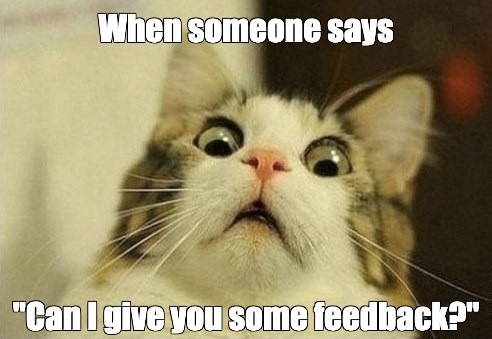
I hate getting feedback… Don’t you?

I hate getting feedback…

It hurts. It stings. It can crush your soul—especially if you think you’re already kicking butt. 

But it’s also the best way to figure out where you can grow to hit your goals.

That’s why I actively seek it out in everything I do. 

Musicians Are Brutal

This practice came from my time in university. I was studying to be (and working as) a professional musician. 

Every week, I had multiple lessons, rehearsals, and performances. And after each one, my teachers, bandmates, and mentors had feedback for me.

It was brutal (to put it mildly). But it made me a better musician. 

These people were better than me, more experienced, and knew what needed to be done to succeed. 

I’ve carried this practice with me into every job I’ve had. It’s made me a better leader, writer, and marketer.

“A mark of a competent adult is their ability to accept feedback. The mark of a child is their expectation of praise without merit.”

—Donald Miller, Business Made Simple, p. 15

Surround yourself with people who want you to improve and succeed in your roles. Actively seek out feedback. 

The more you do it, the better you’ll get. But I can’t promise it won’t sting.

How do you feel about feedback? Are you actively seeking it out?

Get daily insights on business, personal growth, and creativity.

Subscribe today.

Think and Grow Rich in 2021

CLICK HERE TO JOIN US (affiliate link)

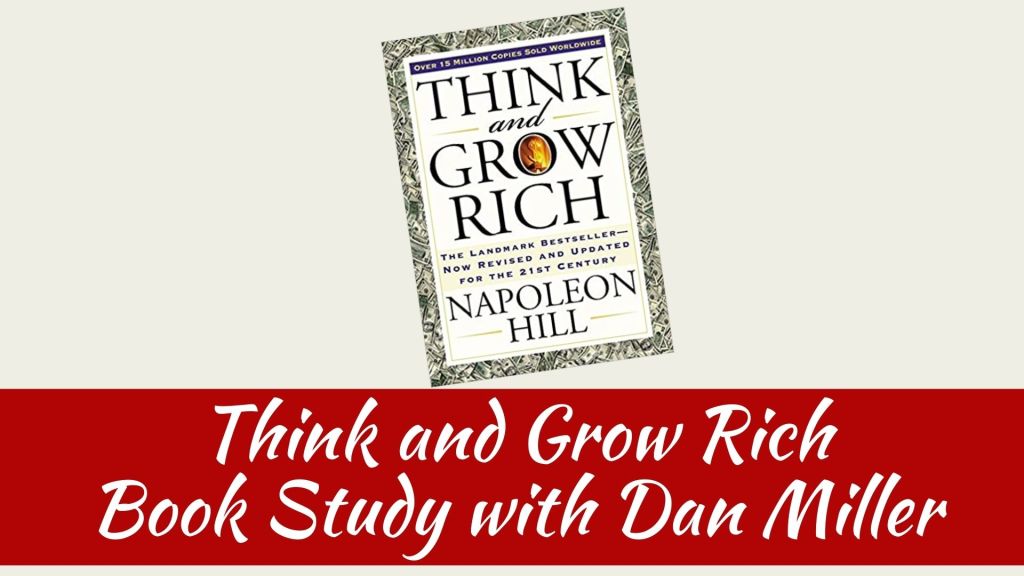
What are you excited about for 2021? One of the things I’m really looking forward to is a study of Napoleon HIll’s Think and Grow Rich. I’ll be doing this with my 48 Days Eagles Community of entrepreneurs and its founder Dan Miller, author of the New York Times Bestseller 48 Days To the Work and Life You Love.

We’re kicking it off with a family movie night. We’ll all be watching the movie online together on January 19th. Then we’ll start our study on January 25th, focusing on one chapter a month. And we’ll be meeting the fourth Monday of each month to discuss our readings.

Join us! It will be life-changing for you and me.

CLICK HERE TO JOIN US (affiliate link)

Get daily riffs, resources, and reflections. Subscribe below!

When Simple Things Are Stupid Hard

My upper back is tired. And the most strenuous thing I’ve done today is carry a few clothes to the washing machine.

Just walking around my home, trying to expand my lungs…it’s enough to leave me winded, short of breath in my dining room chair.

The simple act of chewing feels like I’m lifting a barbell with my neck. I imagine it’s the same strain I felt as an infant learning to lift my head.

Recovering from a major illness makes every little thing you take for granted feel like a Herculean effort.

Starting over with anything feels the same way. Getting laid off. Beginning a new career field. Learning a new physical skill. Getting back some modicum of physical strength and breathing normalcy…

It makes you feel inept…weak…almost helpless. “This shouldn’t be this hard,” you think. But it is.

“Should” doesn’t have any say in reality. All you can do is keep pushing, a little bit each day.

Relearn how to roll over, to crawl, to stand up, to walk…and eventually start running again.

(I was released from the hospital yesterday in case you missed my post.)

Subscribe for daily updates.

Failure and Success Are the Same Thing (Eventually)

The best teacher in the world is failure. Nothing teaches us more or faster than trying and failing at something.

It’s how we learn to walk. It’s how we learn to speak.

What keeps failure from becoming success is a lack of perseverance. We fail once and assume we’ll fail if we try again.

Thomas Edison failed more than 10,000 times in creating the incandescent lightbulb. But he failed differently each time.

When asked about this by a reporter, Edison said, “I have not failed 10,000 times. I have found 10,000 ways that don’t work.” He implied that each failure got him closer to his eventual success.

Had he tried making his lightbulb the same way 10,000 times, he would have been living out Einstein’s definition of insanity. But he didn’t. Instead he chose to keep trying 10,000 different ways.

Failure is a reality, but it’s also a choice. We can choose to learn from it, change things up, and try again. That option will eventually lead to success.

Or we can choose to fail and accept it as a permanent part of our lives.

You’ll find life is much better when you look at failure and success as learning experiences.

Learn more ways you can succeed every day. Subscribe below!

Empathic Learning

The 5th habit Dr. Covey writes about in The 7 Habits of Highly Effective People is all about empathic listening: “seek first to understand, then to be understood.” Empathic listening is putting aside our own narratives, judgements, assumptions, and listening from the other person’s point of reference. When we do this, we become students learning something new from another point of view.

For some reason this morning, I was thinking about my time in college studying my favorite subjects in history, subjects I had been studying since I was a small child. Sad to say, I remember listening to lectures and discussions with my professors from my own frame of reference: “I already learned all about that. Let me tell you what I already know about this subject to impress you.” 

I was the guy who would ask “deep, insightful questions,” when in reality, I was simply asking questions that showed my knowledge of the subject.

How vain, immature, and dumb I was! Had I only been listening––not from my own frame of reference, from the mindset of what I already knew––and instead adopted that wide-eyed curiosity of a child, I could have learned and retained so much more than I did. I would have been able to see the same ideas and subjects in a new light or with new perspectives. 

Instead, I listened to validate what I already thought I knew.

Empathic listening doesn’t just apply to difficult or emotional conversations with relationships in your life. It also must be employed in any learning environment to get as much out of it as possible.

Creating Football Fans

There are two components to learning a subject:

  1. You must want to learn whatever the subject is.
  2. You must constantly engage with the subject until it becomes a part of you.

This is how die-hard football fans (and players) are made. We don’t give them a textbook and test them on all the information it contains – we create an environment where a person wants to learn about the sport, and then we expose them over and over again until it becomes a part of his or her identity.

How do we replicate this in a classroom? How can we create people, children and adults, obsessed with learning something other than sports?

We’ve gotten really good at creating a culture obsessed with football; we’ve done a poor job of creating a culture obsessed with history, literature, or science.

Fear Accompanies Us On All Our Exciting Adventures

Something I’ve been working on a lot during my deep dive into creativity and self-awareness is dealing with fear. It’s always there, and I don’t know about you, but I’ve never been able to find a way to get rid of it.

What I have learned, however, is simple: feel the fear…then act anyway. 

There Is No Danger…

Almost nothing we do in modern life is actually dangerous – it just feels dangerous, and our amygdala tells us to run as fast as we can in the other direction. Making a cold call, sending out batches of promo materials to prospective employers, sitting in an interview…none of these things are dangerous. They just feel dangerous.

Jumping out of a plane with no parachute is dangerous; driving while wearing a blindfold is dangerous.

Trying something new where you may be told no? That’s not dangerous.

Action Overcomes Fear

I’ve decided to feel the fear, and act anyway. First, it was making a phone call to get contact information for someone in charge of a job I desperately wanted to take. Then it was beginning the sales process of promoting myself to that person. Today, it was reaching out to an old contact – a professor at a local college – about working for her in her program.

Each time, I felt tremendous fear, then did the thing that scared me anyway Euphoria followed fear, then the fear melted away. 

And so far, 2 out of the 3 times, it has paid off. The person I called was incredibly kind and more than happy to give me the information I was seeking (why was I so scared?).

The contact at the college was very positive in her response (again, why was I so scared?).

And the third person? Well, I’m not done selling myself to him yet.

What is, and was, the worst that any of them could say? No? That’s not scary or dangerous. It just means I’ve got to try something else.

Win or Learn

But the best part of all this? If I act and succeed, then I win! If I act and fail, I STILL WIN! How? Because I did something that scared me, which makes it easier to do it again next time in a different situation. Because I’m exercising the muscle of action in the face of fear. Because I’m not basing my self-worth over how other people feel about me, what they say about me, or whether or not they say yes to my proposal. I don’t feel the need for that approval anymore – it’s just a happy bonus if I get it. 

I will quote Susan Jeffers at length here:

“We cannot escape fear. We can only transform it into a companion that accompanies us on all our exciting adventures…Take a risk a day – one small or bold stroke that will make you feel great once you have done it.”

–Susan Jeffers

I’ve decided to make fear my companion on this adventure called life. I hope you will too.

Want more inspiration to embrace your creativity? Subscribe below!

Change is a skill

That book you read, the TED talk you listened to, or that seminar you attended–it’s only half of the equation. The materials you absorb will not, in themselves, change you for the better (if that is what you seek).

Change is a skill, which means it is something that must be practiced consistently until whatever you seek to change becomes a habit.

The materials available to you are great: in my opinion, they are vital to get you out of whatever rut you currently find yourself. We all need another voice, a voice we trust, reminding us of what better is.

But it’s up to you to change. It requires taking action.

What will you do to change today?

Join 845 other subscribers

Are you as effective as you could be?

Here’s a story:

A man is walking through the woods alone when he comes upon a lumberjack hard at work. The lumberjack is sawing with all his might through a very large tree, and the man can tell this worker is exhausted.

“How long have you been at this one tree?” the man asks.

The lumberjack replies, “About 4 hours now, and I’m exhausted.”

The man watches for a few more moments and realizes the saw has become rather dull from overuse.

“Why don’t you stop to sharpen your saw?” the man suggests to the lumberjack. “You will probably finish in half the time it is taking you.”

“I can’t stop,” replies the lumberjack. “I’m too busy sawing.”

This story is where Dr. Stephen R. Covey got the name of his seventh habit “Sharpen the Saw®” in his monumental work, The 7 Habits of Highly Effective People.

In essence, most of us feel we are too busy to stop working long enough to revitalize ourselves in ways that would make us even more productive when we returned to work. We think the only solution to more results is more work. This, of course, leads to exhaustion, stagnation, and burn-out.

“The human organism needs an ample supply of good building material to repair the effects of daily wear and tear.”

–Indra Devi

What are you doing each day to supply that good building material you need? There are four dimensions to life–physical, mental, social/emotional, and spiritual–and each ones needs its own raw materials.

For the body: eat right and be active! This does not mean strict diets or multi-hour workouts 7 days a week. It means sensible eating and regular, quality movement throughout the day. I personally recommend Precision Nutrition for their quality (and free) resources, as well as their more expensive coaching options. Here is an article they released today on the benefits of small amounts of movement throughout the day rather than big workouts and nothing else each day.

For the mind: read. This is the simplest, smallest thing you can do each day to rejuvenate your mind and unleash your creativity. If you read only 10 minutes a day at an average speed, you will read approximately one book each month. 12 books a year will change who you are as a person. Start with this reading list here.

For the heart (social/emotional): read The 7 Habits of Highly Effective People. No other book will help you improve your relationships with others and develop the self-awareness needed to effectively conduct yourself in the world than this one.

For the soul: you don’t have to be religious or pick up a copy of religious text to rejuvenate your spirit, but you must invest in your soul somehow. Read inspirational literature or biographies by great thinkers and leaders who inspire you. Go for a walk outside (social distancing, of course) without music or podcasts or social media, and listen to the sounds around you. Let your mind wander when you do it.

Give yourself the right stuff today to keep your saw sharp.

Join 845 other subscribers

*Note: I do occasionally use affiliate links on this blog, which results in a small commission for me if you purchase something. However, I only recommend products in which I truly believe.

Encourage ignorance (and overcome it)

When you are serving other people (i.e., working), there will be times when you don’t have the answer to the problem in front of you.

Perhaps you work in customer service, a retail store, or banking. Someone is going to ask you a question for which you do not have an answer. What do you do?

If you went to a typical school or were processed through typical corporate training, you might have a few possible answers immediately:

  1. Tell the customer you don’t know, you’re sorry, and you can’t help them.
  2. Immediately go to your boss and ask her to give you the answer or take over the situation entirely (unless your boss is a crazy control freak and wants her finger on the pulse of every step you take, she won’t appreciate this).
  3. Try to figure it out yourself by moving through all the formulas, procedures, and company policies with which you were conditioned (definitely not the worst option, but it’s limited in its effectiveness).

Do you see a better option?

The better option

You are surrounded by people that know more than you, have more experience than you, and do the same type of work as you, either in person or resources on the internet. Ask them for help, but take it one step further.

Learn alongside the person you are trying to help. It’s easy and has two benefits: 1) the person in need gets the help he or she requires, and 2) you learn something new that will be in your toolbelt for next time.

Here’s your answer when you don’t know:

“I don’t know the solution to this problem, but I guarantee we can find one. Let’s find out what it is together!“

The flaw in our system

Most of our education and training conditions us to work by ourselves, independently from everyone else, under an authority figure who has all the answers.

“Only raise your hand if you know the answer” becomes “never acknowledge ignorance in front of customers!” That will only discredit you. They will lose faith in you. You will be humiliated.

Actually, no – by being humble enough to admit your ignorance, they will respect you for not lying to them, not giving them bad information that will fail or hurt them in practice, and not wasting their time.

The real world is full of collaboration, synergy, and needs us to use all available resources to find the answers. The real world is an open-book group test.

It is not full of, nor should we encourage, independent work with no outside help, an authority figure with all the answers, or a lack of information that you are not allowed to remedy by looking up the answer.

If the real world isn’t like that, why are we training people to operate that way?

Be bold, be brave, and admit your ignorance. Then go find the answer using every person and resource at your disposal.

“I don’t know – let’s find out together.”

Join 845 other subscribers