Change your story, change your results

Each of us has an internal narrative constantly chattering about who we are. 

But what we don’t always realize is that internal narrative influences how we behave.

If you tell yourself the story that, “Overeating makes me feel happy,” that story might be a stand-in for the real story—“I’m unhappy with different aspects of my life and overeating gives me a small dose of pleasure.”

Until you realize this, you’ll continue to overeat and live on greasy fast food multiple times each week.

(I know this because it’s a story I’m trying to rewrite myself). 

If you tell yourself a story that says, “I’m not skilled at sales or business,” you might never realize your unresolved dream of starting your own venture and working for yourself. 

The first step to overcoming many of our chronic issues is to start telling ourselves a different story. 

Changing what you do starts by changing your identity—who you believe yourself to be. 

Change the story, change the person.

You have more than one shot

50 years ago, you had to stage a grand opening to the masses to your event or business. 

If you wanted to open a store, you banked a lot of money (usually borrowed), on the fact that you had to get a lot of customers right away, or you’d go bust.

So you’d hype everyone up. You’d send out mailers, run TV commercials, tell everyone you knew to spread the word to your friends. 

Hype, hype, hype!

Then you’d hold the grand opening with those big scissors and red tape (metaphorical or otherwise). And it would either succeed—you’d make the money you needed to stay afloat.

Or it would fail, and you’d potentially go bankrupt. 

We still have that “one-shot” mentality today. Whether it’s starting a business, writing a song, publishing a book, whatever—we still feel like we’ve got one shot to succeed. 

That everything hinges on one big moment where either everyone hears about it…or they don’t and you fail. 

The reality is, the internet has made the grand opening both unnecessary and obsolete. 

If you write something that doesn’t perform well, so what?! You can show up and do it again tomorrow… and do it better. 

If you start a business, but don’t get any traction, so what? The stakes for failing in a digital business are minuscule compared to what it used to be. 

You don’t need grand openings anymore. You don’t need hundreds or thousands of customers and followers right away to be successful. 

You now have unlimited chances to attract the people you want to serve. Failing is often free. 

Start small, serve well, and let it grow over time. That’s the key to succeeding in the modern age. 

Are you flip-flopping? Good.

This is the primary sign of being a mature, well-balanced adult:

The ability—AND WILLINGNESS—to change your mind about something you believe or hold dear in the face of new information.

You’ll be ridiculed for it. You’ll be called a “flip-flopper“. But so what?

You’re growing and learning, adapting and changing. That’s all that matters.

The shortcut to mastery

There isn’t one…

“There are no shortcuts to the creative process…the very impatience that drives you to desire shortcuts makes you unsuited for mastery.”

Robert Greene, The Daily Laws p. 84

Do the work. Trust the process. It will be tough to master anything.

But it’s so worth it.

Get good at being bad

One of my favorite Zig Ziglar quotes of all time…

“If it’s worth doing, it’s worth doing… poorly!”

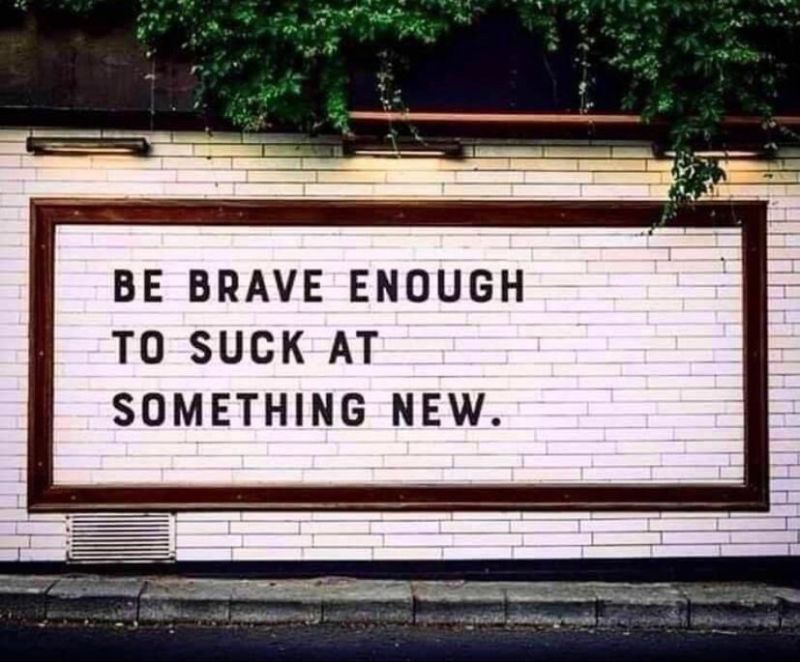
You will never be great when you’re learning something new. Take the time to suck at it on your way to getting better.

If it’s worth doing, it’s worth doing poorly

You’ve been told your entire life you should do things well.

Perfectly.

Like an expert.

And if you can’t do it well, you might as well not even bother to do it at all.

That’s wrong. You can’t instantly be great at doing ANYTHING.

The only place to start is at the level we currently are.

The always relevant, and sometimes irreverent, Zig Ziglar said one of my favorite quotes of all time:

“If it’s worth doing, it’s worth doing poorly.”

What did he mean?

Simple: anything worthwhile requires that we start as a beginner.

Golfing, tennis, writing, painting, jazz improv… It doesn’t matter what it is.

If it’s worth pursuing, you owe it to yourself to be bad at it. And then get better at it every single day.

He uses the example of someone learning to play golf: if everyone could join the PGA Masters tour after a couple of lessons with the local pro, there’s no reason to do it.

Give yourself time to do things badly…

On the way to doing them well.

Subscribe

Who I learned from this week (July 23, 2021)

https://michaelhyatt.com/shave/

Michael Hyatt put together a crazy in-depth guide with four big parts. If you’re looking to up your productive and get more done while working less, I highly recommend you download this ebook.

An absolutely fascinating post by Seth Godin about reaching your audience organically.

Serve a handful of people well, be remarkable, and they’ll tell a few others. It starts small, but the results are exponential.

https://podcasts.apple.com/us/podcast/marketing-made-simple/id1569923210?i=1000526591946

Donald Miller’s “StoryBrand Framework” is the gold standard in effective marketing, especially for creatives, solopreneurs, and small business folks.

His team recently came out with a new podcast called “Marketing Made Simple” which I’m absolutely DEVOURING. Not only are the hosts incredibly engaging and funny, they give practical advice and step-by-step instructions on how to market your business from beginning to end.

There are five episodes so far, each with a call-to-action to fill out your very own StoryBrand Brandscript (which you can start for free right here).

A great article by Ryan Holiday that makes a compelling argument for anger being a primary cause of the Confederacy’s failure in the American Civil War.
I’d like to specifically draw your attention to his 3rd idea in this newsletter.

What’s the single tiny step you can do to move the needle on your project or goal? Even if it feels microscopic?

https://www.calnewport.com/blog/2021/07/21/on-pace-and-productivity/

Last, but not least, this article from Cal Newport shows us that how much time we look at collectively has a big impact on whether or not we look productive.

Scientists like Galileo and Newton had seemingly slow, unproductive days when looked at individually. But when you look at their accomplishments over the span of years, it’s mind-boggling what they did…

Subscribe below for daily insights, resources, and great content delivered directly to your inbox.

What does coaching mean to you?

I heard the best description of what a coach does this week on Michael Hyatt’s podcast, “Lead to Win”:

“I love developing people and helping [them] to see the best potential in them and call it out. And that is what coaching is all about.”

That quote is from Michele Cushatt, Chief Coaching Officer at Michael Hyatt & Company. (You can check out the episode here.)

Her definition of coaching leapt out at me… I had to listen to it at least three times. 

Most of us have an image in our head of a coach as a cheerleader… Maybe it’s someone who tells you “great job” when you finish a task or make a little progress. 

Or maybe “coach” conjures images of someone putting you through drills or practices to help you develop a skill. 

Coaches can and should do those things. But that’s not the essence of what coaching is…

A great coach sees the potential in another person and calls it out! That’s the key. They bring forth what’s already inside someone else. 

They help someone become the best person they can be. The person they are destined to become.

Do you have someone in your life doing that for you? If not, can you find someone?

Or is there someone you know who’s got tons of potential but can’t see it? Or hasn’t developed it? 

Why can’t you take the role of coach and call it out to them?

Subscribe below for daily insights, resources, and ideas delivered straight to your inbox.

Life lessons from the last 18 months

Cherish your loved ones – they’ll be taken from you when you least expect it.

I’ve lost three close family members in 18 months. My father-in-law dropped dead of heart failure in December 2019. He was in perfect health.

My uncle died of cancer 6 months later. I had just seen him at Thanksgiving the previous year, and he seemed to be doing just fine.

Then my dad died in May. I had just spoken with him on the phone a month before… He sounded just like his old self. By the time I got to see him, he couldn’t speak or see me. I was able to say goodbye, but I’ll never know if he heard me.

And I might be losing someone else soon.

Tell your family you love them after you finish reading this. Then do it every day from now on.

Serious illness—or even death—can strike you down no matter your age or health.

My wife and I took the COVID-19 pandemic seriously. We quarantined, wore masks, and did all we were advised to do by the CDC. And both of us still managed to catch it.

My wife had a fever for eight days. I ended up in the ICU on forced oxygen for eight days gasping for breath. Wondering if this was what it felt like to die. The doctors told me had I not come in the night that I did, I would have died in my sleep.

I spent Christmas and New Year’s in a hospital room isolated and alone—except for the occasional nurse or technician. Eight days. And there were people around me even worse off than I was.

I was 30 years old and in perfect health. And I’m still recovering.

Never chase money – you’ll always end up miserable.

I was in my sweet spot at a job I enjoyed—teaching classes all day and putting my creative skills to use on a daily basis. But I felt I wasn’t making enough money, so I took a promotion.

The money wasn’t as good as I thought it would be. And I wound up in a miserable role that stressed me out more than I could have ever imagined.

Then another offer came my way, a chance to escape that misery, and it came with a decent bump in pay. But I had an uneasy feeling about it during the interviews.

I took it anyway, and it left me just as miserable as I was before, but for different reasons.

It might be a cliche, but find something that makes you happy. Then find a way to make a living doing it. Don’t take jobs you know don’t fit you simply because they offer you more money.

Take any or all of these lessons to heart. Let them guide your actions for the last half of 2021 and beyond.

Subscribe below and get daily insights delivered straight to your inbox.

You Are EXACTLY Where You Are Supposed to Be

“Know that wherever you are in your life right now is both temporary, and exactly where you are supposed to be. You have arrived at this moment to learn what you must learn, so you can become the person you need to be to create the life you truly want.”

—Hal Elrod, The Miracle Morning, p. xxxi

Get a daily doses of inspiration.

Subscribe now!