Order-taking

If that’s all you do in your work—wait around for someone above you to give you a task or a project—you won’t have a job for long.

If you’ve read my blog for any length of time, you know my (rather frustrated) feelings on AI. But I can assure you that one thing it does well is take orders from your leaders.1 And it does so faster than you can.

But what it can’t do is take initiative. It can’t go out of its way to connect with your coworkers, managers, or customers and figure out what their problems are.

That’s where you have the advantage: you can be a problem-finder.

And problem finding is perhaps the most vital skill in business today. Because if you can identify the root cause of an issue, you can create a truly effective solution and solve it in a way that AI (probably) can’t.

That’s your differentiator in the AI-era workplace.


  1. Whether it executes on those orders with any sort of accuracy, reliability, or quality is another matter entirely. But it’s fast and (relatively) cheap, so you can bet people will use it. ↩︎

Role-playing games vs. doing hard things

I like role-playing video games. In fact, they’re one of only two types of video games I like to play (the other being strategy games).

In only an hour or so, with the only effort required being time and learning a few button combinations, you can take a character from a complete newbie to a superpowered, super-skilled demigod who can conquer the world.

It’s quite satisfying.

You can watch this character of yours grow, develop new skills, conquer increasingly difficult challenges, and know for certain you’ll reach the apex if you just put in enough time.

This could not be more different from the real world.

Learning new, meaningful skills requires a massive amount of time along with physical and mental energy you may or may not have, especially if you’re working all day or raising a family (or both).

You could spend years mastering something rather than a few hours in a game. And there’s never any guarantee that what you learn will pay off—or that you even can master it.

So you spend your time playing the game rather than doing the hard thing in real life. And each time you make that choice, it gets harder to make the opposite choice next time.

Doing hard things in real life is a muscle that must be exercised regularly, lest it atrophy.

DON’T let AI write the doc!

(This is a follow-up post to “Let Them Review the Doc“)

If you’re typing up a document for your meeting attendees to review…

Or God forbid you’re responding to the meeting doc with AI…

You will get nothing out of the meeting, and no one will be any better off for having spent one of their precious hours talking to you.

I know for many people, this is akin to me asking you not to breathe, but it’s so important.1

The meeting doesn’t need to know what Claude thinks. It needs your brain’s input, your imperfectly formed ideas, your sloppy wording.

Meetings need your humanity.

If you’re going to have AI write your pre-meeting doc or your response to said doc, you might as well just have AI bots hold meetings without you.


  1. I’ve been pushing for this in my work, and every single document I’ve looked at before a meeting was very obviously written and formatted by Claude.

    Why is this a problem? Because when I go into the meeting, the person holding it has no idea what’s written on the document, and it’s obvious. It completely defeats the purpose. ↩︎

Let them review the doc

Here’s a tip for your next meeting:

Type up everything you need to cover, share the document with your team, and let them process the content and their thoughts before you meet.

Not everyone absorbs information immediately when it’s presented verbally or shown through screen-sharing. And even fewer people can crystallize their thoughts into something worth sharing with you live without first digesting the information.

The secret to great meetings is not to have them in the first place.

But if you need to have one anyway, make it a place for prepared discussion, not information delivery and on-the-spot improvisational responses.

AI, politics, and your health

Several people have sent messages to me over the last year asking why I talk about politics or artificial intelligence if I’m “just trying to be a health coach…” The implication (or outright criticism) is, “You should focus on exercise and nutrition because that’s what health is, not AI or politics.”

As someone trained in the Deep Health model of coaching (thanks, Precision Nutrition!), I respectfully disagree.

Human health is multidimensional. It’s not weight loss, V02 max, bench press numbers, meal plans, or whatever “maxxing” fad happens to be circling the web right now (in fact, it’s almost never those things). It’s a holistic combination of numerous facets of your life that all influence each other.

Your health is a system, and like any system, a change in one part affects the whole.

The Deep Health model has six dimensions:

  1. Mental: How focused are you? How well can you learn? Are you so overwhelmed you can’t get anything done?
  2. Emotional: Are you in control of your emotions? Can you express them well?
  3. Existential: Do you have a sense of purpose or meaning in your life? Do you feel fulfilled most days?
  4. Environmental: Is your environment safe and secure? Is it clean and sanitary? Do you have what you need to survive and thrive?
  5. Relational: Do you have rich, rewarding relationships in your life you can rely on? Or are you lonely? Being abused?
  6. Physical: How well do you eat and move? How do you feel day-to-day? Are you chronically ill (as I am)?

Notice I saved physical for last—not because it’s less important, but because I want to emphasize how important the other aspects are. All these dimensions are interconnected, which means that they can all influence your physical health.

Which brings me back to why I talk about AI and politics.

If you worked for the federal government in the United States and were unceremoniously fired by DOGE in 2025, this affects your health. Lack of income, loss of meaning (a lot of which comes from our work), the uncertainty of how you’ll pay your bills or feed your kids—just like that, you’ve had your mental, emotional, existential, and environmental health negatively affected.

If you had your health benefits slashed by cuts to Medicaid or the Affordable Care Act, your physical, environmental, and emotional health have been negatively affected.

If you’re constantly being bombarded by the bullshit scare-marketing coming from the AI CEO tech bros telling you they’re going to kill off the human race, but they can’t do anything to stop it…

Or if your boss drank the AI Kool-Aid and is hounding you to ship more work, faster, with less care or craft, you’ll be incredibly stressed mentally, emotionally, and probably environmentally (because you’re constantly worrying about your job).

I could give you several dozen more examples, but you get my point.1 Each of these “non-health” issues affects your well-being, and they can all affect your physical health.

You might not be able to eat well, or get to a gym, or go for a walk, or do anything “healthy” after being mentally and emotionally (or God-forbid, physically) assaulted all day.

If you believe health is only about how much you lift in the gym or how much protein you get each day, then yeah, I’m out of line.

But that’s not what health is, and that’s not how I coach. You are a multi-dimensional, incredibly complex creature whose physical health is affected by so many things outside of nutrition and exercise. A good coach (which I like to believe I am) recognizes that and works with you to manage all aspects of your health, not just the physical.

So I’ll keep writing about AI and politics—and all sorts of other things too—as long as they keep affecting your health.


  1. And that doesn’t even include our Health Department cutting programs to keep us physically healthy, a decision that has led to viral outbreaks, explosive diarrhea, and death. There’s politics affecting your health again! ↩︎

“People like us do healthy things like this”

According to Seth Godin, the definition of culture is, “People like us do things like this.”

Any sort of “culture” you want to be part of has things people like them do, so all you have to do to join that culture is do those things too.

Want to be a writer? What do writers do regularly that makes them successful? Copy those behaviors, and you’ll be a writer, too.

Have you always wanted to be a politically engaged, active, contributing citizen? What do those sorts of people do daily, and can you build a relationship with them?

I was thinking about this in the context of health this morning, and I thought it could be a really helpful way to develop healthier (and sustainable) practices in your life.

What do the healthy people you know do on a regular basis? Answering that question is a really good way to become people like us in this context (i.e., people who are healthy).

Some of those things are pretty basic:

  • They move often and a lot, in ways they enjoy
  • They eat more whole foods in moderate amounts
  • They sleep well
  • They have ways to manage their stress

The hard part, of course, is actually developing these practices. But one key to becoming a “person like this” is to get involved with those types of people. They will naturally rub off on you.

Culture and community might be a game-changer.

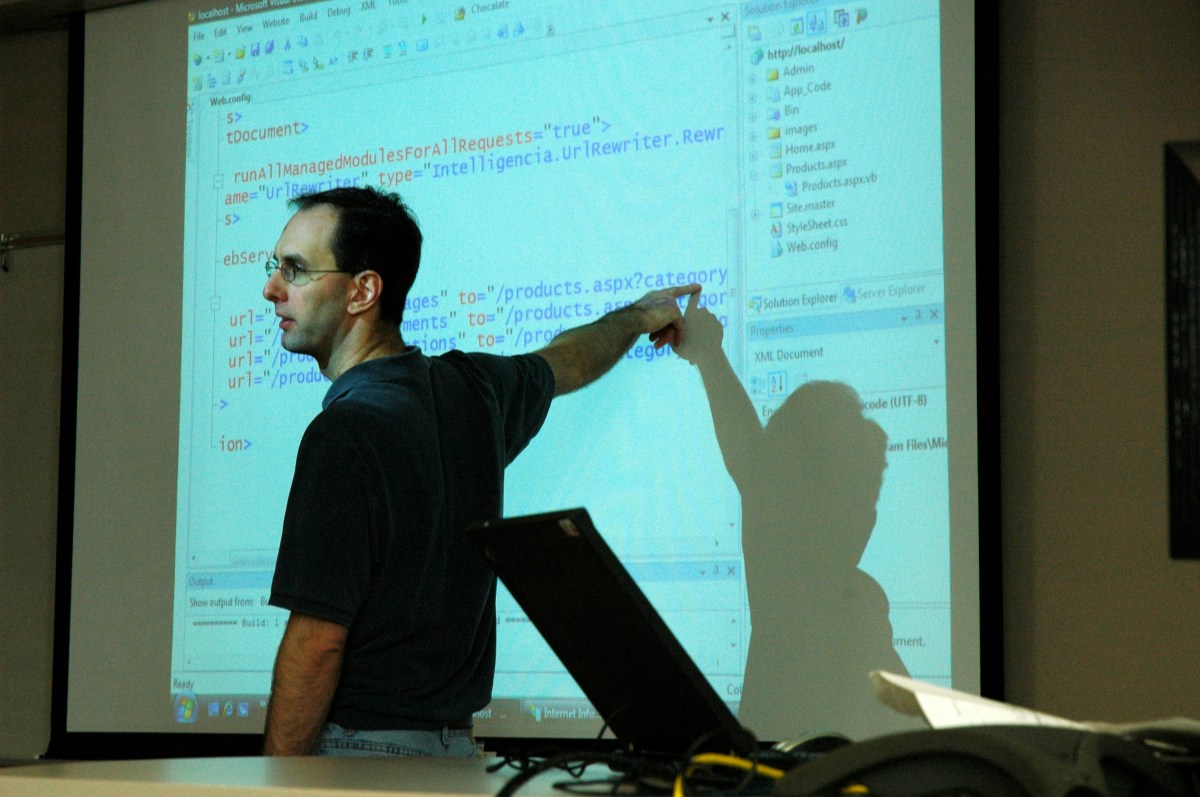
Man teaching pointing to a projector screen.

Talking yourself into learning

I’ve been reviewing some coding skills in my spare time to improve the content and coursework I create for my day job.

As part of my practice, I’ve been talking to myself.

Here’s one example:

“I need to turn this text into a link, so [as I’m typing out the code] I need to wrap this header element in an anchor tag and add the hypertext reference attribute to it and set it equal to the hyperlink I need to direct my audience to. Oh, don’t forget to add the target attribute and set it equal to blank so it’ll open in a new tab.”1

It’s more tedious and time-consuming than simply typing out the code. But the point is to understand the concepts behind what I’m doing, not just to write functional code as quickly as possible. (If I wanted to do that, I’d just have Claude do it for me…)

Teaching someone else—even if you’re teaching yourself by talking out loud—is one of the best ways to prove you know something. When you force yourself to explain something out loud, you learn where the gaps in your knowledge are, which then signals what you need to review. Then, when you come to the same scenario again, you can see if you’ve acquired the necessary ability to explain your former knowledge gap.2

This is active recall: talking or writing out something you’ve learned in your own words, and it’s how I’ve been approaching certain aspects of training at work. Rather than having everyone watch videos or read through course SCORM files, we’re testing employees’ abilities to talk through features.

It starts with review, of course—you still need content they can reference at the beginning of the learning process. But that’s where L&D often falls short. We equate content delivery with learning. And, obviously, that’s not true.3

But the proof of learning comes when they’re forced to talk it out and get graded on their delivery.

There’s no punishment for getting things wrong. But we know for certain where the gaps in understanding are, what needs review and further study. Or we learn that we, the L&D practitioners, missed something in the initial teaching and have to fill it in.

Talk out what you’re learning. If you can explain it to someone else (or yourself)—out loud—there’s a good chance you’ve grasped the concept.


  1. I’m aware that this is extraordinarily basic HTML code for all you web developers out there. But the point is the practice of talking it out, not how advanced the code is. ↩︎
  2. My favorite book on this topic was actually written to help college students improve test scores. Check out Cal Newport’s How to Become a Straight-A Student. It’s not just for undergrads. ↩︎
  3. Again, I have to point out that this is why most online learning (e.g., MasterClass, Udemy, and most corporate training) doesn’t work. Consuming information isn’t learning. It’s part of it, sure, but only the retention and understanding of that information actually matter. And the only truly effective way to test this is through active recall, which is exactly what I’m doing when I talk out my code. And it’s what we’re doing when we have people talk through our product. ↩︎

Just because you can doesn’t mean you should

It’s one of my favorite lines from Jurassic Park, and it applies in just about every situation imaginable.

via GIPHY

In my case, it’s on my mind daily as I watch the L&D industry, of which I’m a part, rapidly adopt AI for anything and everything that it possibly can.

The biggest victim of this is video creation. There are now approximately 7 trillion companies that all offer some form of talking-head, AI-avatar video-generating software that’s supposed to make video creation fast, simple, and easy for practitioners.

The problem is, most of it is awful. At least, if you care about your craft and the quality of your output.

The videos are generic. They don’t actually “TEACH” you anything. They simply come across as informational videos, which ironically is what people constantly complain about in corporate training. “It’s too boring. Not actionable. Just random information that I don’t know what to do with.”

So it’s great if you want to do more of the same stuff that doesn’t work, but you want to do it quickly, cheaply, and efficiently.

However, if you ACTUALLY want to create learning that matters, you might be better served doing it without AI. Or at least learn best practices for making learning stick or making it applicable, then work that into your AI-generated videos.

As always, it comes down to design thinking: Who’s it for and what’s it for?

If you know the answer to those questions, you can make quality content. Maybe with AI, or maybe not.

Just because you can do it with AI doesn’t mean you should.

What skill have you developed in the last five years?

For most of us, I’d bet it’s something like this:

“In the last five years, I’ve gotten really good at reading and sending emails and instant messages. But also, I’m really good at going to meetings.”

Not exactly skills you can sell when you’re looking for your next gig, are they?

For those of us who don’t make or sell tangible products for a living, skills are all we have to trade for money. But the nature of knowledge work means more of us are developing fewer skills the longer we’re in our careers.

We’re spending more and more of our time talking about work rather than doing work. We’re building fewer things and completing fewer projects.

AI is only exacerbating the problem, as we outsource more of our making and thinking to AI chatbots (and getting worse outcomes as a result).

Without projects that we do ourselves—without making things that challenge us to learn—we’re deskilling ourselves. And as a result, we’re making ourselves less marketable in the workforce.

The best time to develop a new skill was five years ago. The next best time is today.

I’m signing up for cold calls

Every week, I sign up for several webinars or other educational opportunities. And every time I do so, they ask for my phone number (always required, never optional).

Several years ago, I noticed that I was getting dozens of unsolicited phone calls each week from people and companies I’d never heard of.

I couldn’t figure out why, until I realized that most of these people worked for companies that sponsored (overtly and sometimes covertly) the events I attended.

It’s obvious now that the events weren’t just for me: they were pipeline-building opportunities for organizations to grow their businesses.

If this sounds annoying, it is. But I’ve come to terms with it.

I realized that, unlike telemarketers interrupting me at dinner, I was getting calls from professionals who were just trying to make a living at the same time they were offering me something that by my own admission—I signed up for their webinar, right?—might benefit me.

Most of these calls go nowhere because they’re for businesses or services I either can’t afford, don’t need, or don’t have the authority to decide on for my job.

But the person on the other end of the phone is a professional. She’s doing her job, and I will respect that by treating her with decency rather than contempt.

Because I might be that person on the other end of the line someday. Whether it’s making contacts for a new job, selling a service I created, or raising funds for a cause I care about, I might be that person making calls.

And I hope the person on the other end sees it as a generous act on my part, not a self-serving one that benefits only me.

So my mantra, when I’m typing my information into a sign-up form, is, “I’m signing up for cold calls.”