Are You Buying What You’re Selling?

Zig Ziglar, the great motivator and sales trainer, found a mantra in the word “enthusiasm.” To him, the last four letters stood for “I am sold myself.”

Zig was a master salesman. He knew if you didn’t believe in what you were selling, that lack of enthusiasm would come across to the prospect.

But what about when you’re not selling a product? What if the thing you’re selling is yourself, and your customer is a potential employer?

This same idea holds true in the job hunt. If you’re trying to persuade an employer to hire you, you have to believe in the product. 

If you’re a freelancer trying to convince a company to use your freelance services, you’re selling a product you must believe in. 

If you’re not enthusiastic about what you have to offer, they won’t be either.

If you don’t believe in yourself, they won’t want to buy your product. And make no mistake: you are the product. 

Grow your enthusiasm. Know what you have to offer; understand what you do best; determine how you can best serve others. And believe that it will benefit another person.

Sell yourself on you.

“You can have everything in life you want, if you just help enough people get what they want.”—Zig Ziglar

Get a daily dose of inspiration. Subscribe below!

When Simple Things Are Stupid Hard

My upper back is tired. And the most strenuous thing I’ve done today is carry a few clothes to the washing machine.

Just walking around my home, trying to expand my lungs…it’s enough to leave me winded, short of breath in my dining room chair.

The simple act of chewing feels like I’m lifting a barbell with my neck. I imagine it’s the same strain I felt as an infant learning to lift my head.

Recovering from a major illness makes every little thing you take for granted feel like a Herculean effort.

Starting over with anything feels the same way. Getting laid off. Beginning a new career field. Learning a new physical skill. Getting back some modicum of physical strength and breathing normalcy…

It makes you feel inept…weak…almost helpless. “This shouldn’t be this hard,” you think. But it is.

“Should” doesn’t have any say in reality. All you can do is keep pushing, a little bit each day.

Relearn how to roll over, to crawl, to stand up, to walk…and eventually start running again.

(I was released from the hospital yesterday in case you missed my post.)

Subscribe for daily updates.

COVID-19 Nearly Killed Me at New Year’s

8 days ago, I was staring at a clock, gasping for air, wondering if I’d ever catch my breath again. Doctors strapped a mask to my face and started sticking tubes in every spot they could.

Simultaneously, I was retching, dry-heaving, and sweating so much I felt like I was in a nasty, hot swimming pool.

I’m happy to say that today, after double pneumonia, acute hypoxemic respiratory failure, and a half dozen other secondary diagnoses, I’m back at home—very weak, very tired—but resting.

I’m 30 years old, in good health, and COVID-19 nearly got me. Even after taking all the precautions and isolating with my wife for months, it only took one exposure to wipe me out.

Not the New Year’s Eve I would have chosen, but it’s the hand I was dealt.

The doctors, nurses, CNAs, respiratory therapists, housekeepers, food service workers, and every other person at St. Dominic Hospital literally saved my life and have allowed me to come home. Hopefully I can make all their hard work worth it before it’s time to go.

Thank you for letting me see 2021 again. Here’s to a happier, healthier year.

Did You Do Something Good Today?

“Never be entirely idle; but either be reading, or writing, or praying, or meditating, or endeavoring something for the public good.”

—Thomas à Kempis

What are you doing right now? Okay, you’re reading this blog post – bad question to ask.

What have you done today? What are you planning on doing today?

Have you written anything? Have you read a good book (or blog post?) 

Have you developed your self-awareness? Or your ability to empathize with people who are different from you? 

Have you done something for the good of another? 

Have you performed any selfless act of service?

Too many of us end each day with a resounding “no” to all these questions. Instead, our answer to the question, “What have you done today?” is usually something like this: “I went to work, came home, and binge-watched Netflix until I passed out.”

Change How You View Your Work

Perhaps you really did nothing other than work today. Perhaps it really had no other benefit than growing your checking account. 

Or perhaps you should reevaluate how you spend the time you are not at work, so that you do create something, learn something new, or serve another person. Or perhaps you should change the way you view your work – I’m betting you did something today that benefitted someone. Reflect on that. 

Too often, we use work, podcasts, and the always-available streaming services to block ourselves from creating our art. We chalk it up to a lack of time. 

But where is your time going? We all have the same 24 hours in a day, 168 hours in a week. Unless we are doing shift work or have a newborn at home, we have time to create good for the world. 

I challenge you to answer one question every night before you go to sleep: “Did I do something good today?”

Never miss a new post. Subscribe today!

Who’s in Love With the Reader?

When you’re writing material for your business, who’s it for?

Are you writing for the reader’s benefit or your own?

A lot of businesses write in such a way that boasts how awesome they are. How proud they are of the awards they’ve won, the success they’ve achieved, the big-name clients they’ve worked with.

The reader doesn’t care.

Your customer wants to know what’s in it for her. She’s asking, “What will I get out of this relationship?” Because working with, or buying from, a business is a relationship.

And if you don’t show the reader love, they’ll break up with you.

No one wants to date an egotistical, self-absorbed narcissist. Don’t let your published business materials come off that way either.

You’ve got to fall in love with your customer, not your business.

If you want to learn how to write in a way that shows your reader some love, pick up a copy of Write to Sell by Andy Maslen. He got me thinking about this question.

Want more insights daily? Subscribe below!

Are You Afraid of Being Told “Yes”?

Fear of rejection is normal. As a new freelancer, businessperson, or job-hunter, the thought of being rejected is terrifying. It’ll stop you in your tracks.

You don’t even have to try hard to imagine the feeling. You reach out, make cold contacts, and have (metaphorical) doors slammed in your face over and over. It’s enough to keep anyone from trying.

But there may be another reason you’re hesitating. A seemingly ridiculous reason you haven’t sent that email or finished that application.

You’re worried they might say yes…

Why would anyone worry about that? Isn’t hearing “yes” the best news possible?

And yet this fear is universal. Because if they say yes, you’re on the hook. You’re now responsible.

If you take on a freelance project, it’s all on you to deliver. If you take on a new job or move into a new career field, you have to perform.

And maybe…just maybe…you’re afraid you won’t be able to live up to the expectations. Maybe you’re worried you won’t deliver on the promise you made.

It’s not always fear of rejection that paralyzes us.

Often, we’re worried we’ll get exactly what we ask for.

Don’t leave just yet—you’ll miss out on future ideas! Subscribe below.

Are You a Professional Artist?

You have a problem with perfection.

You don’t have writer’s block or artist’s block; you’re worried what you create isn’t very good. 

But once you stop worrying about whether something is good or bad, you can get to the business of creating. 

Professionals

To be a professional is to show up and do your work regardless of how you feel. To be a professional artist, then, is to create works of art every day no matter what.

If you’re trying to make a living doing something artistic or creative, you’re a professional. Or at least, you should act like one. 

Even if you don’t feel that you have any good ideas. Even if you’re “just an artist.”

An amateur artist only creates when he feels like it, or when the muse speaks to him. Or, God forbid, after getting inebriated so he can “loosen up” and go with the flow. 

If You Build It, They Will Come…

Remember Field of Dreams? Being an artist is a lot like Kevin Costner building that baseball field.

You don’t wait for the muse to show up before you start creating. If you start creating, the Muse shows up like a curious child. She asks “Ooooo! What’s that? Can I help? Can I do that with you?” 

Waiting for a child to do something you want her to do doesn’t work. But if you just start doing it, she’ll immediately perk up and join you because she wants to be a part of your world. The mythical “Muse” acts the same way.

Some days you might have incredible days full of flow and creative ideas, but I’ve found those to be few and far between. Creation comes before inspiration almost every day. It’s why I show up to my morning pages each day after I wake. 

I don’t write them because I feel inspired: I write them to BECOME inspired. That’s what a professional artist does–indeed, that’s what any professional does.

Act Like a Professional

A lawyer doesn’t wait to become inspired before writing a brief or rehearsing an opening statement. She’s a professional and shows up because that’s her job. 

A surgeon doesn’t wait for the muse to speak to her before operating on a patient. She trains for years so each and every time a patient is wheeled into the operating room, she’s ready to perform. 

What if you approached your art the same way? As your job. What if you showed up every day ready to create whether or not you’re in the mood?

Do the work. Go make the Muse curious today.

Get a daily dose of creative inspiration. Subscribe today!

Thrive in All Weather—Think Like A Sailboat Captain

(HT to Seth Godin and the “EntreLeadership” Podcast)

If you’re piloting a sailboat, you don’t care in which direction the wind blows. All that matters is that the wind is blowing.

If you have wind, you can adjust your sails and steer the boat in the direction you wish to go. Only when there’s no wind are you actually stuck.

If we adopt this same thinking in our work and personal lives, we’ll thrive no matter what happens to us.

Technology changes in your industry? Embrace them and move forward. Your job becomes obsolete? Re-skill and do something else. (Both have happened to me.)

Circumstances will always be less than ideal. Sometimes they’ll be downright awful. But we can’t change which way the wind blows.

Don’t complain about its direction—adjust your sails and keep going.

Photo by Geran de Klerk on Unsplash

Learn more about succeeding in all weather. Subscribe today!

Are We Really “Born to Do” Anything?

It’s a question asked by lots of career counselors, coaches, and well-meaning advisors.

“What do you feel you were ‘born to do?'”

What if the honest answer is we aren’t born to do anything specific?

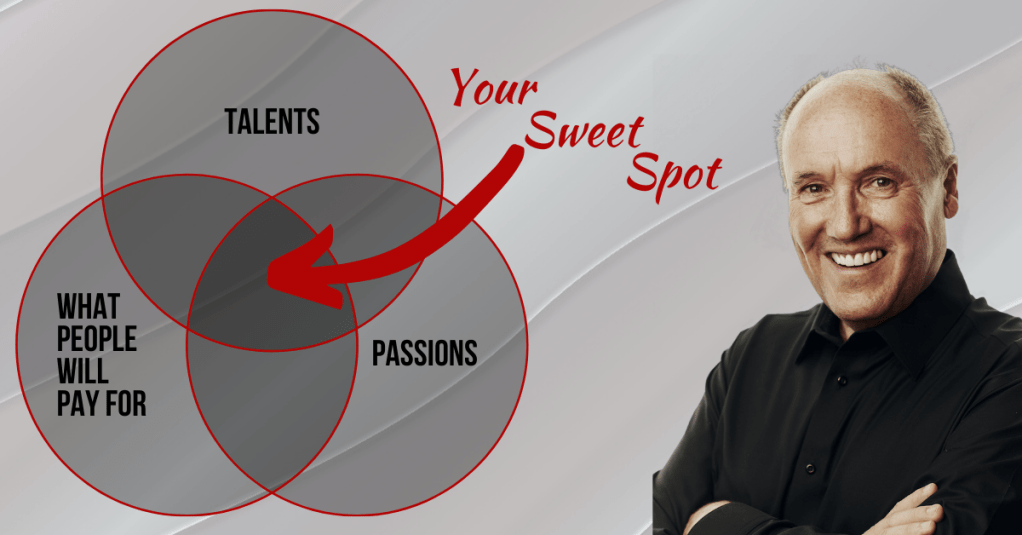
There is an entire area of philosophy dedicated to this idea that was first theorized by John Locke. (You can check out the basics here.) But I’m focusing on talents and passions today.

Was Van Gogh born to paint? Was Steve Jobs born to create the iPhone? Seth Godin would argue no. His answer to this question is simple. Here’s how I understand it:

No one is predetermined to use a certain medium for his or her art. We simply adopt the means and medium of whatever is available to us in our time.

In one of his podcast episodes, Seth says he doesn’t believe that Van Gogh would have painted with oils had he been born in the 20th century. Nor would Steve Jobs have created the iPhone had he been born in the 1700s (the resources and advancements in science were not available for that to have been possible).

And yet, each of us is genetically unique. You have never occurred before and will never occur again in this universe. Surely that means that we are born with innate talents and leanings.

Part of me thinks that’s true. And yet part of me also believes, as career coach Dan Miller says, “Passion is more developed than discovered.”

By this, he means we become passionate about things we engage with over and over again.

I find this idea incredibly liberating. Why? It means if we aren’t satisfied with what we are doing—if our passions are no longer feeding or fueling us—we can choose a new passion. We can develop it to something that feels like we were born to do it.

Maybe, in the end, it all comes down to choice and what’s available to us in our time.

What do you think? Were you born to do something? Leave a comment today!

We Are All Liars

I was flipping through books in a bookstore the other day on an Artist Date. While there, I came across one by my favorite marketing teacher Seth Godin.

Seth boldly claims that all marketers are liars because their jobs are to tell stories. As I thought about it, I realized we’re all liars.

Stories are how humans make sense of the world. It’s been that way since we were sitting around campfires, boasting about the Mastodon we brought down on the plains.

Our stories are never accurate. Our memories are fleeting, piecemeal images we try to put together into coherent statements. It’s why you can ask multiple eyewitnesses what happened at the scene of an accident and get four versions of the same crash

This does not mean there are no true stories, no facts. It just means the stories we tell ourselves and others are never the whole truth.

Fish Stories

How many times have you heard the same fish story from a relative? Did the fish get bigger with every telling?

I remember as a child sitting in the living room with my older brothers, sides splitting from tales of their recent exploits and the ridiculous shenanigans they got up to.

And I remember feeling a sense of jealousy afterwards. “Why couldn’t I tell stories like that?” Stories that were as humorous, grandiose, and absolutely ridiculous.

One reason was I had not mastered telling stories (read: changing details ever so slightly to make the stories better). Another reason was I had not lived long enough to collect interesting stories.

Of course, as I got older and my contact with other strange characters in this world increased, I collected my own fair share of comedies. And now, each time I retell one, I find myself questioning the details.

Did that really happen? Did I add that tiny detail to make the story more cohesive? More enjoyable? Am I remembering it the way it really happened?

The answer, of course, is no. We never do.

We humans like stories, but the stories we tell ourselves change. They’re imprints of what actually happened, not what actually happened.

I guess that makes us all liars.

But it also makes story time much funnier.

Get more daily insights into the human condition. Subscribe below!