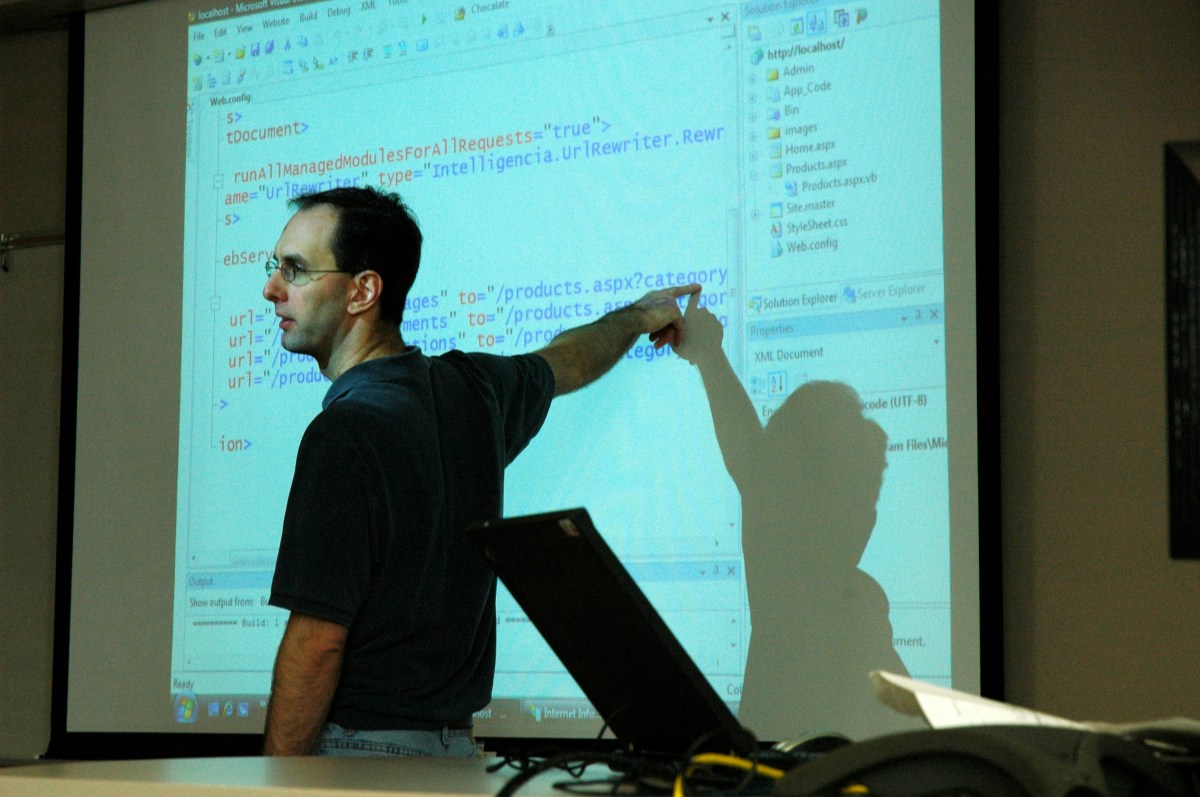
Man teaching pointing to a projector screen.

Talking yourself into learning

I’ve been reviewing some coding skills in my spare time to improve the content and coursework I create for my day job.

As part of my practice, I’ve been talking to myself.

Here’s one example:

“I need to turn this text into a link, so [as I’m typing out the code] I need to wrap this header element in an anchor tag and add the hypertext reference attribute to it and set it equal to the hyperlink I need to direct my audience to. Oh, don’t forget to add the target attribute and set it equal to blank so it’ll open in a new tab.”1

It’s more tedious and time-consuming than simply typing out the code. But the point is to understand the concepts behind what I’m doing, not just to write functional code as quickly as possible. (If I wanted to do that, I’d just have Claude do it for me…)

Teaching someone else—even if you’re teaching yourself by talking out loud—is one of the best ways to prove you know something. When you force yourself to explain something out loud, you learn where the gaps in your knowledge are, which then signals what you need to review. Then, when you come to the same scenario again, you can see if you’ve acquired the necessary ability to explain your former knowledge gap.2

This is active recall: talking or writing out something you’ve learned in your own words, and it’s how I’ve been approaching certain aspects of training at work. Rather than having everyone watch videos or read through course SCORM files, we’re testing employees’ abilities to talk through features.

It starts with review, of course—you still need content they can reference at the beginning of the learning process. But that’s where L&D often falls short. We equate content delivery with learning. And, obviously, that’s not true.3

But the proof of learning comes when they’re forced to talk it out and get graded on their delivery.

There’s no punishment for getting things wrong. But we know for certain where the gaps in understanding are, what needs review and further study. Or we learn that we, the L&D practitioners, missed something in the initial teaching and have to fill it in.

Talk out what you’re learning. If you can explain it to someone else (or yourself)—out loud—there’s a good chance you’ve grasped the concept.


  1. I’m aware that this is extraordinarily basic HTML code for all you web developers out there. But the point is the practice of talking it out, not how advanced the code is. ↩︎
  2. My favorite book on this topic was actually written to help college students improve test scores. Check out Cal Newport’s How to Become a Straight-A Student. It’s not just for undergrads. ↩︎
  3. Again, I have to point out that this is why most online learning (e.g., MasterClass, Udemy, and most corporate training) doesn’t work. Consuming information isn’t learning. It’s part of it, sure, but only the retention and understanding of that information actually matter. And the only truly effective way to test this is through active recall, which is exactly what I’m doing when I talk out my code. And it’s what we’re doing when we have people talk through our product. ↩︎

Just because you can doesn’t mean you should

It’s one of my favorite lines from Jurassic Park, and it applies in just about every situation imaginable.

via GIPHY

In my case, it’s on my mind daily as I watch the L&D industry, of which I’m a part, rapidly adopt AI for anything and everything that it possibly can.

The biggest victim of this is video creation. There are now approximately 7 trillion companies that all offer some form of talking-head, AI-avatar video-generating software that’s supposed to make video creation fast, simple, and easy for practitioners.

The problem is, most of it is awful. At least, if you care about your craft and the quality of your output.

The videos are generic. They don’t actually “TEACH” you anything. They simply come across as informational videos, which ironically is what people constantly complain about in corporate training. “It’s too boring. Not actionable. Just random information that I don’t know what to do with.”

So it’s great if you want to do more of the same stuff that doesn’t work, but you want to do it quickly, cheaply, and efficiently.

However, if you ACTUALLY want to create learning that matters, you might be better served doing it without AI. Or at least learn best practices for making learning stick or making it applicable, then work that into your AI-generated videos.

As always, it comes down to design thinking: Who’s it for and what’s it for?

If you know the answer to those questions, you can make quality content. Maybe with AI, or maybe not.

Just because you can do it with AI doesn’t mean you should.

What skill have you developed in the last five years?

For most of us, I’d bet it’s something like this:

“In the last five years, I’ve gotten really good at reading and sending emails and instant messages. But also, I’m really good at going to meetings.”

Not exactly skills you can sell when you’re looking for your next gig, are they?

For those of us who don’t make or sell tangible products for a living, skills are all we have to trade for money. But the nature of knowledge work means more of us are developing fewer skills the longer we’re in our careers.

We’re spending more and more of our time talking about work rather than doing work. We’re building fewer things and completing fewer projects.

AI is only exacerbating the problem, as we outsource more of our making and thinking to AI chatbots (and getting worse outcomes as a result).

Without projects that we do ourselves—without making things that challenge us to learn—we’re deskilling ourselves. And as a result, we’re making ourselves less marketable in the workforce.

The best time to develop a new skill was five years ago. The next best time is today.

Why is learning hard?

Learning is an activity that moves you from a state of incompetence to one of competence.

That feeling—not knowing something—is uncomfortable. It’s why we avoid it. It’s almost physically painful at times, and we’re naturally wired to avoid pain.

It’s much easier (read: less painful) to be entertained by an online video “course.” At some point, learning requires doing. And when you do it the first, second, or tenth time, it sucks. It’s a painful process. The quality is poor.

MasterClass is popular for a reason: it’s full of high-quality videos of famous people who tell you how to do interesting things… without you ever doing the hard work of learning.

Do you really think that you can become a world-class screenwriter or negotiator by watching a video? Of course not.

You become a great screenwriter by writing screenplays. You become a great negotiator by negotiating with people over and over again. The first screenplay will be terrible. You will lose your first negotiation.

Learning content can give you new ideas and techniques to implement. But you have to actually implement it.

There is no learning without doing.

How to learn a word

The best way to learn a new word is to have it paint a picture in your mind.

Adjectives conjure images of people who embody their meaning.

Verbs project images of the actions they represent.

Few people learn words by memorizing dictionary definitions and reciting them in their minds every time they hear them. The definition is great when it’s completely new and unfamiliar, but it’s only the first step. Mastery comes from the imagery conjured by the words.

Eventually, we develop an intuitive “feel” for the meanings of words and no longer need either the definition or the image they conjure. We become fluent, and the words roll off the tongue.

This path from incompetence to mastery is present in all learning. The “grammar” is just the first step.

Leadership = Applied History

There’s a line on the History Major page at the US Naval Academy:

Effective leadership is applied history.

Leadership, more than anything, is decision-making—specifically decision-making that affects other people, not only you.

By studying history, you can examine the minds of other leaders and understand their actions and the resulting outcomes (good and bad).

You can learn lessons from other people’s experiences rather than from your own failures and setbacks. This will not only save you time, money, and emotional labor—in some cases, it might save lives.

As General James Mattis said:

“If you haven’t read hundreds of books, you are functionally illiterate, and you will be incompetent, because your personal experiences alone aren’t broad enough to sustain you.”

Learn lessons from others by studying history. Don’t repeat their mistakes when you can simply read a book.

The teaching experience got worse after COVID

When the COVID-19 pandemic erupted, it sent all the children home for an extended period of virtual schooling. This showed parents what it was like to deal with lots of kids all day long.

Not just “deal” with them either, but also hopefully have them learn something.

Multiply parents’ experience with their handful of children by 10, and that was what the average schoolteacher dealt with on a daily basis for years before 2020.

What fascinates me about this, however, is that the experience didn’t lead to an outpouring of support. It didn’t lead to calls for higher pay, better working conditions, and more classroom assistance for teachers.

Instead, COVID-19 made schooling much, much worse for teachers as, inexplicably, it led to a focus on culture war issues and concerns over what was being taught in the classrooms.

How do values appear in your life?

What do you value? And how do you structure your life so that the things you value are apparent?

If you say you value thinking, how do you engage with that value on a daily basis?

  • No social media?
  • Embracing boredom?
  • Avoiding mindless TV binging?
  • Walking in silence?
  • Writing when ideas strike you?
  • Writing or thinking in public? (Publishing something)

If you say you value your health, how does that show up in your day?

  • Eating lots of fruits and vegetables?
  • Cooking more meals at home?
  • Intentional movement?
  • Finding ways to build more movement into your day so you don’t have to think about it?

Values are developed through action. They requires practice to become part of who you are.

You’re fired. Now what?

Here’s a question I’ve been noodling on:

What if you got fired today? What would you do?

But wait, it gets worse…

Not only were you fired, but your industry collapsed and no longer exists. And to make matters worse, all the specialized skills you built up in that industry are now irrelevant (hypothetically, an AI could do them all now and for free).

And, you can’t hide by going back to school for another degree.

You have to start something of your own—you have no choice.

What would you start? What would you build? What problem would you solve and for whom?

Take a 20-minute walk and think on this today.

Deliberate practice and writing

Deliberate practice is essential for developing thinking and writing skills.

But how do you do that when it seems like such a nebulous skill to develop?

You practice by extracting the gist of an idea and writing it down in your own words. Then do it again tomorrow.

Now you’re a writer.