What is a teacher?

What makes a great teacher?

The best teachers you’ve ever had were not the ones that gave you good grades or helped you get by in a class you hated. They weren’t the best because they were fun or cool to be around. They did not ensure you got the right answers on the test or graduated at the top of your class.

The best teachers you ever had pushed you to find your own answers. They forced you to ask better questions; they taught you how to learn.

The best teachers, then, are those that make sure that when formal schooling ends, your education continues.

Teaching how to fail

What did you learn about failure in school?

I learned to avoid it at all costs – if it wasn’t a good sentence, don’t write it. If you weren’t sure if the answer you just worked out in algebra was correct, you should probably go back and rework the whole thing. If you can’t draw very well, you just shouldn’t draw anything, because it won’t be good enough for anything.

You see where I am going with this; our educational system is so caught up in compliance, with getting the correct answer, with mastering the test, that the experience of failure is drilled out of us. Better not to do anything than to do something incorrectly.

So we have students going to college that can’t write well because they never learned how to write. They never learned how to write because they were too afraid of doing it badly, which is exactly what you have to do to get better. Start by writing poorly until you get better.

We have adults that cannot draw because they’ve told themselves they are bad at it, so they quit drawing. In actuality, everyone has the potential to learn to draw, you just have to get the right teacher (as an aside, not every artist knows how to teach someone how to draw well).

We have students who are so afraid of getting the wrong answer in a math class, or writing a bad line of code in a coding class, that they don’t put anything down – they don’t even try to work it out and get partial credit because it isn’t the right answer. If they only started, if they only put down the code that might work, they would eventually work it out until they got the right answer.

Leonardo da Vinci, arguably the greatest genius to ever live, failed at so many projects, works of art, and inventions that if you held up his successes next to his failures, we would probably classify him as a failure. But that’s not why we remember him, and that’s not how we measure success and failure.

He persevered and kept trying.

He knew that failure was the best teacher of all, which led him to create some of the greatest works of art in history and to imagine ideas and inventions centuries ahead of his time.

We don’t need to teach our students how to find all the right answers; we need to teach them to try to find an answer to an interesting problem, not the answer a test problem. It might be the wrong answer; that’s okay – just keep working to solve it.

Keep writing bad stuff until the good ideas start to come out.

Keep drawing until your left brain gets out of the way of your right brain, and you start to draw better.

Don’t teach the test; don’t teach the correct answer.

Teach how to ask better questions, how to analyze, how to lead others.

Teach perseverance in the face of adversity and failure.

How to learn anything

Do it.

The thing you want to learn how to do? Start doing it.

Start writing. Start playing the drums. Start drawing. Start reading the classics. Start creating a podcast.

How do you learn how to speak another language? Any teacher worth her salt will tell you that you have to immerse yourself in the language and start speaking it. All the books and college courses in the world won’t help you if you don’t do it.

This is scary, isn’t it? The resistance in your head is telling you that you don’t know where to start or that you can’t possibly learn how to do this or that without a rigorous amount of study. If you don’t know where to start, then yes – go and pick up a book. Watch a YouTube video or download an app. Hire a teacher. But all the reading about it, watching videos about it, being lectured to about it – that won’t get you anywhere until you take action. Once you have a grip on the basics, you just have to start doing.

Learning is easy once you start doing it. Taking action is what’s difficult.

Resources for you

Today I felt like sharing some of the magnificent people and resources that have helped me along my journey to this point in life. I may turn this into its own page at some point as I am sure the list will grow.

Dave Ramsey – what can I say? He really hit me over the head with how stupid I had been for close to a decade. If you want to know how to handle your money and get on the path to becoming wealthy, his book The Total Money Makeover is a must-read. Dave also first planted in my mind the idea that I should find something meaningful in my life to do for work which led me to the person that I will now offer up as my next recommendation.

Dan Miller – writer, speaker, coach, entrepreneur, mentor, Dan is one of the kindest and most giving individuals I’ve ever known (and we’ve never even met in person). He truly inspired me to look inward to find work that is meaningful, purposeful, and profitable. 48 Days to the Work You Love is his masterpiece; it will completely change the way you view work and will put you on the path to doing what you love for a living. He also has the 48 Days Eagles community, an incredible group of people who are supporting each other in stepping out on their own as entrepreneurs. His book recommendations and his idea of investing 3% of my income back into myself led me to discover some of the most powerful learning I have ever experienced as taught by…

Seth Godin – quite possibly one of the most influential people I’ve ever encountered, Seth is a serial entrepreneur (as are Dan and Dave), a master of marketing, storytelling, business, leadership, and one of the greatest teachers from whom I have ever had the privilege to learn. His blog is brilliant, to say the least, and his many books and courses will change your life. That is not an exaggeration. His podcast is one of the most entertaining, thought-provoking, and enjoyable I have ever heard. I have never failed to learn something when I hear Seth speak. As an aside, he is also the reason I decided to get out of my own way and start writing and publishing my ideas.

I hope these resources will benefit you in some way. I will attempt to update them as I have more time and as I continue to put together my “best of…” lists.

What is school for?

Today, I am simply posing a question to anyone who wishes to leave a thought. Please feel free to comment below or at one of my social media sites.

This particular question hit me very hard after listening yesterday to Seth Godin’s podcast (click here). I recommend you listen to the podcast in its entirety at the link above as you think about this question. It’s only about 20 minutes long.

So tell me – what do you think school is for?

Make it a game

One of the reasons learning a new language with Duolingo is so effective (in terms of practicing if not fluency) is the idea of streaks. The app creates a streak for you to link together, treating the learning as a game instead of a tedious task. The longer you continue the streak, the harder it will be for you to give up and break it.

Start a streak with your creativity. One of my friends is attempting to draw every single day; another is hoping to read a little every day. The key is to just do it, whether it’s five minutes of reading or doodling something in your notebook. It doesn’t have to be a masterpiece or an entire novel – you get to make the rule of your game.

Find a way to start a streak in an area of your life you wish to improve and keep it going.

Hobbies

Get one. Seriously, everyone needs a hobby (and no, vegging out in front of the television after a long work day doesn’t count).

Learn a new language. Pick up a musical instrument you have always wanted to play. Start drawing or painting. Take one of the thousands of online courses in a subject that has always fascinated you (hard to go wrong with history).

Whether you are making a living as a creative or not, you need something creative and stimulating in your life that is purely for fun and pleasure. It’s just for you.

Find out what resources you need in order to get started. Write them down. Write down how the hobby will benefit you personally. Write down any obstacles in your way to making the hobby a reality, and if necessary, find a teacher.

Anyone looking to be great needs a hobby. Maybe it will make some money, too. Wouldn’t that be awesome?

Discovering a new passion!

I always believed that I was creative in only one realm, that realm being music. I have since discovered that I was wrong. Who would have thought that a musician and amateur historian would fall in love with computer programming and web development?

I began working for a very large tech company in 2017 which required learning countless new skills. One of those many skills was learning the basics of computer coding so that I might teach others in a rudimentary fashion. I quickly discovered that I had a knack for solving problems and puzzles with these languages. Not only was I good at it, I was enjoying it! It was the first thing since my days of practicing music for hours on end that caused me to lose track of time while I worked.

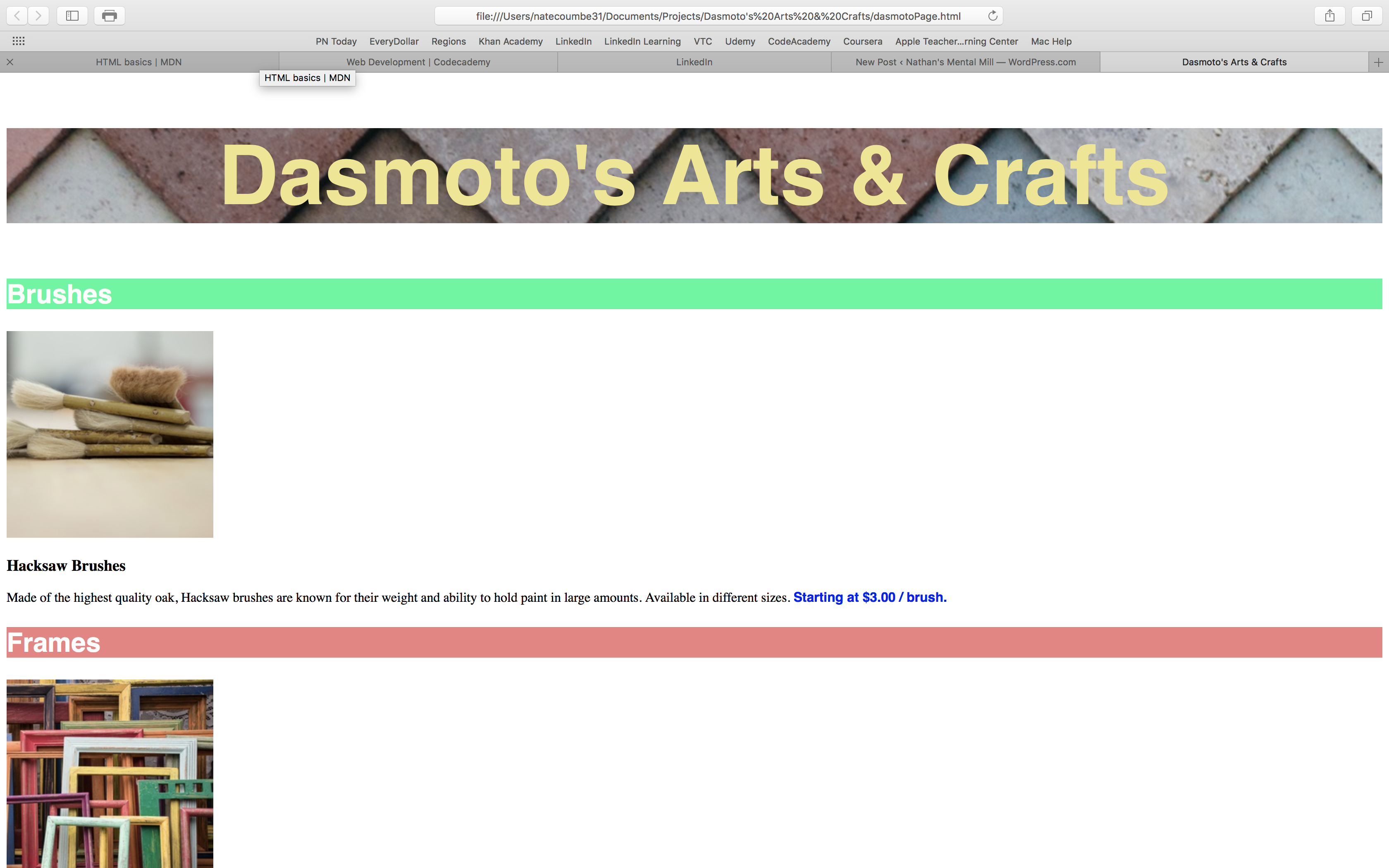
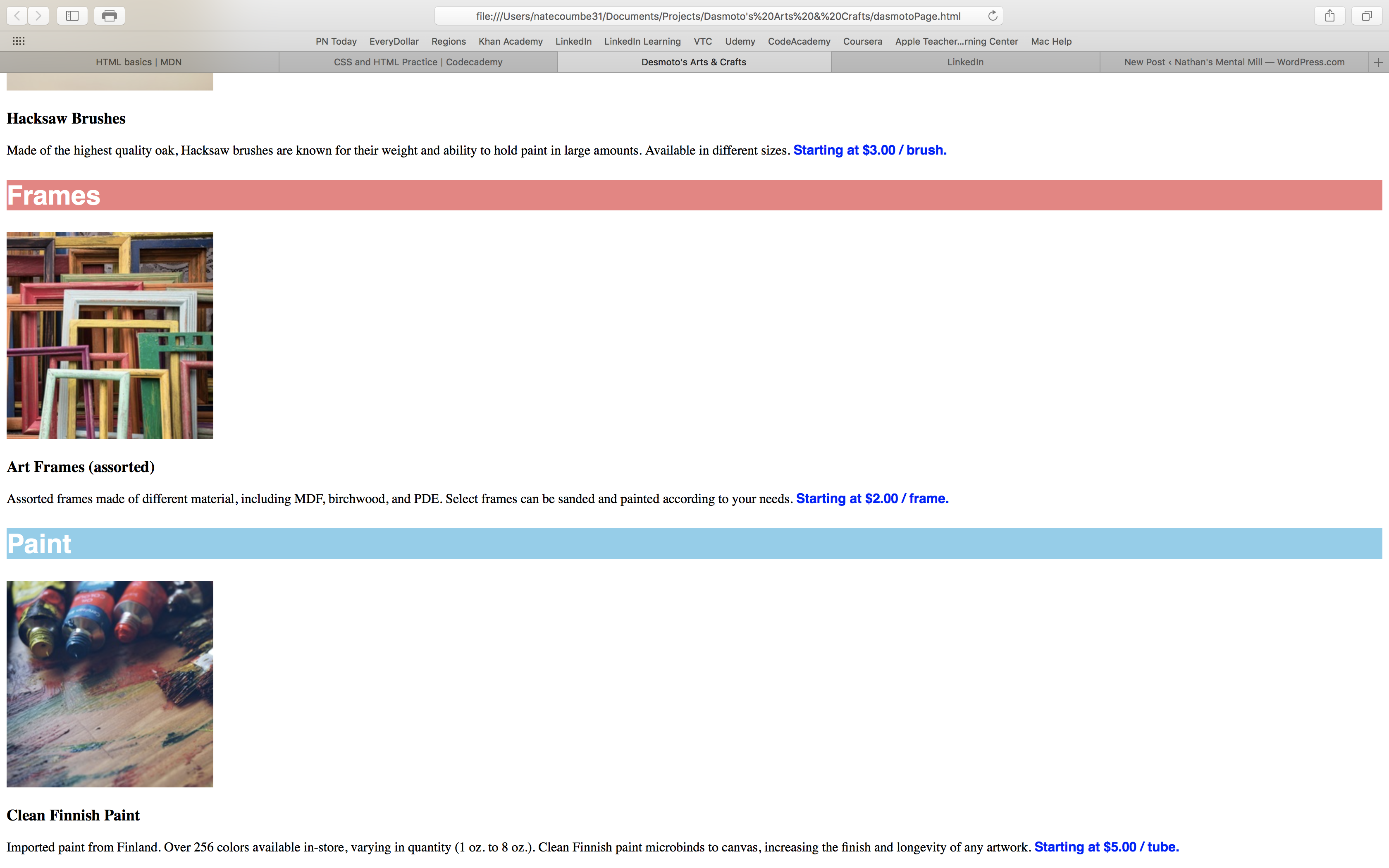
After a while, I decided to explore this area further and see what coding could do in the real world. I came across Codecademy.com thanks to my wife, Theresa; she is a brilliant mathematician and wonderful teacher who has had to learn coding for her master’s degree. I worked through the Code Foundations plan, then picked up the Web development plan. The results are below:

My first little webpage! A HUGE thanks to all of the people working at Codecademy.com for their awesome instructional materials, of which this was a part!

There isn’t much to it, I know, but I am thrilled! I haven’t felt this excited in a long time; I built, from scratch, a simple arts & crafts website today! Using nothing but a “spec sheet” given to me by Codecademy.com, which told me what the desired appearance of the page was to be, and one quick Google search for the answer to a question, I went to work. I programmed my own HTML and CSS code into my new text editor from Atom, linked the files together, inserted pictures, and built a simple, attractive little home page within an hour. I never dreamed I would be doing this, and yet here I am. This has been scratching my creative itch like I never thought possible. 

What begins as a collection of symbols, words, and at times what appear to be indecipherable hieroglyphics comes together in a web browser to show the reader the pictures you see above. It is simply miraculous! Creating physical art by hand is not something at which I have ever been skilled, but by using my newfound computer skills, I think I will be making my own type of art.

I am not finished learning; my skills are still in their infancy, and there are coding languages which I have not yet touched. But the fire which I thought only responded to music has again been lit. Now if you’ll excuse me, I have more work to do!