
Some ideas on hiring (Part 3 of “Same job, different pay”)

(This is part 3 in a rant on hiring, salaries, and job postings. You can read part 1 here and part 2 here.)

If someone with less experience than I, who didn’t attend college like I did, started today at the company I currently work for, in the same role I hold now—do I think she should be paid the same salary as me?

Absolutely, I do.

The work is the work, and if she is doing the same work as me, to spec, she should earn the same amount I do. My years of experience and educational background do not entitle me to a higher salary if we’re doing the same work.

Can she do the work as is expected of her? That’s all that matters.

And for someone looking for a job like mine, if they can learn how to do it well, then why does it matter how they learned?

So if I’m against education as a prerequisite for entry, how should we go about hiring people?

I have two ideas, and the first is simple: more companies should adopt open hiring practices.

There’s a factory in New York that makes the brownies for Ben & Jerry’s Ice Cream. If you want to work at the factory, you put your name on a list.

When a job opens at the factory and you’re next on the list, you get a call asking if you’re still interested in the job. If you are, you report to training, and if you can pass the training, you’re hired.

They don’t care about education, criminal backgrounds, living situation, previous employment, or current skills. If you can learn how to do the job, you get the job at the wage they pay everyone else.

Keep a list of applicants, hire them in order when jobs open up, and train them to do the work.

Why doesn’t every restaurant, coffee shop, and retail establishment in the world already do this?

Simple: They’re scared of making a bad hire. They worry that they’ll hire someone who doesn’t show up to work, arrives late, has a bad attitude, or struggles to perform.

Well… what happens when those same people are hired through traditional (i.e., shitty) job search qualifications?

They get fired.

And if you implement open hiring practices, you spend a lot less money on the recruitment process than you otherwise would, so you lose out on a lot less if you must fire someone.

The absurdity of hiring people through traditional methods of posting job openings, soliciting hundreds of résumés, and holding interviews gives companies a sense of control over who they hire.

But it’s an illusion: either the person will work out or they won’t. And interviewing people with the “right” background on paper isn’t a guarantee that they’re a good hire.


Now, I already know that this idea is so radical for people in knowledge work that it won’t happen anytime soon, even though I firmly believe many companies can hire and train people to perform a significant percentage of the available office jobs out there.

So, what if you’re absolutely certain that you can’t use open hiring due to the nature of the work your company does? Let’s say, because you don’t have the time or resources to train a person to the level you need quickly enough to make it worthwhile.

That’s where my second solution comes into play: contingency hiring.

Time for a story: I was laid off a few months after the COVID-19 pandemic began (from a job I had held for only a few months).

My job search lasted nearly a year (no one was hiring). It was excruciating and terrifying.

But one of the best things that ever happened to me in terms of my career happened near the end: a CEO took a chance on me in an unconventional way.

I’d been studying (and, to some small extent, practicing) marketing for a couple of years before the layoff. I’d spent a lot of time during my unemployment talking to people in the field to get a sense of the jobs available. I wanted to know what skills and knowledge they required so I could make myself more appealing to employers.

A former classmate from university recommended me for her role at a marketing agency when she left to take another job. I went into the interview feeling woefully underqualified, but I knew I had a decent foundation of self-study to build on and could learn the rest of what I needed to know on the job.

The CEO agreed, but was still somewhat reluctant to fully commit to this neophyte in the marketing world (and who wouldn’t be?). So he offered me a deal:

He said that he would let me work for the agency for four weeks in exchange for a single lump-sum payment to see if I could do—or learn how to do—the work required for the role.

After that, we would reconvene, and depending on the results, either he would hire me full-time, or we would part ways with no hard feelings and gratitude for giving the company my time and skill.

It was one of the most generous and thoughtful offers I’d ever gotten.1

If I were starting my own business today, this is exactly how I would hire someone. I’d post a job opening, and then I would select an applicant to work with me on a contingency basis.

Rather than conducting an interview (which only tells me if she’s good at interviewing), I would work on a project with her that I already needed to complete for the business, and I would pay her for her time.

If, at the end of the project, we found it was a good fit (and she still wanted to work for me, because she would also get to try out the business), I would extend a full-time offer to her.

Why doesn’t every company do this all the time? They get work done, can assess whether the person is a good fit for the role (which isn’t always apparent from an interview), and the applicant not only gets paid but also gets to test whether it’s a role they actually want.


I can’t fix the hiring process simply by writing and ranting about it. But I do know that it’s 100% broken right now.

Social media (LinkedIn) has made it worse, not better.

AI and ridiculous job requirements for college degrees and 30 years of experience have reduced the job search to months or years of misery, frustration, and indignity.

But these simple tweaks—from removing degree requirements to contingency hiring—could go a long way to fixing a broken system.


  1. I didn’t end up accepting his offer. I asked him to give me a day or two to think about it and discuss it with my wife, which he happily agreed to.

    Literally, that same day, after I got home from the interview, I got a call from another company I’d had a few interviews with. They had a firm offer for me for full-time remote work with benefits.

    I called him that evening to let him know I was taking the other job offer, which he completely understood. But he also let me know that the offer was still on the table if it didn’t work out. ↩︎

Your job is a trust fund

Think of your job as a trust fund that provides you with a steady income, enabling you to pursue other interests. 

Want to write a book? Your job provides you with the living expenses you need to survive while you’re writing. 

Want to build a small business? Your job salary is the startup funds you need to get started. 

Don’t hold your day job in contempt because you feel like it’s preventing you from doing something great. Reframe it as the steady flow of income it is to help you launch the next thing.

25 free business ideas you can steal

As a follow-up to yesterday’s post, I challenged myself to come up with as many business ideas as I could in 10 minutes that met the criteria I laid out. Here’s what I came up with. Feel free to steal any of them and start your own business.

  1. Offer training content creation services to businesses with a small (or non-existent) L&D department.
  2. Become a health coach and offer sessions in-person or online.
  3. Lead in-home personal training sessions for clients (a concierge training offering). As a bonus, help them set up a minimum viable home gym to meet their health goals.
  4. If you’re a clear and persuasive writer, offer your writing services to small businesses or the marketing departments of larger organizations.
  5. Help other people land new jobs, negotiate raises, or change careers by offering your services as a career coach. This one, you could offer as a no-fee upfront service and take a small percentage of their new salary as payment (like a talent agent).
  6. Become a health and wellness consultant for large companies and design wellness coaching packages for their employees as part of their HR offerings.
  7. Start a green lawn care service, using only electric tools to keep people’s yards looking nice while lowering the carbon footprint of that work (I’m sure you’ve seen all the e-lawn tools if you have a Costco membership).
  8. Become a piano tuner. You can learn how for less than $1,500 bucks, and you’ll have almost no competition as it’s a dying trade.
  9. Become a drum tech for churches. Have you ever seen how beat up and terrible-sounding those drum sets are?
  10. Here’s an easy one: teach music lessons. Specialize in helping students prepare for, and win, auditions. There’s a lot of scholarship money to be had for musicians in college (and the military).
  11. Become a tutor in whatever field you know best. Take the summers off or offer “preparatory” tutoring when school is out.
  12. Become a writing coach for K-12 students. This may be the most important skill students will learn today as AI proliferates and the skill that makes us human is supplanted by garbage.
  13. Create and sell a really helpful e-book that teaches someone how to do a very specific task or skill.
  14. Create an online course on a topic or skill you know well. You can put it up on an e-learning site like Teachable, or you can offer it as an “email correspondence” course like Ryan Holiday does with his excellent Stoic challenges.
  15. Shuttle seniors to doctor’s appointments. You could charge them a low price by the mile or see if senior care homes might pay you for the service.
  16. Start a “walking school bus” for the children in your neighborhood. Children need more movement in their days, and parents might be willing to have a responsible adult or two get their kids to school in the morning while also working off some of that kiddo energy.
  17. Here’s one I’ve been thinking about: create a membership group to organize people around citizenship and political activism.
  18. Offer pet grooming services in your town.
  19. Along the same lines, wash and detail cars.
  20. Here’s another: buy a sponge, bucket, squeegee, and cleaning solution, then sell your services as a window washer to businesses and restaurants in your city.
  21. This one is big where I live: powerwash houses and driveways.
  22. One more handyman idea: paint houses.
  23. Know how to promote the work of others? Become a marketing consultant for small businesses. Trust me, they all need help getting the word out.
  24. Are you a decent cook? Deliver home-cooked meals to customers who don’t have time to cook for themselves every night.
  25. Speaking of cooking, why not offer healthy cooking classes to small groups looking to improve their health and that of their families?

10 minutes, 25 business ideas. I don’t know that I could pull all of them off, but some of them seem promising.

The hard part is picking one and being brave enough to face rejection. Regardless of what you choose, you’ll get a lot of no’s.

But if you’re starting your own thing, that comes with the territory. Don’t let it deter you!

You’re fired. Now what?

Here’s a question I’ve been noodling on:

What if you got fired today? What would you do?

But wait, it gets worse…

Not only were you fired, but your industry collapsed and no longer exists. And to make matters worse, all the specialized skills you built up in that industry are now irrelevant (hypothetically, an AI could do them all now and for free).

And, you can’t hide by going back to school for another degree.

You have to start something of your own—you have no choice.

What would you start? What would you build? What problem would you solve and for whom?

Take a 20-minute walk and think on this today.

The secret approach to bootstrapping

You can be an entrepreneur: someone who builds something big, hires lots of people to do the work, and gets a ton of start-up money from investors.

Or you can be a freelancer: a skilled craftsperson who does high-quality work directly for clients.

But there’s a third option: bootstrapping.

To bootstrap a business is to find a group of customers with a problem who are so willing for you to solve it that they will pay you up front to build the business that will solve it for them.

And the secret to bootstrapping that many up-and-coming business people don’t know is that you don’t necessarily have to have the solution to the problem.

You simply have to see the problem, empathize with the people who have it, and trust yourself to know that you can and will figure out a solution that works.1

Why does this approach matter? Because smart, solution-oriented people often get so bogged down in the details of how to solve a problem that they never do the hard work of finding customers with a problem that needs solving.

So, find people who need help first, then figure out how to solve the issue.

(H/t to Seth Godin and the folks over at Purple Space)


  1. Don’t lie to people and tell them you can solve their problem, then take their money and run. That’s not bootstrapping – that’s a con. ↩︎

What’s Your “Why”?

Some people see this and think I mean “What gets you out of bed in the morning?”

They’d be wrong. Plenty of us have very little that gets us out of bed in the morning.

Maybe we have jobs we hate. Or tough relationships that don’t fulfill us. Or life situations we can’t seem to escape.

If you don’t have that “something” yet, think about it this way:

“What would make you WANT to get out of bed in the morning?”

My “why” has everything to do with my own personal freedom.

  • The freedom to rule my daily schedule
  • The freedom to control my income (however high or low I want it)
  • Freedom from debt
  • Giving my wife freedom to pursue whatever work, career, project, or lifestyle she desires

But I also feel I have a purpose that involves helping other people find freedom, happiness, and joy in their lives. And I genuinely believe the best way to do that is to help them create and run successful businesses or freelance practices.

Why? Because it’s the best way for them to have the freedom to live life on their terms. To do what they love and help the people they want to help. To make the difference they seek to make in the world. 

And I feel like I can achieve that purpose as a copywriter and marketer. That work helps people serve their customers, grow their businesses, and achieve the kind of freedom I’m talking about.

What’s your “why”? Tell me in the comments below.

Don’t forget to subscribe!

Speak Your Dreams Into Reality Today

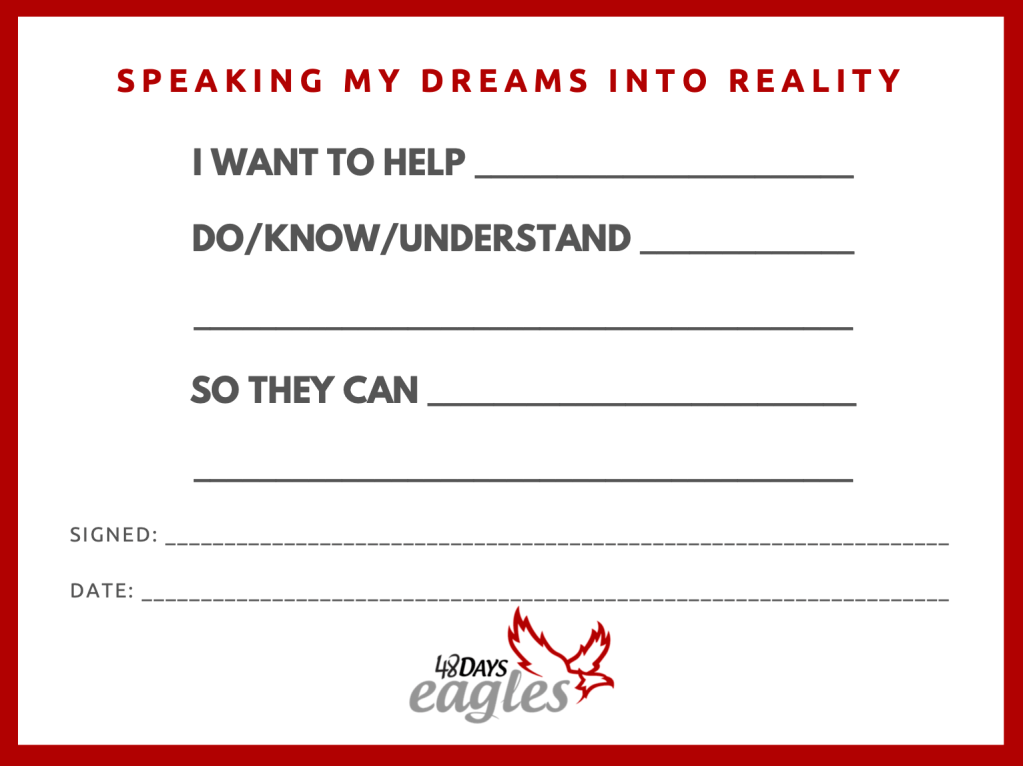
I got an email from the 48 Days Eagles (affiliate link) asking what my main business goal is for 2021. I thought I’d share it with you as well. So here goes:

“I want to help small businesses and entrepreneurs write better copy for their websites and marketing efforts so they can increase the sales of their products and services and grow their businesses.”

Why do I want to do this? Because if I can help others succeed in their business endeavors, they’ll be able to live out their hopes and dreams.

Now it’s your turn. Use this awesome layout to create your own business goal.

What’s your dream? Have you spoken it into reality yet?

And most importantly, can I help you with your dream or business?

Let me know in the comments!

Are You Buying What You’re Selling?

Zig Ziglar, the great motivator and sales trainer, found a mantra in the word “enthusiasm.” To him, the last four letters stood for “I am sold myself.”

Zig was a master salesman. He knew if you didn’t believe in what you were selling, that lack of enthusiasm would come across to the prospect.

But what about when you’re not selling a product? What if the thing you’re selling is yourself, and your customer is a potential employer?

This same idea holds true in the job hunt. If you’re trying to persuade an employer to hire you, you have to believe in the product. 

If you’re a freelancer trying to convince a company to use your freelance services, you’re selling a product you must believe in. 

If you’re not enthusiastic about what you have to offer, they won’t be either.

If you don’t believe in yourself, they won’t want to buy your product. And make no mistake: you are the product. 

Grow your enthusiasm. Know what you have to offer; understand what you do best; determine how you can best serve others. And believe that it will benefit another person.

Sell yourself on you.

“You can have everything in life you want, if you just help enough people get what they want.”—Zig Ziglar

Get a daily dose of inspiration. Subscribe below!

Should You Get Paid Every Time You Send an Email?

Wouldn’t it be great if you got paid every time you sent an email? I dunno about you, but I’d love to live in that world. 

I send hundreds each week. If I earned the price of a postage stamp on each one, I could make a pretty easy living.

Am I Devaluing Myself?

I’m an up-and-coming copywriter. To make a living, I spend several hours each week reaching out to potential clients, offering them my services as a writer and marketer. I do this because I’m a salesperson. And if you’re trying to make a living in a similar way, so are you. 

I recently came across a Twitter post telling me that I was devaluing my work by selling myself. To sum it up, the writer said I should either:

  1. Have clients beating a path to my door willing to pay me, OR 
  2. I should get paid every time I send an email, proposal, or pitch to a potential client before any work is done. 

I understand the author’s point. My time is valuable, and it stinks when I feel I’ve “wasted” my time pitching to someone who doesn’t buy. But I 100% disagree.

Sales Professionals Don’t Get Paid to Prospect

How do professional salespeople get paid? They sell a product and get paid a commission. They don’t get paid when they prospect or send proposals to customers. The only way they make money is by closing a sale. 

I sell a service, and I only get paid if I provide that service. And that service is not pitching ideas. If it was, I’d be a billionaire right now because I have a few thousand ideas each day, and most of them are awful.

Selling Your Service Is Like Applying for a Job

Each time I pitch a client, I’m putting in a job application. Think about all the jobs you’ve applied for in your adult life. What if you got paid for every job application you ever completed? Wouldn’t that make for an awesome career?

Often we don’t have a lot of experience for the jobs we are applying for, especially if we are new to the workforce or a field. When asked what a beginner should do, the Tweeter said, “get paid to pitch.”

We’ve all gotten those phone calls from sleazy salespeople. Does this sound familiar?

“I’ve got this great new system that will keep you from paying any taxes this year. But I can only tell you what it is if you sign a non-disclosure agreement and pay me $2,000 upfront.”

You know you’re losing money and going to jail if you get in bed with that guy. You don’t want to have anything to do with an idea you can only hear after signing an NDA and paying upfront.

How to ACTUALLY Get Paid to Pitch 

There are two parts to this tactic:

  1. Charge higher prices to compensate for the inevitable rejections you’ll get.
  2. Overdeliver to your clients and customers so it’s worth paying you higher prices!

One of my favorite phrases comes from the marketing genius Seth Godin:

“You’ll pay a lot, but you’ll get more than you paid for.”

That is the only way this guy’s Tweet works. 

Selling Is Tough

I get it. Creating proposals, pitching to customers, and facing possible rejection—it really stinks. It takes a lot of time and hard work. It’s frustrating. 

But let me be clear: THAT DOESN’T MEAN ANYONE OWES YOU ANYTHING!

The world doesn’t work that way. We are all in sales, and much of that involves reaching out to others. It means facing the very real possibility of rejection coupled with no monetary gain. 

So go ahead and pitch. And if you want to get paid for that, build the cost into your pricing structure. 

But make sure you overdeliver on that promise to your customer. 

Feeling inspired? Like, comment, and share so others can benefit! And subscribe below!

Why is freelancing so terrifying?

We human beings like security – it encompasses the first two levels of Maslow’s “Hierarchy of Needs.” It’s fundamental.

To get that feeling of security, we work hourly wage jobs; we try to get hired at famous companies for regular, unchanging salaries with hopes for a 3% raise every year (which doesn’t outpace inflation).

Freelancing – being “a knight without a king” as Seth Godin likes to say – seemingly goes against that feeling of security. There is no guarantee; you don’t get paid simply for showing up somewhere for a specified amount of time.

But it’s better.

The illusion

There is no security in hourly rates; there is no security in working for a famous company. As the COVID-19 pandemic has shown us, the moment something bad or unexpected happens, your security is at risk.

The security is an illusion. No longer can we work at the same company for 20 years, slowly moving up a corporate ladder, waiting for that day when we call it quits and HR hands us a gold watch and the envelope containing our pension information.

There is no security anymore. There is only you.

“Security lies in our ability to produce.”

–General Douglas MacArthur

Make your own security

What do you already know or do well?

Can you write? Create websites? Draw and paint? Build things with your hands? Sell?

Maybe you’re a whiz at smoothing customers’ ruffled feathers. Perhaps you have a knack for motivating and encouraging other people.

There is something you already do, or something you already know about, that other people are willing to pay for. You simply have to muster the courage to offer it to them.

Each of us must explicitly state to ourselves what we know how to do and do well. That knowledge and the willingness to execute on it are the only things that give us any sort of real security in the workplace.

If you can find someone and offer them something they are willing to pay for, and do that over and over again, you are a freelancer. You have no boss, no one telling you what to do next, but also no one telling you, “I’m sorry but we have to let you go.”

You have no guarantee of income – in either direction! You can make as little or as much as you want, as long as people are willing to pay for it. But I’ll bet you got stopped on the phrase “no guarantee” or “as little…as you want” while glossing over the rest of it.

As a freelancer, you determine your job, the work you do, your hours, the people you serve. Perhaps it’s not the loss of security you fear: it’s the fear of complete and total responsibility for your success or failure.

We aren’t used to that, but it’s the only way we’ll survive.

Secure your own future today. Don’t wait for someone else to do it for you.

Join 904 other subscribers