
On the frivolousness of educational requirements in job postings (Part 2 of “Same job, different pay”)

I anticipated some of the pushback I’d receive from yesterday’s post, and I wanted to address it here.

Some might argue that certain jobs require graduate or other advanced education to obtain them. And I agree some should: I’d much rather have a surgeon who went to medical school operate on me than one who learned from YouTube.

And we’re all better off with engineers who went to school for the subject than relying on amateurs to build our bridges.

But doctors, engineers, nurses, and other “professional” roles all require specialized education simply to learn and carry out the basics of their jobs.1

This isn’t the reality for many knowledge or service sector jobs, which comprise a significant portion of our modern workforce. However, you might point out that many of these jobs require a college or even graduate education, as indicated in their job postings. Isn’t that at odds with what I’m saying?

No—because these jobs don’t actually need you to have a degree. It’s a tool to keep you from applying for them.

Hiring managers simply use that to make their lives easier and weed out 90% of otherwise qualified applicants without ever having to look at their applications. It reduces their workload.

For the vast majority of us working in the knowledge sector, a college education neither prepares us for specific jobs, such as those professional jobs listed previously, nor does it actually equip us with most of the skills required for knowledge work. We learn on the job and through self-education.

You don’t need a master’s degree in computer science from MIT to work as a software developer. You simply need to know how to program (and be damn good at it). You can learn on Codecademy or attend a bootcamp, gaining enough knowledge to get a job. You’ll have to learn the specifics of the role when you start working, anyway.

I work in learning and development, so I’m somewhat biased in my thinking on this. The shift in L&D now is toward skills-based training and qualifications. Essentially, we’re trying to answer this question:

Leaving aside formal education, what specific skills does a person either need to possess—or need to learn—to be qualified for this specific job?

You don’t consider their past college education (or lack thereof); you only consider what they’re capable of. This approach doesn’t harm people who attend school for specific fields because, as long as they’re qualified by their skills, they can still get the job. However, it also doesn’t prevent those who didn’t attend a formal school, but who do possess the necessary skills, from securing work for which they’re qualified.

Again, why do we need someone who is applying for a job in marketing or customer success to have a college degree? If they have the skill, or can learn it outside of a university, shouldn’t that be enough?

For most knowledge work jobs, it’s simply ridiculous to require a college degree (and I have two of them, neither of which I’ve ever used in my knowledge work jobs).

So I suppose I’m arguing two things:

  1. Eliminate degree requirements for most jobs.
  2. Pay the same wages (and good ones) for the same work, regardless of educational background or years of experience.2

Only the quality and the results of the work should matter. Not how much education someone has.

And for God’s sake, not based on how good someone is at negotiating. Not everyone is comfortable negotiating salaries or demanding raises, especially when they think their boss will just fire them and hire someone cheaper if they try.

We are obsessed with meritocracy in this country, often to our detriment. And we obsess over it in such a way that it harms people who may be just as capable at a job as someone else, but who don’t have the courage or the skills to negotiate with someone in a position of power above them.


Does this mean that I think another L&D specialist at my company who hypothetically started today should make the same amount of money I make after nearly four years of raises?

Absolutely, I believe that. But I’ll save that rant for Part 3 tomorrow.


  1. I have a holdup about including lawyers in this list for one very specific reason: Until sometime in the 20th century, you did not have to go to law school to practice law. You simply needed to pass the bar exam for the state(s) in which you intended to practice.

    Walter Gordon, a native of my home state of Mississippi (who was one of the main characters in Band of Brothers), passed the bar exam after the war while still in law school and was allowed to practice even without his diploma.

    At some point, law schools realized they could make a lot more money if they collaborated with the American Bar Association to require would-be lawyers to attend their schools, thereby creating a somewhat arbitrary barrier to entry into the field.

    Are lawyers who attend law school objectively better off? I don’t know, nor do I feel qualified to say. However, it does seem similar to what we encounter in knowledge work job searches.

    Are all hiring managers part of some cabal to make it difficult to get jobs? No. It’s simply easier for them and also just “how things are done around here.” The status quo is the status quo for a reason. ↩︎
  2. What if someone in the same role as someone else is objectively better at the job than the other person? Personally, I believe this issue can be easily resolved with bonuses or commissions.

    I don’t mean paying people crappy wages and hoping that they’ll make it up in bonuses (looking at you, restaurants paying servers $2.13 an hour). I mean that if two people are doing the same job, but one of them has been outstanding for just one quarter or year or whatever, pay that person some sort of bonus to show your appreciation.

    But don’t punish the other person who is doing good work—to spec, doing what needs to be done and is asked of her—by paying her less for arbitrary reasons. ↩︎
Same job, different pay

I saw a job posting’s salary description the other day that gave me pause.

The salary was dependent on three things:

  1. The number of courses taught (yeah, that makes sense. More work = more pay)
  2. The type of courses taught (More advanced courses = more difficulty = more pay. Also makes sense)
  3. The educational level held by the instructor…

That third item is the one that gave me pause. Here’s why:

If two people are doing the exact same type of work at the exact same level of quality, why should one with a higher-level degree be paid more than the person with a lower-level degree?

You might say, “Well, they went to school longer. They have more education. They’re more qualified.”

So what? Does that degree automatically mean that the person is more skilled at the job? No, not at all. 1

More education does not automatically confer a higher level of qualification or suitability for a job. The skill of the person, and nothing else, does that.

If the person with the higher degree actually delivers more or better work than the other, then I understand receiving more pay. They are arguably more valuable. But that has nothing to do with the degree and everything to do with the output of the worker.

Additional education might enable that higher quality, but then again, it might not. There are countless MBA graduates out there who are suitable for little more than responding to email or working in middle management. They would flounder trying to run a small business.

Perhaps changing the nature of the work in question would make this make more sense:

Let’s say Person A has a master’s degree in burger-flipping, and Person B has a bachelor’s degree in burger-flipping. But both workers flip the same number of burgers each hour at the same level of quality expected of anyone on the line.

Should Person A be paid more money simply because they got a master’s degree in the subject? I would argue no, because the quality of the output and the nature of the work are the same.

You might think I’m stretching this a bit, but I’m not. It’s the work that matters, the output, the results.

A person’s demonstrable skill determines their qualifications, not a piece of paper. That paper is often a false proxy for genuine qualification, a stand-in for real value.

But we buy into it because we’ve been trained to believe that more is better, higher is better. We must stop this.

We have to start measuring the proper targets and rewarding the right things appropriately.


  1. I’m aware that teachers are paid at different salary levels based on their educational levels (e.g., a master’s degree earns more income than a bachelor’s degree. However, just because that’s the case doesn’t make it right.

    Teachers should not be paid based on how much schooling they received, but on how good they are at schooling others. If someone with a master’s degree is educating students in a way that they outscore everyone else, then I can understand paying that teacher more (and she should share her secrets with everyone else so they can level up their students and make more money too!).

    Also, teachers should simply be paid substantially more than they currently earn, but that’s a topic for another day… ↩︎

Self-education is great. Self-education is limiting.

When I was 18, I auditioned to become a jazz studies major in the percussion department at the University of Southern Mississippi.

I’d been a musician for most of my life, taking my first lessons at the age of seven and attending one of the state’s best arts schools for a significant portion of my education.

But… I’d studied violin, piano, and voice. I was a completely self-taught drummer. I’d learned everything I knew from playing along to my favorite CDs and watching videos of my favorite drummers, trying to emulate them.

The audition did not go well. Dr. Wooton, the head of the department, asked me to play a ratamacue; I had no idea what that was.1

He asked me to play a G Major scale on his marimba. I remember exactly what I said: “Is it laid out like a piano keyboard?” He chuckled. “Yes, just like a piano.” I picked up a marimba mallet (I’d never held one) and slowly, painfully, pecked out a G Major scale with one hand.

Finally, he asked to see my drum set skills. Dread gave way to excitement… Until he asked me to play a Songo. I had no clue what that was. He asked for a Samba, a 2nd-Line… I just shook my head.

Finally, he asked for a bossa nova. “THAT ONE I KNOW!” I shouted. And I proceeded to demolish his drums like a metalhead on PCP playing the worst bossa nova ever attempted by a drummer.

“NO!” He said. “It’s a light and airy dance music. You play it like this.” And he sat behind the drums and tapped out something a Brazilian native would have happily danced along with.

Dr. Wooton, eventually and probably grudgingly, told me that he would take me into his studio, but that I desperately needed lessons. I decided to delay my entrance to USM by a year while I studied snare drum, drum set, and xylophone with a local private teacher (Jeff Mills, drummer for the blues musician you see in “O, Brother Where Art Thou”).

My skills under Jeff’s tutelage, buoyed by my preexisting musical knowledge, grew exponentially in just a year. I was able to audition again and even pass an audition to join the lower-level jazz band at the university, where I eventually earned a degree.

Why does this story come up now?

Well, I realized a couple of days ago that I’m once again back in the exact same place, but this time in my corporate career.

I work in learning and development for a moderate-sized corporation. And I genuinely feel like I have no idea what I’m doing.

There’s even a term for people like me in the industry: “Accidental trainer.” It’s someone who was really good at teaching, who moved into the corporate world and began implementing those same skills as a trainer… With no formal training.

L&D is its own beast, its own field with tons of nuance. And you need skills ranging from business strategy and project management to adult learning theory, instructional design, and cognitive psychology… Not to mention a penchant for being able to cajole, persuade, and sell to people above you.

Everything I’ve learned has been through on-the-job self-education to accomplish a project or do a task assigned to me. However, I’ve reached a point, much like in my audition, where the cracks in my education (or lack thereof) are starting to show.

It’s getting harder and harder to do my work well because everything is more complex than ever before. More is expected of me, and I worry I’m not up to it where I am today.

So the solution is education: actual education by people who know what they’re doing… Not random readings and YouTube videos. I need a new Jeff Mills for my learning and development career (and don’t worry—I have found something.)

At some point, I think we all discover that self-education and learning on the job aren’t enough to accomplish what’s being asked of us. We need a teacher, a mentor, a master to show us the way. Something, or someone, that knows the ins and outs of the field of study and can help us master it.

If you’ve reached this point, I hope you’ll try to find someone like that to help you level up.


  1. I later found out it was one of his favorite rudiments (sort of a “word” in the language of drumming), and it quickly became mine. If you want to see a master using them, check out this video. ↩︎

The teaching experience got worse after COVID

When the COVID-19 pandemic erupted, it sent all the children home for an extended period of virtual schooling. This showed parents what it was like to deal with lots of kids all day long.

Not just “deal” with them either, but also hopefully have them learn something.

Multiply parents’ experience with their handful of children by 10, and that was what the average schoolteacher dealt with on a daily basis for years before 2020.

What fascinates me about this, however, is that the experience didn’t lead to an outpouring of support. It didn’t lead to calls for higher pay, better working conditions, and more classroom assistance for teachers.

Instead, COVID-19 made schooling much, much worse for teachers as, inexplicably, it led to a focus on culture war issues and concerns over what was being taught in the classrooms.

Philosophy, History, and Business – You Need All Three

Why is it considered strange that my bookshelves are full of history, philosophy, and business texts? Furthermore, why is there a cultural push to make people choose between those seemingly disparate subjects?

If you want to study business, you must go all in on it. There is no room for history or philosophy. Or so the prevailing wisdom says.

But that’s ridiculous! Let’s put aside the fact that some of history’s most outstanding leaders were business people as well as great leaders, philosophers, and students of history.

You cannot be a well-rounded citizen without these three subjects combined. One helps you understand yourself and what’s right; another enables you to understand the world and why things are how they are; and the third teaches you how to serve others while making a living yourself.

When combined, all three do a bit of each and compound the effects.

We need more polymaths, Renaissance Men (and women!), and multipotentialites, not fewer. Stop stressing over “picking,” and follow your interests wherever they lead.

Remember your founder’s roots

It amazes me how many companies still require their prospective employees to hold college degrees before they’ll even CONSIDER talking to them about work…

Especially because so many companies are founded by college dropouts, straight-D students, and vocal critics of modern education.

With so much information and easily accessible methods to build the skills necessary to do competitive work, college is quickly becoming a handicap more than anything else.

It’s four years spent in a classroom accumulating information rather than developing skills, building projects, and doing actual work. (And yes, I’m a college graduate who’s criticizing EXACTLY what I went through).

Never will you be required to sit through hours of lecture and regurgitate information on tests in your working career. But that’s what I’d estimate 90% of college is.

How does that help a company looking to hire for a role? Obviously it doesn’t.

I’d like to see more companies embrace what Apple, Google, Amazon, and other big tech companies are doing:

Value competence and proven skills over accreditation and papers.

Show you can do the work and forget what your “education” was all about.

Hopefully more companies will remember their founders’ roots and get out of this antiquated industrial mindset.

Is This Book Better Than an MBA?

Colleges don’t teach you how to succeed in the business world. Business schools teach theory, case studies, and lots of accounting and finance. But what they don’t teach you is how to run a profitable, cash-positive business. 

Sadly, they don’t even teach you how to work in a business. At least not in a way that makes money for your employer.

That’s a problem. Why? Because that’s what business owners, managers, and leaders want: value-driven professionals who generate cash.

Here’s the Solution

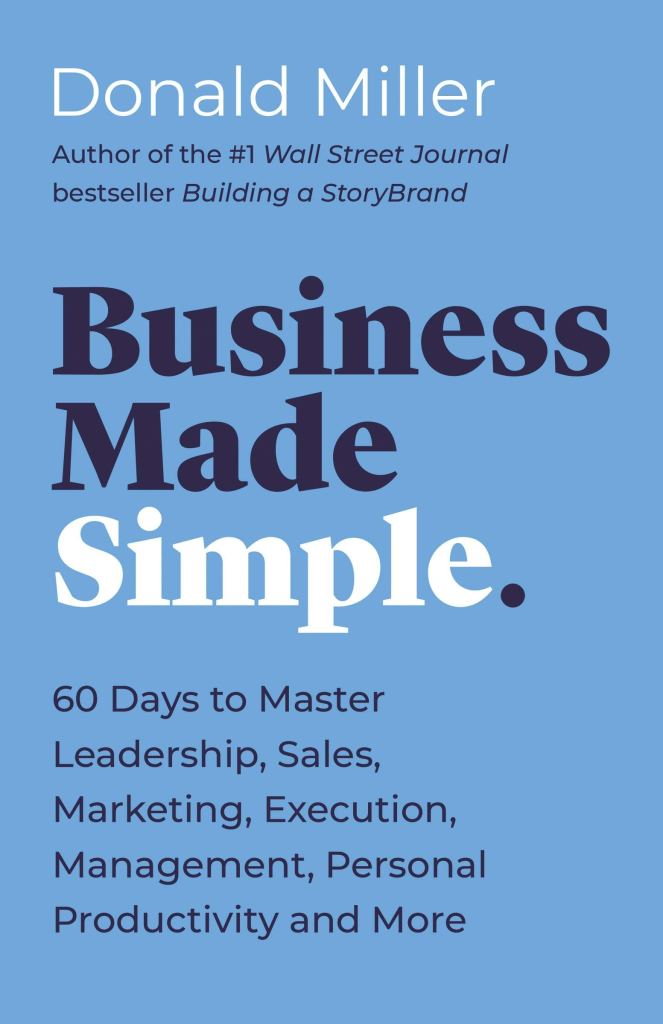
Donald Miller has done it. He’s created a book and podcast that teach you exactly what you need to know to run a profitable business. If you haven’t yet checked out Business Made Simple, do it today!

Buy the book. For just $20 bucks, you can get a better business education in 60 days than you would spending $50,000 on an MBA. And listen to the podcast—it’s absolutely free!

Learn practical skills you need to succeed like:

  • How to write a mission statement that drives and inspires you and your team.
  • How to create a clear message that drives customers to your products and services.
  • Sales processes that actually work.
  • Execution strategies that grow your business exponentially.

What If You’re Not A Business Owner?

Maybe you’re not an entrepreneur. Maybe you just want to have a successful career as a team member or employee. That’s okay!

Business Made Simple is for anyone who’s job it is to generate cash for a business. And guess what? That’s you! Whether you’re a salesperson, marketer, customer service agent, or a janitor, this book will help you succeed at work. 

If you’re looking to stand out in your job search, get promoted, or just contribute more in your work, you need check this stuff out. Get a business education that actually pays off.

Get a copy today!

Get daily insights on business, personal growth, and creativity.

Subscribe today.

How to Make Revolutionary Change in Your Personal Life and Career

Dr. Covey taught me perhaps the most important and fundamental life lesson of all. It’s the idea of paradigms and the See-Do-Get formula.

What Are Paradigms?

Paradigms are our ways of seeing the world. As Dr. Covey describes it, they are maps of the territory we are navigating. As we know, maps are a representation of the world but not the world itself. These “maps” affect every aspect of our daily lives.

See-Do-Get

Our paradigms put us into a cycle known as “See-Do-Get”. How we see something (our paradigm) affects our behavior (what we do). Our behavior affects the results we get. These results then reinforce our viewpoint. They become a never-ending cycle that can only be short-circuited by changing how we “see”. We must examine the map.

A Story to Illustrate the Point

I once knew a teacher whose students approached him about putting on a short play for the school. They saw this as a way to put the English literature they were studying into a fun and creative context. But this teacher saw his students as an uncreative bunch of hooligans with no talent. He did not believe them capable of staging anything worthwhile.

Grudgingly, he let the students “try” to put something together. Because of his mindset, he failed to encourage them, coach them, or help them in any way. His only offering was scathing criticism because he saw no possible positive outcome. The students became increasingly frustrated and unhappy with their efforts. They began to believe their teacher correct in his views and quit the project after a few weeks. Their “failure” further reinforced the teacher’s own paradigm.

I felt devastated when I found out about the situation from the students. Why did it happen that way? Because he saw them as uncreative, incapable, and without talent, he treated them as such. He failed to help or encourage his students and did nothing but criticize and condemn. This behavior led to the results he expected all along.

The Root of Any Problem

How we see a problem (or person, political party, or random happenstance) is a problem itself. It affects our behavior and the results we get, leading to a self-fulfilling prophecy.

Design thinking teaches us to reframe problems in ways that allow us to take positive action on them. Only by changing how we see something can we get to the root of the issue. If you want to make positive change in any area of your life, first examine how you see the problem.

What would have happened had this teacher been aware of the way he saw his students? What if he had taken a step back and seen them as young, curious, and full of potential? Maybe he would have treated them as budding thespians and offered encouragement. This change in behavior might have led to a fun, engaging, and successful student project. And who knows? It might have had lasting effects on all the students, even the ones who came to watch.

Instead, his negative mindset destroyed all hope of having any success at all.

I’ll leave the final word on this subject to Dr. Covey himself:

“If you want to make minor improvements, change your behavior. But if you want to make quantum improvements, change your paradigm.”

—Dr. Stephen R. Covey

What more advice for living an effective life? Subscribe below.

Empathic Learning

The 5th habit Dr. Covey writes about in The 7 Habits of Highly Effective People is all about empathic listening: “seek first to understand, then to be understood.” Empathic listening is putting aside our own narratives, judgements, assumptions, and listening from the other person’s point of reference. When we do this, we become students learning something new from another point of view.

For some reason this morning, I was thinking about my time in college studying my favorite subjects in history, subjects I had been studying since I was a small child. Sad to say, I remember listening to lectures and discussions with my professors from my own frame of reference: “I already learned all about that. Let me tell you what I already know about this subject to impress you.” 

I was the guy who would ask “deep, insightful questions,” when in reality, I was simply asking questions that showed my knowledge of the subject.

How vain, immature, and dumb I was! Had I only been listening––not from my own frame of reference, from the mindset of what I already knew––and instead adopted that wide-eyed curiosity of a child, I could have learned and retained so much more than I did. I would have been able to see the same ideas and subjects in a new light or with new perspectives. 

Instead, I listened to validate what I already thought I knew.

Empathic listening doesn’t just apply to difficult or emotional conversations with relationships in your life. It also must be employed in any learning environment to get as much out of it as possible.

Creating Football Fans

There are two components to learning a subject:

  1. You must want to learn whatever the subject is.
  2. You must constantly engage with the subject until it becomes a part of you.

This is how die-hard football fans (and players) are made. We don’t give them a textbook and test them on all the information it contains – we create an environment where a person wants to learn about the sport, and then we expose them over and over again until it becomes a part of his or her identity.

How do we replicate this in a classroom? How can we create people, children and adults, obsessed with learning something other than sports?

We’ve gotten really good at creating a culture obsessed with football; we’ve done a poor job of creating a culture obsessed with history, literature, or science.