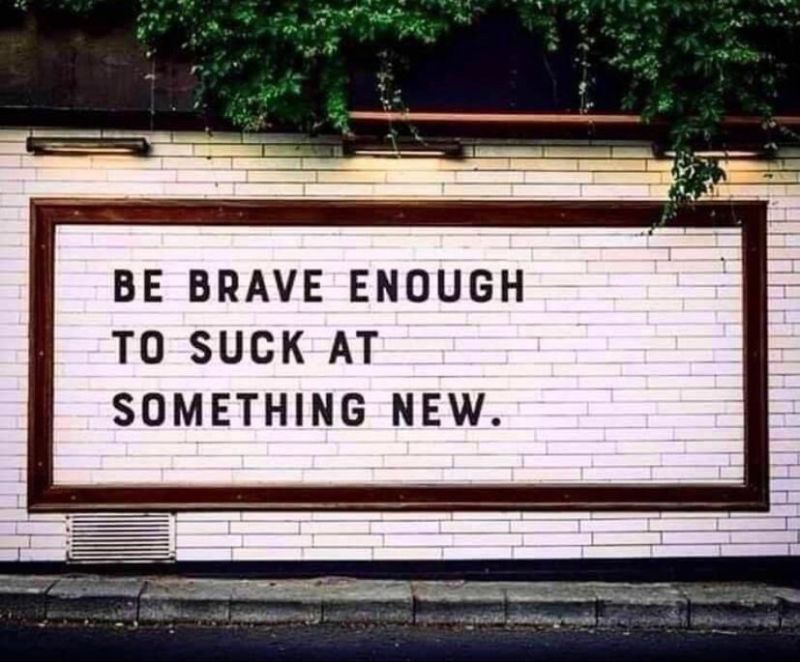
If it’s worth doing, it’s worth doing poorly

You’ve been told your entire life you should do things well.

Perfectly.

Like an expert.

And if you can’t do it well, you might as well not even bother to do it at all.

That’s wrong. You can’t instantly be great at doing ANYTHING.

The only place to start is at the level we currently are.

The always relevant, and sometimes irreverent, Zig Ziglar said one of my favorite quotes of all time:

“If it’s worth doing, it’s worth doing poorly.”

What did he mean?

Simple: anything worthwhile requires that we start as a beginner.

Golfing, tennis, writing, painting, jazz improv… It doesn’t matter what it is.

If it’s worth pursuing, you owe it to yourself to be bad at it. And then get better at it every single day.

He uses the example of someone learning to play golf: if everyone could join the PGA Masters tour after a couple of lessons with the local pro, there’s no reason to do it.

Give yourself time to do things badly…

On the way to doing them well.

Subscribe

Choices

Almost everything that’s ever happened in your life has been the result of a choice.

A lot of it has happened because of your own personal choices.

But even those things that have happened to you completely and totally outside of your control have usually resulted from a choice…

Someone else’s choice in that case. And it created circumstances, good or bad, that affected you.

Interesting, and quite sad, to think about.

Subscribe

What single superpower would you want?

As you can tell (because I keep quoting it), I’ve been reading and re-reading Seth Godin’s newest book.

Here’s the latest one that’s had my brain buzzing:

“The problem with the model of the well-rounded superhero [talking about Superman being able to solve any problem] is that there are very few well-rounded superheroes. It’s much more likely that we’ll succeed by overinvesting [emphasis added] in just one or two skills.

He continues by giving us a challenge:

“The challenge, then, is to have one superpower. All out of balance to the rest of your being. If, over time, you develop a few more, that’s fine… [But] begin with one.”

My first thought was: “I don’t know what superpower I want to invest all my time in.”

And then it came unbidden: writing.

So what about you? If you could only choose one, what superpower would you want to invest in?

Subscribe

What are trophies for?

Why do we award medals and trophies to athletes who compete at Olympian levels?

Why do we build statues to great leaders and war heroes?

Is it to immortalize their achievements, or something greater than that?

The great orator Demosthenes said:

“Reflect, then, that your ancestors set up those trophies, not that you may gaze at them in wonder, but that you may also imitate the virtues of the men who set them up.”

They don’t exist for us to stare with admiration. The point isn’t so our children will say “gee, whiz, Mom, that’s really cool what you did.”

These monuments to great achievement exist to move us to even greater ones.

Don’t just admire others’ work and success—aspire to be that same kind of person. Do work that others will look upon in awe and seek to emulate or surpass 50, 100, or 1,000 years later.

Don’t erect monuments for your own glory. Instead, use them to inspire others to surpass you.

Subscribe

Hit the buzzer before you know the answer

The secret to winning Jeopardy?

Hit the buzzer before you know the answer

If you wait until you know the answer, that split second hesitation lets the other person get ahead of you.

If you hit the buzzer first, you’ll at least have a chance of getting it right.

But if you wait, the opportunity to succeed instantly passes you by.

(H/t to Seth Godin for reminding me of this principle.)

Subscribe

We don’t control the world around us…

Here’s a quote worth writing down:

A Stoic believes they don’t control the world around them, only how they respond—and that they must always respond with courage, temperance, wisdom, and justice.

I believe the same thing applies to all humans, not just those of us who practice Stoicism.

Write it down (and check out the author’s post).

Subscribe

“You’re not sick… You don’t get a day off”

I’ve had a migraine all day long… I’ve been so miserable it’s been tough to get anything done.

And yet, in the back of my head, I’ve heard Seth Godin’s voice from one of his best podcast episodes:

“You’re not sick… You don’t get a day off.”

Sadly, when we’re creators, artists, people trying to change the world—essentially, because we’re human—we don’t get a day off from our responsibilities.

It would be so easy to use something as a reason not to do the work I desperately need to do for myself and others.

But I don’t get a day off from being human. So I put in the time, however small or insignificant the progress might seem.

Subscribe

Make people better

What’s the purpose of a leader?

If you subscribe to Ryan Holiday’s “Daily Stoic” newsletter, you’ve probably seen he’s done a week-long feature on leadership and Stoic philosophy.

One email he wrote earlier this week stood out to me… I’ve been able to think of little else since. It’s about the sole purpose of being a leader. Here are some of the quotes used in the email:

“Happy is the man who can make others better, not merely when he is in their company, but even when he is in their thoughts. —Seneca

Another one here from Seneca:

“Nobody can live happy [sic] if he cares only for himself, if he turns everything to his own benefit: you have to live for others, if you want to live for yourself.”

Then, near the end of the email, he sums up an idea from Marcus Aurelius:

“As Marcus Aurelius writes in Meditations, people are our proper occupation. ‘[My] job is to do them good.’ When we make others better, he writes elsewhere, ‘we perform our function.’

Summing up his newsletter, he makes this statement:

Leaders make people better.

We’re all leaders. And we’re all philosophers.

So let’s make other people better.

Subscribe

Are you an innovator… or one of the others?

Here’s one of the most enlightening things I’ve heard this week (and it’s 30+ years old).

It’s a quote by Denis Waitley from his audio program “The Psychology of Winning“:

“Victims are inactive, waiting and dreading… the survivors are reacting, and hanging in there… the dreamers are in the shower, active but nonproductive… [but] the innovators are out of the shower, dressed, ready, and proactive in the market. 

The innovator for the 21st century has the visionary’s ability to look ahead…

The philosopher’s ability to learn from history…

The inventor’s ability to employ breakthrough concepts…

And the entrepreneur’s ability to deliver those concepts profitably and effectively to the marketplace.”

Right now, if I’m honest, I’d say I’m somewhere between dreamer and innovator. What’s holding me back? My failure to take action when I think I should.

What about you? Where do you fall within these categories?

Subscribe

Infinity makes your career difficult

“Infinity” overwhelms us. We aren’t wired to understand or cope with it.

When we humans are faced with a seemingly infinite number of choices, most of the time we make no choice at all.

We freeze up, afraid to make the wrong one…

Or we just walk away…

Or, sometimes, we just go with whoever or whatever happens to be #1 that day—the “industry leader”.

And today, we have an infinite number of career choices. We grow up being told we can be anything… and in many cases that’s true. Most of the gatekeepers are gone.

But we’re also pushed to develop competence in many areas, rather than expertise or remarkability in just one or a few. We have to get Bs in everything, rather than an A+ in our favorite area and some Cs in the others.

This need to be good at everything, combined with too many choices, paralyzes us. Because we don’t want to pick the “wrong thing”. We don’t want to dedicate years of our lives and massive amounts of money to something that might not be a good fit.

So we don’t pick at all… Or we just pick the one that has the highest possible salary, the best job prospects, or the most security.

We don’t consider who we are, how we’re wired, what we love, what changes we’d like to see in the world…

We just go with whatever comes our way… but we can do so much better than that. We can contribute so much more.

But we have to choose what we’re going to focus on… and what we’re going to quit.

So what do you do? How do you overcome the paralysis of analysis? The overwhelm we experience when faced with too many choices?

Tell me your thoughts in the comments.

(H/t to Seth Godin for inspiring this post)

Subscribe