Stories sell

No one cares about the features of anything. What they want to know is how it helps them.

“What do these features do for me?”

A friend of mine was asking about the internet provider we use in our home. Naturally, I wanted to sell him on the service that we use because I think it’s the best.

So I told him, “You get up to one gig upload and download speeds.’

Then I thought about it for a second and realized this: most people don’t know what that means. More importantly, they don’t care. 

So I changed up my approach and told a story instead.

I told him that some of the projects I do each week for work have to be uploaded to Vimeo. “With our old Internet provider, I explained, “it would take me between 15 and 20 minutes to upload a single video. Now, with this new provider, it only takes me about 20 to 30 seconds to do the same thing.”

He was sold, right then and there.

Stories are how we humans make sense of the world. Stories are also what sells—anything and everything.

No matter what you’re trying to persuade someone to do, find a way to tell them a story about it.

Inconvenience sells

I was leaving the gym this morning when I started checking my pockets for my car keys. 

Then I thought, “Why don’t women’s clothes have pockets?”

Since I see the world through the lens of marketing, I came up with a theory:

Maybe women’s clothes don’t have pockets so industrialists could sell more purses. 

Before there were purses, there were pockets in everything. You needed to be able to carry your stuff around with you.

I’m sure that didn’t sit well with the people who made and sold purses. When presented with a fancy new bag, I’m sure customers thought, “Why do I need a heavy, expensive bag to carry my stuff when I have pockets?”

But if you get rid of the pockets, you make things inconvenient. You’ve created a new need—the need to have something to carry your stuff around in.  

(Let’s not even get started on all the accessories sold simply to carry around in a purse…)

If this is true, it goes to prove a great (potentially immoral) marketing point:

If you don’t have a problem, make one up, then sell the solution. 

Marketers do this to us all the time. We need to be aware of it.

Are you actually being inconvenienced, or did a sly marketer make it that way?

A new poet in our midst

My wife has a good friend who just published her first book—a beautiful book of poetry written from deep in her heart.

She is the perfect candidate for Seth Godin’s marketing tactic known as First, ten. And I told her that was all the marketing she needed to do when she released this book.

The premise is simple: find 10 people you trust, and show them your work. If they like it, have each of them tell 10 more people.

Like rings in a pond from where a stone struck, the ripples spread outward, ever larger and more impactful on the shores they touch.

Well, consider this my way of telling 10 people (quite a bit more than that actually). I urge you to check out her poetry here… And afterwards, FOLLOW HER LEAD!

Create your own art and share it with the world. Tell 10 people and let word spread. You won’t regret the effort.

(And check out her blog here.)

You have more than one shot

50 years ago, you had to stage a grand opening to the masses to your event or business. 

If you wanted to open a store, you banked a lot of money (usually borrowed), on the fact that you had to get a lot of customers right away, or you’d go bust.

So you’d hype everyone up. You’d send out mailers, run TV commercials, tell everyone you knew to spread the word to your friends. 

Hype, hype, hype!

Then you’d hold the grand opening with those big scissors and red tape (metaphorical or otherwise). And it would either succeed—you’d make the money you needed to stay afloat.

Or it would fail, and you’d potentially go bankrupt. 

We still have that “one-shot” mentality today. Whether it’s starting a business, writing a song, publishing a book, whatever—we still feel like we’ve got one shot to succeed. 

That everything hinges on one big moment where either everyone hears about it…or they don’t and you fail. 

The reality is, the internet has made the grand opening both unnecessary and obsolete. 

If you write something that doesn’t perform well, so what?! You can show up and do it again tomorrow… and do it better. 

If you start a business, but don’t get any traction, so what? The stakes for failing in a digital business are minuscule compared to what it used to be. 

You don’t need grand openings anymore. You don’t need hundreds or thousands of customers and followers right away to be successful. 

You now have unlimited chances to attract the people you want to serve. Failing is often free. 

Start small, serve well, and let it grow over time. That’s the key to succeeding in the modern age. 

“Form” follows “function” for a reason

Anyone who’s creative will tell you they often get lost in the weeds of their project. But the “why” and the “what” behind your work are much more important than the “how”.

And yet, we often get stuck trying to fit our message into a medium that it might not be well-suited for.

“I’m a writer,” we say to ourselves. So when we get to a piece of content that might better serve our audience in a video format, we balk. Or we turn a blog post into a book…

“I’m a drummer,” a musician might say, so she believes it’s the only way she can create music… No need to pick up that guitar or try to pluck out a melody on the piano, thank you very much!

The form doesn’t matter as long as it serves the content and the audience. That means you don’t have to be a blogger, a writer, a podcaster, or a coach forever.

As long as you are doing something to spread your message, how you do it is irrelevant.

First, put wood on the fire

Here’s one of my favorite quotes from Earl Nightingale:

“It’s foolish to sit in front of the fireplace and tell it ‘first give me some heat. Then I’ll give you some wood.’“

Of course, it’s a little foolish to talk to your fireplace at all. But that’s not the point.

Why would you expect the fire to warm you up with no wood? That’s as foolish as thinking people will buy from you before you’ve created value for them.

You have to help people before they’ll give you money…

You can’t get warm if you don’t put wood on the fire.

Subscribe below to get daily insights, resources, and ideas delivered straight to your inbox.

What I Read This Week (July 9, 2021)

Here’s something new I’m trying out:

Every Friday, I’d like to update you, the loyal readers, on what I have been reading or listening to over the past week.

I’m hopeful that you’ll find awesome insights and new folks to follow who’ll help you level up your life.

Here’s this week’s first post!

Michael Hyatt is one of the foremost bloggers on the internet today. His five steps to avoiding burnout were simple and actionable. I’ll be working them into my routine from now on.
One of Seth’s longer posts, here he talks about how to find customers and the strategies you can use to grow your base. Definitely worth a read when you have the time.
Not sure why this one isn’t embedding correctly, but here’s a great article by one of my copywriting mentors on how to quickly and effectively learn ANY new skill.
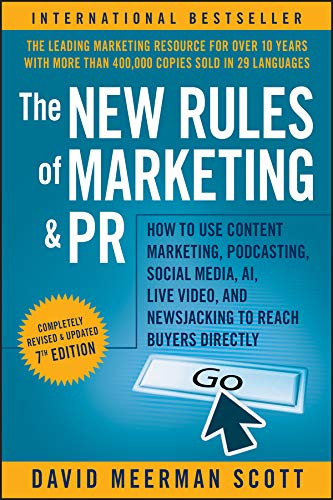
I mentioned David in an earlier post this week on blogging in community. I recently cracked this book back open to check out what he had to say about the best ways to blog, inspiring that previous post. If you do ANYTHING involving content, I highly recommend this book. Click the image to get a copy at Amazon.

Don’t forget to subscribe for daily insights delivered directly to your inbox!

Blog in community (and grow your blog fast)

One of the most helpful things I’ve learned as a blogger came to me from David Meerman Scott. There are two parts, and the first is this:

Before you start your own blog, follow other blogs and bloggers and engage with the ones that matter to you.

I’ve been an avid blog consumer for years, reading from great thinkers and companies like Seth Godin, Michael Hyatt, HubSpot, and Mr. Scott himself of course. They’ve shaped my own thinking and helped me figure out my path forward as a marketer.

This first step lets you figure out how you can contribute to the discussions and the questions being asked on the internet. This is a great starting point for creating your own content.

But the second part of what David taught me was the most profound: engage with their content, leave comments, start discussions. And when you do that, include a link to your own blog.

We often forget the “engagement” step. Don’t just consume—engage! And almost no one links back to themselves for follow-up.

Bloggers like to support other bloggers. They like to talk, discuss, disagree in a civil manner, and try to make the world a better place. By engaging with their content and leaving behind a link as a calling card, you’re encouraging this type of civil discourse.

Now, if you don’t yet have your own blog, you can do the same thing by linking to your LinkedIn profile. Or better yet (since people won’t be able to see your whole profile or its content without connecting), create a free, public about.me page to leave behind.

Think of it as your digital business card, a way for people to learn who you are and follow up with you if they’re so inclined.

Try it the next time you comment on someone’s blog or social media post. I guarantee people will want to hear what you have to say. And they might follow up as well.

(If you want to learn more about David Meerman Scott’s blogging strategies, check out his book The New Rules of Marketing & PR (7th Edition) wherever books are sold.)

Don’t forget to subscribe! Get daily insights to level up your life delivered directly to your inbox.

Why Would You Intentionally Confuse Them?

If your goal is to get someone to buy from you (or trust, believe, understand, or empathize with you), why would you intentionally confuse them?

Why make it harder than necessary to get the information they need to make a decision?

Why use confusing phrases or vague points in an attempt to hide the cost of your product?

Do you think it makes them more likely to take action? Really it will frustrate them, damage any trust that’s already been built, and push them away.

“If you confuse, you lose.”

Donald Miller

Make things direct and clear, especially prices. Don’t hide the truth because you’re worried about sticker shock or how someone will react.

If you feel the need to hide it, you might need to rethink what you’re doing. That goes for everything you do, not just selling.

Get daily insights delivered directly to your inbox. Subscribe today!

Who’s It For?

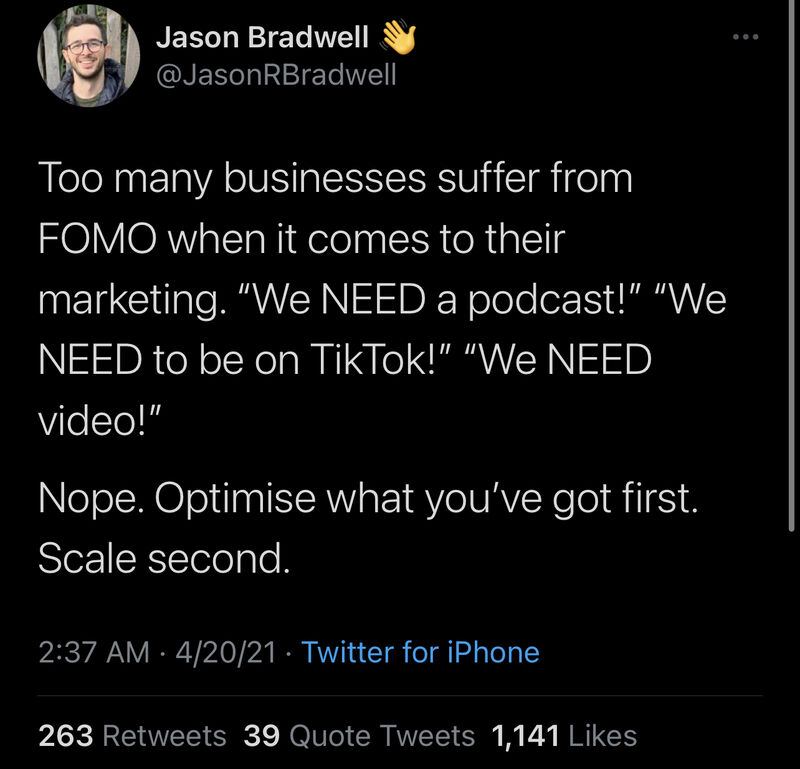
Jason Bradwell tweeted this a while back:

“Too many businesses suffer from FOMO [Fear of Missing Out] when it comes to their marketing. ‘We NEED a podcast!’ We NEED to be on TikTok!’

We’re all marketers now, trying to change the culture and influence others (hopefully for the better). But we have a problem: we get so caught up trying to figure out the tools and tactics, we stop focusing on the people!

What if your target audience isn’t ON TikTok?

What if your ideal customers don’t LISTEN to podcasts?

Why use those platforms if they aren’t helping you reach the right people?

“Who’s it for?” is the first question we should be asking.

H/t to Seth Godin for teaching me what’s most important in marketing.

(Here’s the original post if you’re interested.)

Learn how to make the world better. Subscribe today!