Baseball follows the decline of American democracy

“Baseball suits the character of this democratic nation. 

Democracy is government by persuasion. That means it requires patience. That means it requires a lot of compromise. Democracy is the slow politics of the half-loaf. 

Baseball is the game of the long season, where small, incremental differences decide who wins and who loses particular games, series, seasons. In baseball, you know going to the ballpark that the chances are you may win, but you also may lose. There’s no certainty, no given. You know when the season starts that the best team is going to get beaten a third of the time; the worst team is going to win a third of the time. The argument over 162 games—that middle third. 

So it’s a game you can’t like if winning’s everything. And democracy is that way, too.” 

—George Will, “Ken Burns: Baseball

I would now posit that Americans’ declining interest in, and ability to watch and focus on, baseball directly correlates to our declining democratic ideals. 

When winning is everything—like it is in the new American pastime, football—and our culture reflects that, American democracy can no longer function. 

Baseball has become the jazz music of American sports culture: something we created that truly reflects who we are as a culture, yet no one cares about anymore.

Baseball and jazz—two of the greatest cultural creations that are 100% genuine American innovations—are the same two things most Americans don’t care about, understand, or appreciate. 

We’ve traded cerebral, authentically human jazz for three-minute pop songs, mostly created by computers with singers who rely on autotune to hit anything above or below a 5-note range. A 162-game baseball season over 8 months, for a 16-game football season that lasts 5 months. 

I’ve often said that our declining interest and ability to follow baseball is an indication of social media’s detrimental impact on our ability to focus for long periods. 

Now I’m quite certain it heralds something much worse.
Expertise must come before audience

We have the process backward for becoming well-known.

The current wisdom is to become famous (most likely on social media) to obtain a big audience. Once you have said audience, you can make a living off them by selling their attention or whatever random idea you decide to push.

However, the opposite approach is not only less sleazy but will also lead to lasting rather than fleeting success.

Imagine building a huge following on social media, then selling financial advice (or God forbid, products!) to that audience without knowing anything about the field. You’d quickly be labeled a fraud or scam artist. (Unfortunately, this happens every day.)

If, instead, you started by building your expertise in the field of finance, then built an audience who would benefit from your knowledge, you would have a group of people who trusted you. And trust is almost as good as currency in the modern economy.

Writing changes how we speak

I sent my mom a hilarious video the other day. One portion contained tons of Gen Z slang she didn’t understand. 

Now, me being a millennial, I knew what it all meant (even though I don’t use it myself). She asked me to translate, so I did. 

Now, as hysterical as this scenario sounds, it actually brought up a good point. 

Members of Gen Z speak the way they text rather than texting the way they speak (which is what us “old folks” do).

Nearly everything said is a shorthand for something else… because it’s faster to type the slang or shorthand than it is to write out the word or sentence. 

Now, even though my generation had AIM (that’s AOL Instant Messenger for you youngsters), Napster, MySpace, and the like, we never adopted shorthand as a way of speaking in person. I would argue that’s because only a small portion of our communication happened in shorthand using this technology. 

We spent most of our time hanging out in real life, talking on the phone, chatting in class (and being punished for it). In short, most of our communication was through spoken, rather than written, word.

But since Gen Z was the first generation to grow up with the ubiquity of cell phones and social media (rather than having it introduced later in life like it was for Millennials), it’s completely changed the way they communicate. 

A huge majority of their time is spent “writing” in the since that they are using written communication in some form. 

Texting. Messaging. Making Reels and TikToks. Creating snippets of text on SnapChat.

Which brings me back to the original point of this post. 

Language changes as writing changes, so writing changes how we speak. 

It’s a fact of history: our vocabularies expanded exponentially because we started writing things down. And the more we wrote down, the more clarity we were able (and needed) to create about what we were trying to say.

So when you spend all day writing as your main form of communication, the spoken language changes to reflect your writing.

For more daily musings like this, subscribe below:

Don’t Try to Be Famous—Solve Problems Instead

Controversial Opinion: Becoming a social media influencer is NOT the best way to thrive in today’s economy. 

Yes—there are people on TikTok, Instagram, and all the other platforms making a fortune. 

Social media influencing is the new Hollywood. Most of us only see the handful of big-name players making fortunes, and we assume we can easily do that too.

What we miss are the hundreds or thousands of actors making little to nothing in the entertainment industry or working odd jobs to pay the bills.

There isn’t anything wrong with that, but our culture is telling us we can all do this on social media now. 

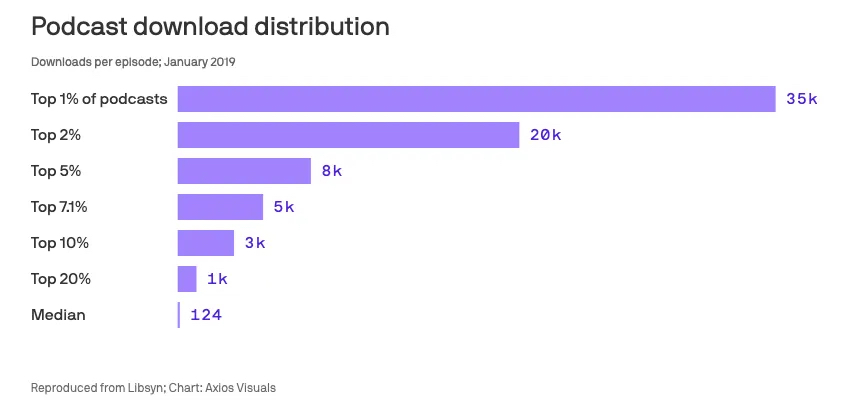
Ever heard of the long tail? Here’s an example (about podcasts):

50% or more of all podcasts have only been listened to by 124 people… Which is not a sustainable business model. 

This is a power-law curve, and it applies to just about everything.

If you solve problems for people by BEING one of those influencers, that’s a different story.

But measuring your success and hoping one of these companies will pay you a fortune for hits on your content is a bad way to live your life.

Commonsense, fundamental money principles combined with a steady income from solving problems for people over a long period of time.

This is the way to make a fortune. It’s just not slick or instant, so it isn’t sexy. 

Subscribe below for daily insights, resources, and content delivered directly to your inbox.

We Are at War! (A Content War, That Is)

There is a war going on, a content war—one of which we are all a part. If you are on social media or have a smartphone, you now have a voice.

We have two choices:

We can sit on the sides and watch passively, soaking up everyone else’s content and letting it sway us one way or another.

Or we can choose to create, contribute, and add our voice to the mix and try to be heard. To change someone for the better. To make a difference however small. 

It’s true you may never be noticed. You might be drowned out by all the other voices. But doing the work is still worth it—in fact, it’s all that matters.

If we do not speak up, there is no chance that we can improve anything. And those that seek to make things worse will overtake those who want to make things better. 

Never miss an update. Subscribe below!

How to get an education that pays during your quarantine

When was the last time you learned something new?

It was probably a few minutes ago when you read an article on your favorite social media site, and you weren’t even aware you were learning. Why not do it intentionally?

Learning and education don’t cease when school ends. If it does, you’ve made a choice, and you will quickly find yourself becoming obsolete.

No one cares about the degree you got 10 years ago. They want to know if you are competent in the areas needed to accomplish the kind of work you want to do.

Learning and going to school are not the same thing. You might have hated school, but you definitely love learning. School requires that you do things you hate, but you aren’t in school anymore. You can learn whatever you want to learn right now.

Always wanted to learn how to draw? Do you want to redo math, not because you have to but because you want to? Maybe you want to learn calligraphy or tennis. Perhaps you want to get a new job, but you don’t have the marketing skills needed by the company. Now is the time, and now you HAVE time.

Learning anything new is part of your ongoing education. Why not do it intentionally? What are you doing right now to invest in your own education?

I’ll give you some ideas.

How to learn for free (or at least cheaply)

  1. Read The 7 Habits of Highly Effective People. If you only do one thing on this list, do this one. The $10 you spend on this book will be the best investment you ever make. It will change your outlook on life, it will improve your relationships with other people, and it will revolutionize how you act.
  2. Take online courses.
    • LinkedIn Learning
    • Udemy
    • Coursera – want a recommendation? Seth Godin has the absolute best courses on Udemy. Start there.
    • Khan Academy (retake high school absolutely free and enjoy it this time)
    • CreativeLive – learn how to draw, take stunning photographs, start your own creative freelancing business, and so much more.
    • Massachussetts Institute of Technology OCW (seriously, take actual courses from MIT absolutely free)
    • edX – Speaking of great schools, this website lets you take real, full courses from Ivy League schools from the comfort of your living room for free. No strings attached. If you want a certificate to hang on your wall or post on LinkedIn, you can pay a small fee and get proof that you completed Ivy League courses.
    • HubSpot Academy – become an expert in marketing for absolutely nothing.
  3. Read books.
    • Libraries still exist. Even if they aren’t open right now, you can download e-books for free from every library in the country. Go read books on subjects about which you are curious. It doesn’t cost you a dime.
    • Download the Kindle app for free on your phone. Then buy The 7 Habits of Highly Effective People. Seriously. You can buy books on every subject imaginable for less than $10 each. Most of the time you can get them for $5 or even $0.99. There is no excuse for failing to read. Swap 30 minutes a day of mindlessly scrolling Instagram, and you will become an expert on a subject in a matter of weeks or months.
  4. Subscribe to magazines.
    • Read the Harvard Business Review. It is well worth $18 a month. Get an entire master’s degree in business for what you spend on lunch.
    • Success Magazine and Inc. are two of my favorites. The former will inspire you to live your best life; the latter will give you much-needed insights on how to succeed in any work or business.
  5. Listen to podcasts – again, FREE.
    • “Akimbo” by Seth Godin
    • “48 Days to the Work You Love” by Dan Miller
    • “EntreLeadership” from Ramsey Solutions
    • “On Leadership with Scott Miller” from Franklin Covey
  6. Watch TED Talks and documentaries on Netflix or Amazon Prime Video.

There is no reason for you not to come out of this crisis with new skills, new knowledge, and an unofficial masters degree in one subject or another.

Be proactive. Take control of your education today.

Join 904 other subscribers

Note: a few of the links above are affiliate links. I get a small commission if a purchase is made. This does not affect you in any way.

Networking is terrible, but there is a better way.

Networking – the idea of surrounding yourself with lots of people who might be able to open doors for you and help you get jobs – is a terrible practice.

It sucks.

The premise is flawed; it goes against every notion and every principle of decency and humanity. To effectively network, it seems one must adopt the mindset of, “What can this person do for me? How can she connect me with the HR department at [insert famous company]? What resources can she offer me so that I can get better (more marketable and attractive to potential employers)?”

Take, take, take, take. It’s a very common practice in Social Networking – some will say, “Use [pick your Social Media poison] to grow as many potentially helpful connections as possible so that maybe one of them can help you get a job at a certain company.”

The selfish focus, the mindset of “me,” is horrid. What is worse: it often backfires and alienates those you are attempting to use for your own selfish gains.

You think these “connections” can’t read right through your message? You’re wrong.

A new way to network

I propose a new way to network – go on your LinkedIn profile and start going down the list of connections. For each one, ask yourself this question: “Can I make a contribution to this person today, and if so, how?”

One important note: this requires a paradigm shift – a genuine change in your way of thinking (here’s a post about paradigms). You cannot adopt this posture while thinking in the back of your mind, “How can I contribute in a way that will get me something later?” You haven’t actually changed anything about the process that way.

If you really want to test this out, find someone in your list of connections who truly cannot “do” anything for you, in the sense of making a connection, giving a recommendation, or helping you get a job. When you find this person, ask yourself what contribution you can make: maybe it’s a simple message of gratitude for something they posted; perhaps it’s asking how their business is performing during the current crisis.

It doesn’t have to be much – it only has to be genuine. Only you will know if your intentions are pure.

“Ask not what your country can do for you; ask what you can do for your country.”

–John F. Kennedy

JFK said it well, and the same message applies to networking.

Ask not what your connections can do for you; ask what you can do for your connections.

Join 904 other subscribers

Verify, don’t trust.

Perhaps it is because of my history education background, but I have a pet peeve about verifying information.

Human beings love stories: we have been telling stories ever since we could draw, write, or communicate with the most basic sounds. It is part of human nature. Because we like stories so much, we also love to embellish, hyperbolize, and, frankly, make stuff up.

In times of crisis, the last point is particularly common. There is a lot of misinformation out there: cures have already been created; vaccines are readily available; drinking liquid silver and bleach will keep you from catching the notorious coronavirus that causes COVID-19; mutations are occuring; martial law is being enacted.

Humans like to tell stories, and even when it is unpleasant, humans like to have their emotions stimulated. People make up stories to trigger these emotional responses. You must be aware of this.

This is not new.

For as long as we have been telling stories, writing articles, and now, using social media, people have been sensationalizing things simply to be heard. People crave attention; they desire to be heard. Some people will do anything to make that happen.

This habit of making things up, of telling half-truths, of seeking attention from the public – it isn’t new. The difference now is scale: more people than ever before, 2 billion in fact, have a voice; not all of them use that voice for good.

You must be vigilant, and check your sources. You must also resist the urge to share every single social media post you see, especially if you haven’t verified the information you are reposting. It will cause fear, panic, and anger. This situation is bad enough as it is, and people are already feeling dread.

Why make it worse?

You are lucky to live in world now where you have a voice; 100 years ago, you would not be so blessed.

“With great power comes great responsibility.”

–Uncle Ben from Spider-Man

You have a voice: please use it responsibly.

Join 904 other subscribers

Be careful what you share

We each have at our fingertips an unlimited amount of information that continues to grow at an unparalleled pace. This means that with each passing day, it gets harder and harder to check the validity of what we are seeing and reading.

This is especially true in today’s immensely divided political landscape, with more and more messages, rhetoric, memes, and articles being published with the sole purpose of further dividing the nation. Someone creates something or bends the truth to suit their worldview, and then it is published to the world. Then another person shares it, and another; then perhaps another person adds something or tweaks it even further, and soon you have a post that is highly biased and quite possibly untrue.

Be careful what it is that you post on your social media accounts; before you do, do just a bit of research to try and find the truth of what you are sharing.

If it becomes too hard to figure out whether or not what you are posting is true, that might be a hint that you shouldn’t post it…