First, put wood on the fire

Here’s one of my favorite quotes from Earl Nightingale:

“It’s foolish to sit in front of the fireplace and tell it ‘first give me some heat. Then I’ll give you some wood.’“

Of course, it’s a little foolish to talk to your fireplace at all. But that’s not the point.

Why would you expect the fire to warm you up with no wood? That’s as foolish as thinking people will buy from you before you’ve created value for them.

You have to help people before they’ll give you money…

You can’t get warm if you don’t put wood on the fire.

Subscribe below to get daily insights, resources, and ideas delivered straight to your inbox.

Is This Book Better Than an MBA?

Colleges don’t teach you how to succeed in the business world. Business schools teach theory, case studies, and lots of accounting and finance. But what they don’t teach you is how to run a profitable, cash-positive business. 

Sadly, they don’t even teach you how to work in a business. At least not in a way that makes money for your employer.

That’s a problem. Why? Because that’s what business owners, managers, and leaders want: value-driven professionals who generate cash.

Here’s the Solution

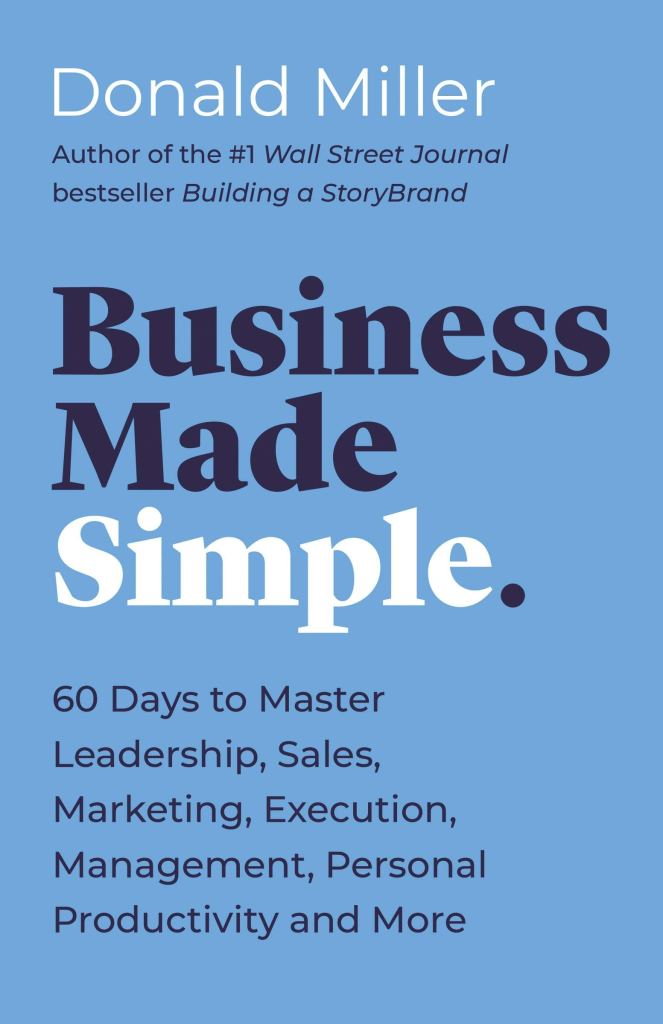
Donald Miller has done it. He’s created a book and podcast that teach you exactly what you need to know to run a profitable business. If you haven’t yet checked out Business Made Simple, do it today!

Buy the book. For just $20 bucks, you can get a better business education in 60 days than you would spending $50,000 on an MBA. And listen to the podcast—it’s absolutely free!

Learn practical skills you need to succeed like:

  • How to write a mission statement that drives and inspires you and your team.
  • How to create a clear message that drives customers to your products and services.
  • Sales processes that actually work.
  • Execution strategies that grow your business exponentially.

What If You’re Not A Business Owner?

Maybe you’re not an entrepreneur. Maybe you just want to have a successful career as a team member or employee. That’s okay!

Business Made Simple is for anyone who’s job it is to generate cash for a business. And guess what? That’s you! Whether you’re a salesperson, marketer, customer service agent, or a janitor, this book will help you succeed at work. 

If you’re looking to stand out in your job search, get promoted, or just contribute more in your work, you need check this stuff out. Get a business education that actually pays off.

Get a copy today!

Get daily insights on business, personal growth, and creativity.

Subscribe today.

Are You Buying What You’re Selling?

Zig Ziglar, the great motivator and sales trainer, found a mantra in the word “enthusiasm.” To him, the last four letters stood for “I am sold myself.”

Zig was a master salesman. He knew if you didn’t believe in what you were selling, that lack of enthusiasm would come across to the prospect.

But what about when you’re not selling a product? What if the thing you’re selling is yourself, and your customer is a potential employer?

This same idea holds true in the job hunt. If you’re trying to persuade an employer to hire you, you have to believe in the product. 

If you’re a freelancer trying to convince a company to use your freelance services, you’re selling a product you must believe in. 

If you’re not enthusiastic about what you have to offer, they won’t be either.

If you don’t believe in yourself, they won’t want to buy your product. And make no mistake: you are the product. 

Grow your enthusiasm. Know what you have to offer; understand what you do best; determine how you can best serve others. And believe that it will benefit another person.

Sell yourself on you.

“You can have everything in life you want, if you just help enough people get what they want.”—Zig Ziglar

Get a daily dose of inspiration. Subscribe below!

Should You Get Paid Every Time You Send an Email?

Wouldn’t it be great if you got paid every time you sent an email? I dunno about you, but I’d love to live in that world. 

I send hundreds each week. If I earned the price of a postage stamp on each one, I could make a pretty easy living.

Am I Devaluing Myself?

I’m an up-and-coming copywriter. To make a living, I spend several hours each week reaching out to potential clients, offering them my services as a writer and marketer. I do this because I’m a salesperson. And if you’re trying to make a living in a similar way, so are you. 

I recently came across a Twitter post telling me that I was devaluing my work by selling myself. To sum it up, the writer said I should either:

  1. Have clients beating a path to my door willing to pay me, OR 
  2. I should get paid every time I send an email, proposal, or pitch to a potential client before any work is done. 

I understand the author’s point. My time is valuable, and it stinks when I feel I’ve “wasted” my time pitching to someone who doesn’t buy. But I 100% disagree.

Sales Professionals Don’t Get Paid to Prospect

How do professional salespeople get paid? They sell a product and get paid a commission. They don’t get paid when they prospect or send proposals to customers. The only way they make money is by closing a sale. 

I sell a service, and I only get paid if I provide that service. And that service is not pitching ideas. If it was, I’d be a billionaire right now because I have a few thousand ideas each day, and most of them are awful.

Selling Your Service Is Like Applying for a Job

Each time I pitch a client, I’m putting in a job application. Think about all the jobs you’ve applied for in your adult life. What if you got paid for every job application you ever completed? Wouldn’t that make for an awesome career?

Often we don’t have a lot of experience for the jobs we are applying for, especially if we are new to the workforce or a field. When asked what a beginner should do, the Tweeter said, “get paid to pitch.”

We’ve all gotten those phone calls from sleazy salespeople. Does this sound familiar?

“I’ve got this great new system that will keep you from paying any taxes this year. But I can only tell you what it is if you sign a non-disclosure agreement and pay me $2,000 upfront.”

You know you’re losing money and going to jail if you get in bed with that guy. You don’t want to have anything to do with an idea you can only hear after signing an NDA and paying upfront.

How to ACTUALLY Get Paid to Pitch 

There are two parts to this tactic:

  1. Charge higher prices to compensate for the inevitable rejections you’ll get.
  2. Overdeliver to your clients and customers so it’s worth paying you higher prices!

One of my favorite phrases comes from the marketing genius Seth Godin:

“You’ll pay a lot, but you’ll get more than you paid for.”

That is the only way this guy’s Tweet works. 

Selling Is Tough

I get it. Creating proposals, pitching to customers, and facing possible rejection—it really stinks. It takes a lot of time and hard work. It’s frustrating. 

But let me be clear: THAT DOESN’T MEAN ANYONE OWES YOU ANYTHING!

The world doesn’t work that way. We are all in sales, and much of that involves reaching out to others. It means facing the very real possibility of rejection coupled with no monetary gain. 

So go ahead and pitch. And if you want to get paid for that, build the cost into your pricing structure. 

But make sure you overdeliver on that promise to your customer. 

Feeling inspired? Like, comment, and share so others can benefit! And subscribe below!

You are a salesperson…don’t screw it up!

“But Nathan! I’m not in sales!” I’m sorry, but you’re wrong.

What’s your role at work? Office manager? Administrative assistant? Florist? Customer service rep? Your title doesn’t matter–you’re in sales.

We all work on commission. Perhaps that commission is a “guaranteed” bi-weekly paycheck for a certain amount each time, or maybe you are paid on the number of hours you work each week. It doesn’t matter–you work on commission.

How is that possible? If you don’t show up to work, you don’t get paid. If you screw something up badly enough, you get fired. Your income is only guaranteed if you work, just like a salesperson’s income is only guaranteed if she sells.

Even if you physically don’t work in a role where you are allowed to sell a product or service to a customer, you are still involved the sales process, because you represent your company.

If you offend a customer or badly represent your brand in some way, it’s quite possible you will lose a sale for the person who actually works in sales.

Since sales is the only part of a company that actually produces revenue, any lost sale results in lost income for your employer which might mean you don’t get that raise you were hoping for next year. Or worse yet, you might get fired.

“Not everyone can make a sale, but ANYONE can lose a sale.”

–Zig Ziglar

We all get paid for results, regardless of how well it’s hidden in hourly wages or a regular salary.

Think like a salesperson.

Join 904 other subscribers

You are self-employed

All of us, if we do work that causes us to get paid, are self-employed. It doesn’t matter who signs our paychecks–we work for ourselves.

What does it mean to be self-employed? It means you are your own boss. It means your income is based on your work.

If a freelancer or entrepreneur doesn’t show up for work–if they don’t create enough value for another person–they don’t get paid. This is obvious when you don’t work for a big company with payroll every two weeks.

What about the salesperson working on commission who does have someone who signs her paycheck? If she doesn’t contact the customer, provide value to that customer, and make a sale, she doesn’t get paid.

What about you? The hourly worker or the salaried cubicle-dweller (perhaps virtual cubicle-dweller is more accurate right now)? What happens if you don’t show up for work?

You don’t get paid.

What happens if you fail to create value for the company that employs you?

You get fired.

As soon as you realize you are self-employed–as soon as you realize that you are responsible for the value you create and the income you generate, regardless of how you get paid–you will secure your future.

Even if you are laid off, the attitude of self-employment will cause you to stand out from droves of people who want to know what a company can do for them rather than what they can do for their potential employer.

Adopt the self-employed mindset and you’ll rarely have to worry where your next paycheck comes from.

Join 904 other subscribers

You must develop these two skills

Writing and sales: if you want to be successful in anything, you must be able to do both well.

If you have an idea, you must communicate it to others; if you want it implemented in some way, you must persuade them.

Writing and sales.

If you want a new job, you have to let others know why you’re the applicant for them by first getting their attention and then persuading them of your worth and potential.

Writing and sales.

“Writing is organized thinking on behalf of persuasion.”

Seth Godin

Writing helps you clarify your thoughts and communicate more clearly. You need it in every field in which you might work. Learn to write.

Parents, physicians, therapists, educators, and those in every other profession must win over those they serve–children, patients, students–to their way of thinking. Learn to sell.

Writing and sales: the most important skills of a modern worker.

Join 904 other subscribers

Great power. Great responsibility.

Uncle Ben said it best: “with great power comes great responsibility.” This should be the phrase by which every leader and marketer lives.

Marketing and leadership are two fields primarily focused on influence. Leaders focus their efforts on influencing what work gets done and on what companies place emphasis; marketers focus on what products get made, what gets purchased, and what changes are made in our culture.

With great influence also comes great responsibility. Leaders and marketers have in their hands the power to persuade others towards things that are either helpful or harmful.

Who gets to decide which is which? Technically, it’s the follower, the consumer, or the customer. But we are all human–we know before a customer tells us whether or not our product or idea will harm her.

If you lead others, if you sell, or if you persuade, please take your responsibility–the power you have over other people–seriously.

Don’t take advantage.

Join 904 other subscribers

“But why is no one listening to me?”

You are having an argument with your spouse, and she doesn’t understand your point of view, no matter how much you push it.

Your children won’t do anything that you ask them to do. They won’t engage or communicate with you; they shut down every time you try to talk to them.

You are writing blogs and posts, but no one is reading or responding to them.

You’ve created a product that will change lives, but no one is buying it.

Naturally, you ask the question:

“Why is no one listening to me?”

You feel you are doing everything right. You have the right ideas or the right argument; you know more than your children; this product is truly amazing and has revolutionized the way you see and do things. And yet, no one is listening. No one is engaging. No one is buying.

Why?

Because you aren’t listening to them.

The only way to get others to listen to you, to engage with you, to buy from you, is to listen to them and understand their points of view, their wants, and their needs.

If you bludgeon people over the head with your arguments and ideas, they won’t accept them; they don’t have the same ideas, the same noise inside their heads. They are telling themselves different stories. The key to being listened to, to making an impact, is to understand those other stories.

You don’t have to agree with them, but you do have to listen to and understand them. When people feel understand, when they feel heard, when they know that you see them and their side of things, they feel more open to hearing what you have to say.

“Seek first to understand, then be understood.”

–Stephen R. Covey, The 7 Habits of Highly Effective People

No one is listening to you because you aren’t listening to them.

Your spouse won’t listen to your side of the argument because all you are thinking of is your side of the argument.

Your children won’t listen to your advice and guidance – even though you probably do know more and understand more than they do – because they don’t feel like you understand them, how they feel, or the narrative in their heads.

No one is buying your stuff because as awesome as it is, they don’t get how it will benefit them or how it will make them feel once they use it. Why? Because you didn’t take the time to understand what they want or how they want to feel.

Understand

To influence someone, you must open yourself to the possibility of being influenced by the other person. This means creating a feeling of understanding in the other person. This is not meant to be manipulative: you must genuinely want to understand the other person. Also, people can tell if you are simply trying to manipulate them rather than understand them.

Listen to what your spouse wants; listen to how your children feel; listen to the needs and frustrations of your customers.

Understanding must always come first; otherwise you’ll fail.

Join the others in creating change the world needs. Subscribe below.

Join 904 other subscribers

*Some of my posts contain affiliate links, which means I make a small commission on any purchases.

Marketing isn’t evil. You are.

Okay, so you’re not evil – I just wanted to get your attention.

Our culture is so used to being “sold to”, to being bombarded with advertisements and brand marketing that we’ve been taught to believe that marketing, trying to influence someone to do something or change something or buy something, is evil.

Marketing is a tool. Tools are not evil; they are morally neutral. Their capacity for good or for evil lies in the hands of the wielder.

Would you ever call a hammer evil? Of course not: personifying an inanimate object with morality is preposterous. If you used the hammer to bludgeon someone to death…is the hammer guilty of evil or are you? Did the hammer commit evil?

Likewise, if the hammer is used to put a nail into a wall to hang a picture for a little old lady in a retirement home, the hammer is not good, nor has it done good. The person using the hammer has used it for its intended purpose to do good.

Marketing is not evil, but people doing marketing can be. Using marketing is evil if it is used to persuade people to do bad things or to do things that cause harm to themselves or others. Using marketing for deception is wrong.

Marketing that creates beneficial change in the world is good. Persuading people to do something that helps themselves or creates better circumstances, even if they know they are being influenced by marketing, is good.

Marketing isn’t good or evil, but what and how you market might be.

Go market the right thing in the right way.

(Who determines what the right thing is? That is a discussion for another day.)

Join the others in creating change the world needs. Subscribe below.

Join 904 other subscribers

*Some of the links in my posts are affiliate links, which means I make a small commission on any purchases.