The Weasleys: two sides of the passion coin

One of my all-time favorite literary creations is the Harry Potter series by J.K. Rowling. It is a story that grew up at the same time I did, and it still brings me great joy today. Because I know it so well, and because it doesn’t overstimulate my mind as I am trying to wind down, I tend to read it before bed. While reading Harry Potter and the Goblet of Fire, I was struck by the inadvertent focus on passions in the first few chapters.

Two different ideals on passion are illustrated in the book. Arthur Weasley, the father of all the red-headed Weasleys, is obsessed with all-things Muggles. He “collects plugs,” and his wife thinks him crazy for it. The Weasley twins, Fred and George, are known far and wide for creating mischief and mayhem wherever they go. I want to unpack this a bit more.

Arthur Weasley has followed his passion (non-magic people) and made an entire career out of it. He works for the Misuse of Muggle Artifacts Office in the Ministry of Magic, protecting the Muggles he loves from witches and wizards who would do them harm. His hobbies at home are all based around Muggle items, from cars to plugs and electricity. And yet, even though he has followed his passion, his family is impoverished.

Throughout the series, we are constantly reminded how little the Weasleys have because their father seemingly has no ambition. I don’t believe this is the case; he simply followed his passion down a deep rabbit hole without ever paying attention to how he could monetize his curiosity.

Career coach Dan Miller often talks about the three-legged stool model of work: for it to work well, there must be passion, talent, and a way to make money from it. Arthur has failed to build that third leg of the stool, and his family has suffered from it. This is by no means a warning against following your passions and talents; it is simply a reminder that you must pay attention to how you can make a living from them, or else you simply have a hobby.

Now let’s turn our attention to the Weasley twins. There is no doubt that they are brilliant witches and wizards. They hold their own plenty of times against other witches and wizards in combat. Not only that, but Hermione Granger herself comments at one point on how impressive and advanced their magic must be for their magical gag products to work.

They are obviously immensely creative and talented in their passions, which seem to be mischief-making and comedy. Yes, it gets them in trouble at school, but only because their school, like our own modern educational system, is a place to sit quietly, obey, and pass the end-of-year exams. Their mother, Molly, is constantly chastising them about not getting enough high exam marks, about causing too much trouble, about not being ambitious like their father and choosing comedy and invention over working for the Ministry.

How is that for irony? For one, government work, whether magical or not, has never been the most creative of workspaces, nor, in my experience, do many people in government tend to be overly ambitious and concerned with making a difference in, or leaving a mark on, the world. I find it fascinating how closely this relates to us in the real world. Our schools stifle creativity and individual differences among their students; we encourage them, not to pursue what they excel in, but to pursue what will pay well and be the “secure,” as if such a thing even exists anymore in the information age. We focus on improving everyone’s weaknesses to make everyone more like the average student, rather than focusing on strengths so that we can all stand out and achieve our unique purpose.

If the Weasley twins had followed their dad’s example, or their mother’s advice, they would never have lived up to their true potential. By book six, Harry Potter and the Half-Blood Prince, the twins succeeded in creating Weasley’s Wizard Wheezes, opening up a highly successful magical joke shop, and becoming fabulously wealthy in the process.

Let’s take a lesson from the Weasleys today. Have the focus of Arthur Weasley, but the ambition of Fred and George. I strongly encourage you to follow your curiosity wherever it leads. Ignore the naysayers, but keep in mind the idea of the three-legged stool; all three legs must be present or you only have a hobby, like Arthur Weasley. Find a way to monetize and maximize your obsession, and you will be successful beyond your wildest dreams.

Reaping excellence

I came across a little maxim yesterday that got my mind going, so I wanted to share.

“Sow a thought, reap an action; sow an action, reap a habit; sow a habit, reap a character; sow a character, reap a destiny.”

There is also a quote that pairs nicely with this maxim:

“We are what we repeatedly do. Excellence, then, is not an act, but a habit.

– Aristotle

What is it that you repeatedly want to do? If you did it often enough, do you believe you would truly develop excellence in that habit?

Perhaps you should ask a related question: if what you are doing now isn’t something in which you want to develop excellence, what do you repeatedly think about? Once you have an idea in mind, you can then apply it to the maxim.

For example, let’s say that a person is constantly thinking about art, but only thinking, never creating any herself. We’ll start there.

“Sow a thought…” she is constantly thinking about and admiring the artistic work of others.

“Reap an action…” the aspiring artist decides to take drawing lessons and vows to draw a little bit every day, no matter how small it might be.

“Sow an action…” drawing each and everyday becomes second nature.

“Reap a habit…” she no longer even thinks about if she will draw today; the only thought on her mind is what to draw. A habit is developed.

“Sow a habit…” drawing has become second-nature to her now. It’s as habitual as brushing her teeth or eating.

“Reap a character…” she has become, intentionally or not, an artist. It is now who she is, a fundamental feature of her character. She is now one of the people she once admired.

“Sow a character…” you can see the rest. Her destiny is whatever she decides to make it at this point. She has already developed the skills and habits needed to carry her far down the path of artistic success, whatever she decides that looks like for her. Perhaps it is a career in art, or perhaps it is just a wonderfully enjoyable hobby. But it is now who she is.

So, what is it about which you constantly think? How can you turn those thoughts into action, and then practice those actions often enough until habits form and a certain character you want develops?

“We are what we repeatedly do…”

Decide and act on that in which you strive to be excellent.

Play your music

“Many people die with their music still in them. Why is this so? Too often it is because they are always getting ready to live. Before they know it, time runs out.”

OLIVER WENDELL HOLMES, Former U.S. Supreme Court justice

The other day I wrote a blog post about exploring the things about which you seem to be innately curious. I was discussing this subject the day before I wrote it, and during the conversation, I had something of a heartbreaking thought: I believe each of us has a unique purpose, a unique interest that, if nurtured, will allow that purpose to be lived out. And yet it seems as though a great majority of the human race never achieves their purpose.

Why is this so? Is the curiosity squashed out of them before they have a chance to develop it into something meaningful and lucrative, simply because it is different from what others think is a viable vocation or career? Is it that many are so focused on simply eking out a living that they never raise their heads long enough to look their purpose in the eye and pursue it? Are they so caught up in fantasy worlds, technology, and social media that time that could otherwise be spent on pursuing these inclinations is wasted? Or worse still, is the opportunity to live a purpose-filled life literally taken away by violence, famine, or disease?

Perhaps it is all of these reasons and more, but while you still breathe, while you still have time on this earth, I encourage you to listen to Mr. Holmes and play your music. Listen to Ralph Waldo Emerson and follow the beat of your own drummer.

Your curiosity, your natural affinities towards certain skills, subjects, passions, and interests – they were all given to you for a purpose. Follow them where they lead, ignore the naysayers, shun the nonbelievers.

Start today. Do something you feel you were meant to do.

The peculiarity of curiosity

Human beings are weird…

I had a conversation yesterday with my cousin, Erin, in which we discussed curiosity and the peculiar inclinations each one of us possesses.

I believe Robert Greene needs to be quoted at length here:

“[We each have] a deep and powerful inclination toward a particular subject.

This inclination is a reflection of a person’s uniqueness…it is a scientific fact that genetically, every one of us is unique; our exact genetic makeup has never happened before and will never be repeated. This uniqueness is revealed to us through the preferences we innately feel for particular activities or subjects of study. Such inclinations can be toward music or mathematics, certain sports or games, solving puzzle-like problems, tinkering and building, or playing with words.”

– Robert Greene, Mastery

I vividly remember discovering my own inclination: I was 9 years old, in the library of my elementary school, looking for a book to read. I picked up The Journal of Scott Pendleton Collins by Walter Dean Myers and was hooked. I am not exaggerating when I say that that one (seemingly) random book changed the course of my life. I became a voracious reader, taking a deep dive down the rabbit hole of World War II history, attempting to put my hands on any and every book I could on the subject.

By the age of 10, I was reading college-level historical monographs, encouraged by both my parents and my teachers. This interest gradually spread out until I was gorging myself on stories of American history, colonial times, European battlefields, and ancient civilizations.

Why?

Why is it that reading one book propelled me into so an extensive study of a particular field? Why am I so drawn to this subject, and yet I care nothing for sciences (unless I’m looking at them from a historical perspective) or cooking or any other number of subjects? Why am I drawn to history when another person is delighted by math or chemistry? And yet another person is drawn to space, theology; to beauty and hair care; or to art and photography.

I don’t have a true answer to the question. It is simply amusing to me. We can be so alike, and yet each of us seems to have a curiosity, sometimes more than one, which separates us from every other human being that is or ever has been.

All I can think is that we have been uniquely created by God, the universe, the Higher Self, or whichever spiritual ideal in which you believe. We have each been created with a unique curiosity that, if satisfied, if given the opportunity to develop enough, will help us fulfill our purpose on Earth and make it a better place for those curious beings that come after us.

I hope that you will follow your own curiosity, wherever it leads. It is quite possibly the most necessary thing you can do with your life.

Stop telling people to avoid the arts

How many of us have told someone that she should choose a real major, one that is applicable in today’s job market, rather than pursue something creative like art, music, or literature?

(RAISES HAND)

Why do we do this? It is well-meaning enough, I suppose: we don’t want them to struggle financially, we don’t want them to fail, we don’t want them to get hurt because it is so hard to live as an artist…

Let’s just stop, shall we?

What if the person to whom you gave this advice is actually quite talented as a writer? What if she has spent so much of her free time drawing, painting, and sculpting that she has become a fantastic artist? Do you really feel comfortable telling her that she should go get her MBA, work in middle management, collect her benefits, get the 401(k) match, and just worry about “all that artsy stuff” in her off hours, because she can’t make real money in the arts? Why is that good advice (especially when that last claim is bogus)?

Handle Money. Fail often.

Why don’t we teach her instead? Let’s make sure that we are teaching our children how to handle their finances, how to live on a budget, spend less than they make, save money, make money, and how to avoid debt at all cost (this is the real reason so many of us starve these days). We should most definitely teach her not to go $100,000 in student loan debt for her MFA in painting, but that does not mean we should tell her not to pursue her passion – those are not the same thing.

At the same time, we should also be teaching her to fail and fail often. Have her start trying to sell her art online. That doesn’t work? Should we tell her that she should quit and go get a real job? No! You don’t tell a child to stop trying to ride a bike because she fell off and scraped her knee; you tell her to get up and encourage her to try again.

Do the same thing with your creative child or friend. Encourage her start teaching other people what it is that she knows. She can make online videos of her work so that others can see it and her ideas will spread. Find whatever avenue works for her.

Encourage

There has never been a better time to be an artist than today – the market is wide open, the possibilities are limitless. You can be an artist in anything at which you are talented; it does not have to be a traditional “art”. Let’s focus on teaching our family and friends the right skills they need to survive and thrive – let’s teach creativity, leadership, personal finance, marketing and storytelling. Then let’s send them forth to pursue that which they most truly enjoy.

If we can teach them to handle money well, and to learn and grow from failure, they will all be fine.

We will all be just fine.

Why did they not follow a passion?

One of the most common subjects we talk about these days is following our passions. Some of us are passionate about music, art, or writing, while others enjoy business, finance, and marketing. Regardless of the specifics, many of the conversations among our peer groups revolve around ways in which we can pursue careers and success in these areas. It has gotten me thinking about our parents’ generation and those that came before.

Most of the media on television or the internet today lampoons the adults of the mid-20th century, who went to a white-collar office job or a blue-collar factory job every day, did the same boring thing day after day, left at 5pm, came home, and spent the rest of the evening watching television before falling asleep and doing it all over again the next day. It is obviously satirical in many cases, but it also doesn’t seem far from the truth.

Why did our parents and grandparents do that? Was that all that was available to them? Did they not have specific passions they wanted to pursue? Were they actually content with working simply to earn an income to buy a house with a two-car garage for their 2.5 children to live happily ever after in the suburbs? Did they not also spend time with their friends and family discussing art, music, or writing and how they might pursue these areas? Does that explain why so many of them are portrayed today as drinkers and layabouts at home?

I don’t have an answer to this question; it just seems to me that the idea of pursuing passion areas as a career is a relatively modern one. Perhaps it is born from the end of the industrial age where factory work (and yes, office work counts) has been replaced by information work. We are now required to be creative and unique in order to stand out and survive in a globalized economy.

I just want to know if the passion was there and got stamped out, or if passion just never entered their minds.

New toys

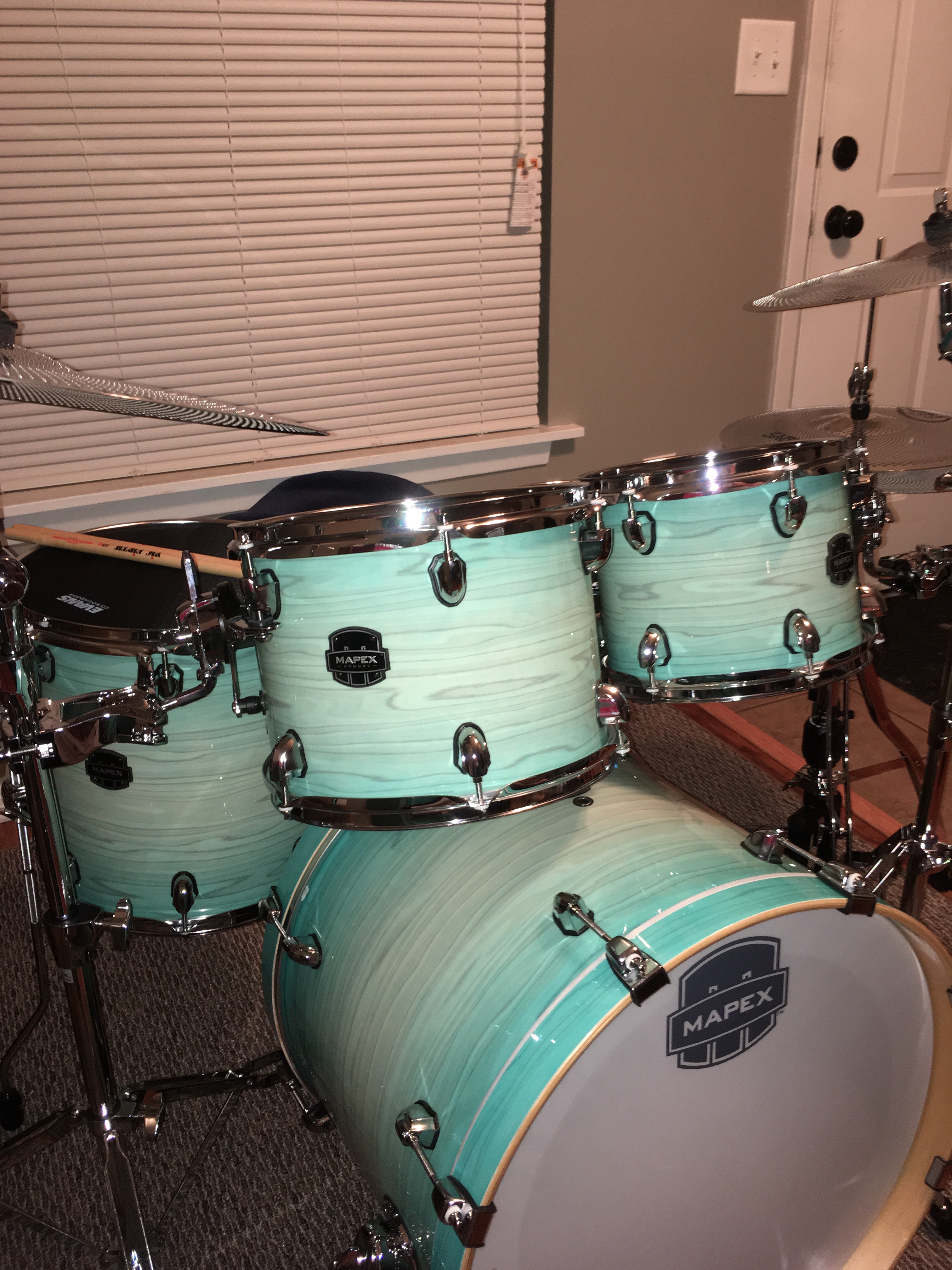
There is nothing quite like coming home and opening new toys. Even when you’re almost 30.

My new practice and teaching kit arrived today, and I could not be more thrilled.

How to learn anything

Do it.

The thing you want to learn how to do? Start doing it.

Start writing. Start playing the drums. Start drawing. Start reading the classics. Start creating a podcast.

How do you learn how to speak another language? Any teacher worth her salt will tell you that you have to immerse yourself in the language and start speaking it. All the books and college courses in the world won’t help you if you don’t do it.

This is scary, isn’t it? The resistance in your head is telling you that you don’t know where to start or that you can’t possibly learn how to do this or that without a rigorous amount of study. If you don’t know where to start, then yes – go and pick up a book. Watch a YouTube video or download an app. Hire a teacher. But all the reading about it, watching videos about it, being lectured to about it – that won’t get you anywhere until you take action. Once you have a grip on the basics, you just have to start doing.

Learning is easy once you start doing it. Taking action is what’s difficult.

Change happens

Human beings are notoriously bad at two things: thinking about the future…and adapting to change.

Now before I go on, this article references something that was sent to me about President Trump’s campaign, but I am not trying to write a political post. This is simply an observation of how people are are being set against one another because of change.

We have scientific proof that there is more carbon in the air today than there was 50 years ago (which causes the Earth to retain more heat). We have documented, scientific evidence that our oceans are becoming cesspits overflowing with plastic and other waste which is harmful to the creatures that inhabit them.

So the culture is experiencing a change: companies all over are adding links to their “About Us” sections to show their customers how they interact with the environment. Start-ups and entrepreneurs are creating delivery boxes to help people go greener. Local businesses are trying to source their goods from local people with minimal or no packaging. And individual Americans (and humans in general) are making efforts to lower their footprint by using less plastic or finding alternative ways to commute.

Then you have something like this:

You can find more information about the item here if you want to look more into it.

A small idea like a biodegradable paper straw, innocent of anything except trying to save a turtle here or there, is politicized and given the label of “liberal”.

What purpose does this serve except to divide us Americans even further? Why take an idea like the paper straw, something that harms no one and has long-term benefits for everyone, and use it as fuel on a fire to incense one group of citizens against another?

Change is happening; change is inevitable and has been occurring as long as there have been people. And people have fought against change as long as we have existed.

Yet change is still happening. People are attempting to think long-term about some of the behaviors we have practiced over the past century and are trying to do something about it. We can either accept it, or attempt to fix it later when it’s too late to prevent it. Either way, change will occur.

In the meantime, we must stop politicizing EVERYTHING and making every single issue in our culture an issue of belief, of us pitted against them. And we must stop letting people drive wedges between us regardless of our own thoughts and beliefs. We must be able to have a civil discourse about issues that affect the future – perhaps not your future, but that of your children and grandchildren.

Change is going to happen whether we want it or not, but we can affect the sort of change that we want if we can only stop working against each other and ask questions, then listen

In the meantime, I will continue to take my own cup to restaurants and politely refuse plastic straws when offered. If you wish to ask me about it, I would be delighted to have a civil discussion with you.

Leave a legacy

What calls you? What pull do you feel in the pit of your stomach when you think about it? What is that something that fires you up, fills you with passion, excites you at the thought of contributing?

“You vocation will leave a legacy.”

– Dan Miller, 48 Days to the Work You Love

Vocation, career, and job are three different things, and vocation is the one on which you must focus first. Your vocation, your calling – that is what will leave its impact on the world.

I have been gifted with an insatiable curiosity all my life which has made me the consummate student, and the best teachers are always lifelong students. My calling, the pull I feel in my stomach, is to leave the world a better, more informed, more educated, and more beautiful place because of the knowledge and wisdom I hope to impart to others. Whenever someone talks about educational reform, or better ways of learning and teaching, or how to truly prepare others for the real world outside of an outdated, industrialized classroom, I feel called to contribute.

You see now that this calling can cover a variety of different careers: teacher, coach, politician, entrepreneur, musician, artist, writer. So many different titles could fulfill this calling as long as I use that career to leave the legacy for which I am striving.

So today, sit for a few minutes and listen to what your life has to say to you and about you. Recognize those moments when you feel truly inspired and truly tuned in to something going on around you or something to which you are listening. Ask yourself what you want to be remembered for when you are gone from the world.

What legacy do you wish to leave?