I hate getting feedback… Don’t you?

I hate getting feedback…

It hurts. It stings. It can crush your soul—especially if you think you’re already kicking butt. 
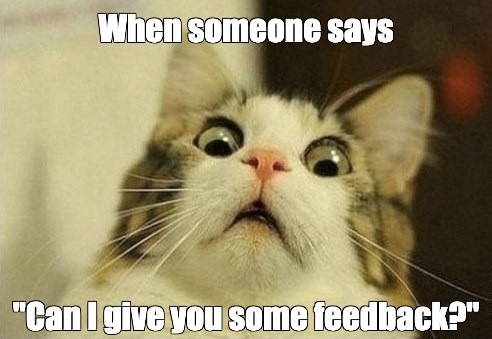
But it’s also the best way to figure out where you can grow to hit your goals.

That’s why I actively seek it out in everything I do. 

Musicians Are Brutal

This practice came from my time in university. I was studying to be (and working as) a professional musician. 

Every week, I had multiple lessons, rehearsals, and performances. And after each one, my teachers, bandmates, and mentors had feedback for me.

It was brutal (to put it mildly). But it made me a better musician. 

These people were better than me, more experienced, and knew what needed to be done to succeed. 

I’ve carried this practice with me into every job I’ve had. It’s made me a better leader, writer, and marketer.

“A mark of a competent adult is their ability to accept feedback. The mark of a child is their expectation of praise without merit.”

—Donald Miller, Business Made Simple, p. 15

Surround yourself with people who want you to improve and succeed in your roles. Actively seek out feedback. 

The more you do it, the better you’ll get. But I can’t promise it won’t sting.

How do you feel about feedback? Are you actively seeking it out?

Get daily insights on business, personal growth, and creativity.

Subscribe today.

Artist-of-All-Arts

I don’t think I’ve ever met a single artist who was not a jack-of-all-trades in the arts and humanities–an “artist-of-all-arts” if you will.

It seems every artist is not only attracted to multiple forms of art but develops skill in multiple areas as well.

My late friend Michael McNally was a brilliant cellist and a gifted, passionate actor. My friend Lindsey is a skilled artist, photographer, designer, and also a singer with a beautiful voice. (You can see some of her work here and here.) Another friend of mine, Alden, is one of the best photographers I know as well as a talented artist and connoisseur of music.

It seems to me that anyone attracted to the arts and humanities is attracted to all of them. It’s as if once the right brain is fully engaged, it looks for beauty everywhere. 

Such is the life of an artist, and why, I suppose we can seem to others to be so scattered in our work and interests–and perhaps feel that way about ourselves. 

An artist is a lover of beauty no matter its form, so we chase it everywhere.

What about you? What forms of art are you attracted to or skilled in? Let me know in comments below!

Want more inspiration to pursue your creativity? Subscribe below!

Wisdom and Mission

Life is like a tuning fork: when struck, the tuning fork resonates a true pitch, one that doesn’t alter as long as it rings. Each of us is like a musician in an orchestra: we must strive to tune ourselves to that tuning fork, the true pitch ringing in our lives.

How much effort do we expend trying to create our lives, our careers, our families, based on how others have succeeded? We strive to emulate other families – keeing up with the Joneses next door. We constantly research which careers pay the most or have the most advancement potential, hoping that the next job is the right fit.

It doesn’t work.

Each of us has unique characteristics and traits we were either born with or developed over time. Would not we be better served in trying to find things in the world that matched us, rather than attempting to mold ourselves into something “out there” in the world?

It would be like a musician seeing a tuning fork then creating his own, hoping that it was the right pitch but with no knowledge of the subject (himself). Were he to use it to tune his instrument, he would find that the pitch isn’t correct.

Your mission in life isn’t something you create; neither is wisdom. Victor Frankl said that we detect rather than invent our missions in life. It’s already there: you must simply align yourself with it, not strive to create it.

Wisdom isn’t created – you cannot make yourself wise. You must seek it out, finding it in others who have come before you, in scripture or great writing, and in your own experience of the world.

“Everyone has his own specific vocation or mission in life….Therein he cannot be replaced, nor can his life be repeated. Thus, everyone’s task is as unique as is his specific opportunity to implement it.” – Victor Frankl

Seek your mission; seek wisdom.

Don’t miss a thing! Subscribe below to get updates delivered directly to your inbox.

Join 904 other subscribers

The instrument is a means to an end

Instrument – noun 

  1. A tool or instrument; 
  2. a thing used in pursuing an aim; 
  3. an object or device used to produce musical sounds.

The purpose of an instrument is to accomplish a goal. Play a song; perform surgery; type a book; draw a sketch.

Why, then, do we spend so much time focused on learning the tool, the means to the end, rather than pursuing the end itself?

How ridiculous would it be for a surgeon to spend four years of her education learning how to use a scalpel? His end goal is to perform surgery, and the scalpel is simply a tool to help her achieve that goal. So she focuses on what he is trying to accomplish, rather than on the scalpel, and learns to use the scalpel to achieve the goal – helping the patient lying in front of her.

A drum set, trumpet, guitar, or violin is a tool used to create music. And yet, in conversations I’ve had with other musicians and from my own personal experience, an inordinate amount of time in the education of a musician is spent on technical exercises or non-musical experiences. 

I am not diminishing the importance of mastering every facet of one’s tool – a surgeon must be a master with a scalpel; a musician must be in total control of her instrument. But to focus on technique, on the instrument only, while ignoring the purpose for which it was created, is to learn only half of a craft. 

How different would an artist’s life be if every exercise or technical study was drawn from a major work in her field? What if, in learning a song, one created one’s own technical exercises that enabled mastery of the music being played, rather than technique for technique’s sake? 

Learn medicine, not scalpel technique.

Learn to create art, not how to use a pencil.

Lean to play music, not an instrument.

Don’t miss a thing! Subscribe below to receive updates as soon as they post.

Join 904 other subscribers