How to learn a word

The best way to learn a new word is to have it paint a picture in your mind.

Adjectives conjure images of people who embody their meaning.

Verbs project images of the actions they represent.

Few people learn words by memorizing dictionary definitions and reciting them in their minds every time they hear them. The definition is great when it’s completely new and unfamiliar, but it’s only the first step. Mastery comes from the imagery conjured by the words.

Eventually, we develop an intuitive “feel” for the meanings of words and no longer need either the definition or the image they conjure. We become fluent, and the words roll off the tongue.

This path from incompetence to mastery is present in all learning. The “grammar” is just the first step.

Two types of happiness

Hedonic Happiness: Happiness that comes from the pursuit of pleasure and the avoidance of pain.

Eudaemonic Happiness: Happiness that comes from living a meaningful life.

You say you want one, but do your actions speak otherwise?

Subscribe to receive the blog directly in your inbox!

Happiness is a by-product

It is pursued and obtained indirectly by doing things—consistently, deliberately, and long-term—that may not always be physically enjoyable in the moment but inevitably result in a feeling of happiness.

Instead of trying to will happiness into existence, focus on the conditions that bring about happiness—sound mind, healthy body, meaningful work, deep relationships—and perhaps it will emerge. —Clay Skipper

Subscribe below to get the blog directly in your inbox!

Two ways to have more

The first way is the one we most often focus on: earn more money.

Get a higher-paying job to buy a nicer house, go out more, and live a life of luxury. In short, you want to earn more money to have the freedom and flexibility to live a better life.

But there’s an inverse to this idea: needing less.

Lower your expenses by moving into a smaller home, downgrading to one car, or making more meals at home. Decrease what you need money for, and you get the same effect: more freedom and flexibility, but with the money you already make.

One isn’t better than the other, but one might be easier to obtain.

Subscribe to receive the blog delivered directly to your inbox!

How will you measure your life?

Is it by the number in your bank account?

The amount of influence you have over people and events?

What about your job title and the status it brings?

All valid options. But is that what you’ll want to think about as you take your last breath?

Or maybe you’ll use a different measuring stick.

The amount of art you created.

The number of people you changed for the better.

How well you raised your children… And what tremendous people they became.

You get to choose.

*This post was inspired by the book How Will You Measure Your Life? by Clayton Christensen et al.

For more daily musings like this, subscribe below:

3 meaningful moments

One of my coaches taught me a new exercise this week, and I felt I should share it far and wide.

It’s called the “3 meaningful moments” exercise.

The gist is to think back on 3 different moments from major periods in your life—childhood, adolescence, and adulthood—then write about them in detail.

Once you have this done, you are to distill your experiences into a single word that ties the threads together.

I’ve included my response to this exercise below

***

I was 9 years old, enrolled at an arts school in my city, and required to read a certain number of books each term to get Advanced Reader points. On a whim, I picked up a book that had a picture of a soldier on it— a “Dear America” book entitled The Journal of Scott Pendleton Collins, A World War 2 Soldier.

The opening scene described in graphic detail the D-Day landings at Normandy, France in 1944. From that moment forward, I was hooked on history.

I begged my mom (and she acquiesced) to take me to the library, which became almost a weekly occurrence, and read as many books (many of them well beyond what a 9 year old should have been reading) on that topic.

My interest soon spread out to encompass all of WWII and then history in general. Eventually, my bookshelf at home was FULL of books on just about every topic imaginable, and my library has only grown since then.

When I was 14, my parents bought for me a bass guitar. I’d been studying violin and piano from the age of 7, so I was not without musical skill. But I proceeded to teach myself how to play the bass.

Then I picked up my mom’s acoustic guitar, and taught myself that too. My brother got a set of drums, and I picked up the sticks and taught myself that as well.

That became my focus—I was decent at everything else, but I focused on drums for the next 10 years, taking lessons and eventually getting a bachelor’s degree in jazz studies with an emphasis in percussion.

Giving me that first instrument led me on a journey through every type of music imaginable, and taught me extremely valuable skills such as deliberate practice, diligence, patience, listening, empathy, and more.

At 27, I’d been working for Apple for about a year, when I was offered the chance to become a Creative. In that role, I served as a teacher, workshop facilitator, troubleshooting expert for customers, and a coach of sorts for employees on how to use all our technology.

This was the first time I’d been working when I felt that feeling of flow. Teaching came more naturally to me than just about anything else. Being in front of a group of people, helping them learn and master new skills—this felt more natural than just about anything else I’d ever done before.

And I was GOOD at it.

I had regular customers who’d wait and wait for my classes just so they could work with me. And I learned so many skills: how to sell, how to speak in public, how to present, adapt teaching styles on the fly. And I loved what I did.

Not only was I good at it, but it gave me the chance to learn so many new skills—drawing, computer coding and programming, music production, photography, videography, and all-around creativity. The only reason I left that job was because I wasn’t making enough money to support my family while doing it.

I’m trying to think of a word that ties all of these threads together. “Learning” is the first one that comes to mind. But then “curiosity” came to me. And that feels right at the moment. I truly think curiosity has defined my life and been the underlying reason for both my insatiable desire to learn new things, but also my ability to become proficient at so many disparate things as well.

***

If you have the time and desire, I’d love to hear about your “3 meaningful moments” in the comments below.

What’s Your “Why”?

Some people see this and think I mean “What gets you out of bed in the morning?”

They’d be wrong. Plenty of us have very little that gets us out of bed in the morning.

Maybe we have jobs we hate. Or tough relationships that don’t fulfill us. Or life situations we can’t seem to escape.

If you don’t have that “something” yet, think about it this way:

“What would make you WANT to get out of bed in the morning?”

My “why” has everything to do with my own personal freedom.

  • The freedom to rule my daily schedule
  • The freedom to control my income (however high or low I want it)
  • Freedom from debt
  • Giving my wife freedom to pursue whatever work, career, project, or lifestyle she desires

But I also feel I have a purpose that involves helping other people find freedom, happiness, and joy in their lives. And I genuinely believe the best way to do that is to help them create and run successful businesses or freelance practices.

Why? Because it’s the best way for them to have the freedom to live life on their terms. To do what they love and help the people they want to help. To make the difference they seek to make in the world. 

And I feel like I can achieve that purpose as a copywriter and marketer. That work helps people serve their customers, grow their businesses, and achieve the kind of freedom I’m talking about.

What’s your “why”? Tell me in the comments below.

Don’t forget to subscribe!

Make Money Working In Your Sweet Spot (Free Masterclass)

CLICK HERE TO SAVE YOUR SPOT

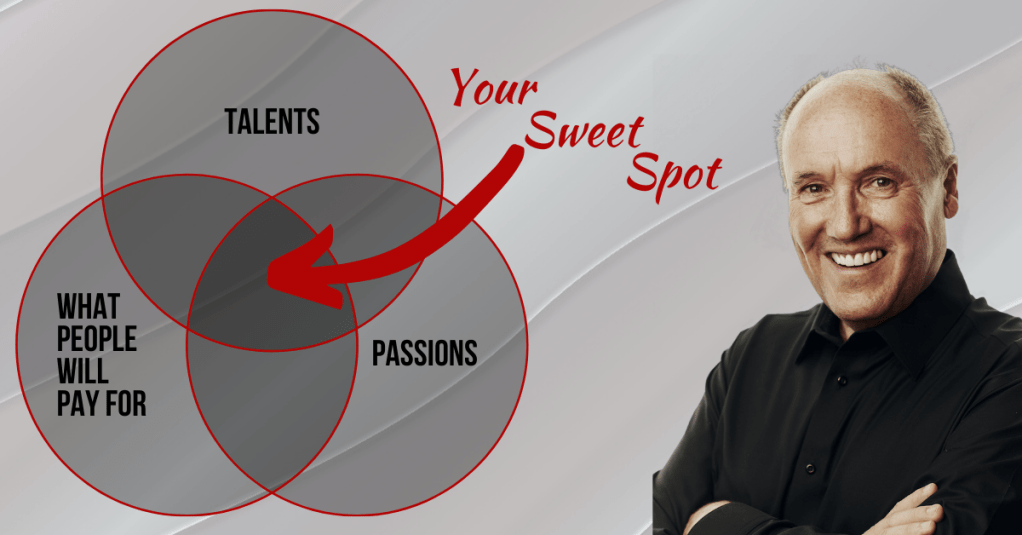
If you’re hoping to begin living a fulfilled and meaningful life while still making a nice living for your family, you have to find your sweet spot.

We all have one. It’s the place where our passions and talents meet the world’s willingness to pay us.

My friend and mentor Dan Miller, author of the New York Times Bestseller 48 Days To the Work and Life You Love, is hosting a webinar on Thursday, January 14th to take you through the steps of determining your own unique sweet spot.

There are two times to choose from: 1pm CST and 7pm CST.

CLICK HERE TO SAVE YOUR SPOT

Never miss a post! Subscribe below!

*Occasionally, I’ll create posts with affiliate links. These don’t cost you a penny but can result in a small commission for me if you purchase anything.

Successful people do ONE thing all the time

Successful people are normal. They have no superhuman abilities, no extreme discipline honed by years of meditation or special operations training. However, they do something the rest of us don’t always do:

They choose.

Successful people choose what is important to them; they choose to prioritize what is important throughout the day; and they choose to carry out those things regardless of feelings or external triggers.

You must plan to do the things that matter – the things that will get you where you want to go. These are the achievements, contributions, and attributes for which you want to be remembered at your funeral.

Before you can plan them, however, you must define them. How will you achieve what’s important if you don’t know what is important?

You won’t.

But even if you lay out what is important and plan your day accordingly, it will not matter unless you choose to carry out the items of importance. This is what separates successful people from the rest.

“The successful person has the habit of doing the things failures don’t like to do….They don’t like doing them either necessarily. But their disliking is subordinated to the strength of their purpose.”

E.M. Gray – “The Common Denominator of Success”

Even if something is important, and you are aware of its importance, you will find times when you really don’t want to do it. You won’t want to exercise; you won’t want to read your kids to sleep after a long day at work. If you don’t, that’s fine. But you are making a choice based on feelings or circumstances, relinquishing control of your own life.

Every action you take or don’t is a choice. Choose to do the things that further your mission, rather than choosing to let other people, feelings, and circumstances choose for you.

Choose to be successful.

In summary

Define what really matters most to you.

Plan your days based around what is important.

And most importantly, choose to act regardless of how you feel, what other people do, or what is going on around you.

Join 904 other subscribers