Copy the masters

If you want to improve your drumming, copy musical phrases from masters like Elvin Jones or Tony Williams.

If you want to learn a new style of art, copy the sketches and brush strokes of da Vinci and Van Gogh.

If you want to  become a world-class copywriter, copy the best, most successful ads from people like David Ogilvy or Claude Hopkins.

From medieval apprenticeship practices to their modern-day equivalents in universities and 1-on-1 mentorships, the best creatives know you must first start by copying the masters. 

You learn the fundamentals of most everything first by imitation. Only then can you add your own touch to create something wholly your own.

For more daily musings like this, subscribe below:

My math teachers lied to me

All my math teachers told me growing up that I had to learn arithmetic, algebra, geometry, all these formulas… but for what? 

Their sole argument when I pressed them with “why?” Because I wouldn’t always have a calculator in my pocket.

Well, the joke’s on them. Not only do I ALWAYS have a calculator on hand (sometimes literally in the case of my smart watch), but it can do a lot more than basic arithmetic. 

The phone in my pocket, the watch on my wrist—both of these have scientific calculator qualities (real TI-84 stuff) built in. They can do just about everything but graph. 

But you know what else? I’ve never had to use that power for anything in the real world.

I’ve never once had to calculate the slope of anything. I’ve never had to use linear equations for my job.

What I have needed to do was quickly figure out percentages in my head to help a customer.

Use probability to make a decision.

Measure off a table and do complex fraction stuff to get the merchandising in an Apple Store as close to perfect as possible. 

None of this was learned in a classroom. I learned it all doing work in the real world. That’s why I always ask, “What’s the project?” when learning something new.

(And I still have that calculator in my pocket. I wonder what they tell students nowadays why they have to learn those seemingly abstract facts?)

For more daily musings like this, subscribe below:

Art hardens you against feedback

I spent years of my life being criticized (often brutally) by teachers and peers during my time as a musician.

It hurt—a lot. For a while, anyway.

Eventually you realize something:

It’s not about you. It’s about the work.

Even when the comments seem personal or exceedingly harsh.

You realize there’s this other thing you’re trying to bring into the world (in my case, a piece of music). And there are ways to do it that are creative and wonderful… And ways to do it that are just plain wrong.

At some point, the musician realizes that the people they’re making art with all have the same goal: to bring to life a beautiful piece of music in the way it needs to be.

And when you’re all working toward that shared goal, it makes the feedback easier to bear. You learn to separate the self from the art.

It’s not about you—it’s about the work.

For more daily musings like this, subscribe below:

A fun-filling (rather than fulfilling) career

Starting in the late 1970s, the idea of “passion” entered our discussions about work. 

The goal became to find work that aligned with pre-existing interests, rather than pursuing mastery of a difficult craft (which had been our way of doing things for hundreds of years).

Don’t get me wrong, you absolutely must be interested in what you do. That’s vital to persevere through the difficulties that arise in learning anything new and worthwhile.

But I’m coming to find that our obsession with trying to align work with things we already like is sapping us of our ability to enjoy (or at least be satisfied with) most any type of work available to us.

We’re asking our jobs what they can do for us, rather than focusing on what we can offer the world by engaging in those jobs.

Satisfaction and enjoyment in our work is a lot like motivation. We think we have to wait for motivation to hit before we act on something (like getting in a workout or finishing a difficult project). But that motivation only comes after we’ve taken the action.

Action precedes motivation, not the other way around. And happiness in our work often comes AFTER we do the difficult work itself.

It’s probably not what you want to hear… But that doesn’t make it untrue.

For more daily musings like this, subscribe below:

What’s the project?

Go ahead: read the books, watch the videos, and take the courses. 

But at the end of all that, you need to take action. And the best way to do so is to have a project. 

I don’t mean a 3-panel trifold board school project that you dread so much you put it off until the night before it’s due. 

I mean a project that puts into action the stuff you’ve just learned. Something that fires you up. And lets you use your new skills in a way that will let you experiment while also helping others.

Maybe that’s:

  • Writing and submitting an article to practice your research skills
  • Building a website to practice your design abilities
  • Creating a YouTube video “lecture” to teach someone what you just learned
  • Playing a solo for friends and family (or dare I say, other, more critical musicians?)

When I was working and studying as a musician myself, I learned this was an unspoken rule of improvement. 

Everything you learned had one goal attached: perform what you learned in front of someone else.

That pressure to perform led to vast improvements in my playing abilities, especially my weekly recurring jazz trio gig. I had to be laser-focused on putting newfound abilities to use on a regular basis. 

My unspoken mantra became: “If I can’t use this tonight, I haven’t really learned it yet.” 

Until you can use what you’ve “learned” in the real world, nothing has happened. 

Human beings are artisans and craftspeople: your brain is wired to make things and do something with what you learn. Not just have it marinate in your mind after reading a book or watching a video. 

Making, performing, creating, teaching. These acts put our knowledge to use… and make us feel useful. Like the masters of a craft that we all have the ability to be. 

So, you need projects. 

They’re the key to learning new things. But they’re also the key to fulfilling work and a meaningful life. 

For more daily musings like this, subscribe below:

I can’t do that…

…right now.

Those are the two missing words in that all-too-common statement. 

  • I can’t play the guitar
  • I can’t hit a baseball
  • I can’t write good content
  • I can’t speak Spanish
  • I can’t dance the salsa

…right now.

Because you can learn how to do just about anything. And I don’t mean that in some fantastical, “you can do it”, Disney-movie sense.

Because it won’t be easy. It might feel painfully uncomfortable. In fact, it definitely will. 

But the human brain is capable of learning anything with enough time and deliberate practice.

But if it’s a skill, meaning it can be learned and isn’t some genetic issue (and most skills aren’t), it can be done. By you. 

The question becomes whether or not you 1) have the time and 2) want to put in the effort.

But if the answer is, “No, I don’t want to do that,” then fine. No harm, no foul. Don’t worry about it. 

But change the language. “I don’t want to…” is much different than “I can’t.”

For more daily musings like this, subscribe below:

If it’s worth doing, it’s worth doing slowly

Rapid results rarely last. Everything worthwhile takes time and patience.

  • Parenting 
  • Marriage 
  • Reading a difficult book 
  • Getting a degree 
  • Learning a new skill 
  • Building a business 

Rapid weight loss is dangerous and usually leads to a reversal.

Speed reading might let you get through more books… But more books isn’t the goal. 

The goal is mastery, not rapidity. Deep understanding, not casual interest.

In a world obsessed with speed, be a tortoise.

For more daily musings like this, subscribe below:

Remember your founder’s roots

It amazes me how many companies still require their prospective employees to hold college degrees before they’ll even CONSIDER talking to them about work…

Especially because so many companies are founded by college dropouts, straight-D students, and vocal critics of modern education.

With so much information and easily accessible methods to build the skills necessary to do competitive work, college is quickly becoming a handicap more than anything else.

It’s four years spent in a classroom accumulating information rather than developing skills, building projects, and doing actual work. (And yes, I’m a college graduate who’s criticizing EXACTLY what I went through).

Never will you be required to sit through hours of lecture and regurgitate information on tests in your working career. But that’s what I’d estimate 90% of college is.

How does that help a company looking to hire for a role? Obviously it doesn’t.

I’d like to see more companies embrace what Apple, Google, Amazon, and other big tech companies are doing:

Value competence and proven skills over accreditation and papers.

Show you can do the work and forget what your “education” was all about.

Hopefully more companies will remember their founders’ roots and get out of this antiquated industrial mindset.

Get good at being bad

One of my favorite Zig Ziglar quotes of all time…

“If it’s worth doing, it’s worth doing… poorly!”

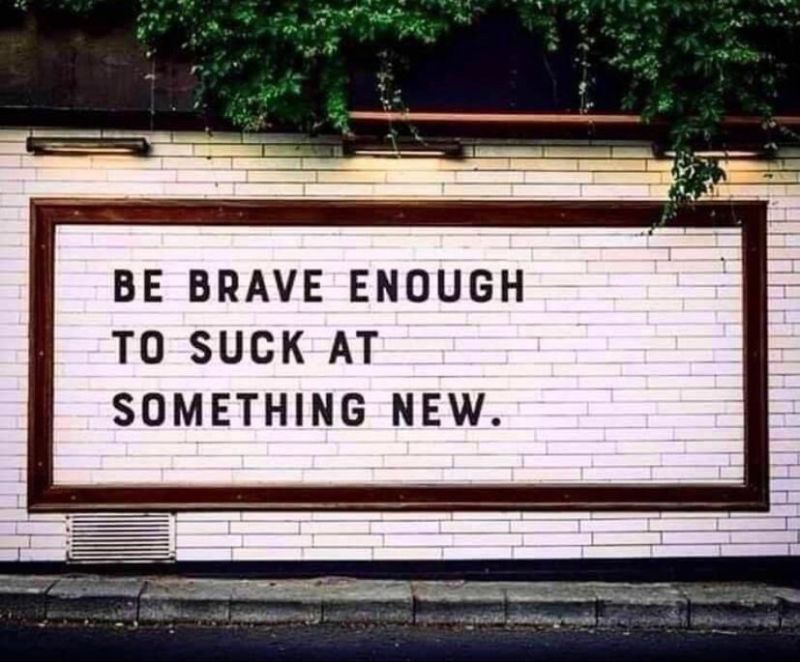
You will never be great when you’re learning something new. Take the time to suck at it on your way to getting better.

If it’s worth doing, it’s worth doing poorly

You’ve been told your entire life you should do things well.

Perfectly.

Like an expert.

And if you can’t do it well, you might as well not even bother to do it at all.

That’s wrong. You can’t instantly be great at doing ANYTHING.

The only place to start is at the level we currently are.

The always relevant, and sometimes irreverent, Zig Ziglar said one of my favorite quotes of all time:

“If it’s worth doing, it’s worth doing poorly.”

What did he mean?

Simple: anything worthwhile requires that we start as a beginner.

Golfing, tennis, writing, painting, jazz improv… It doesn’t matter what it is.

If it’s worth pursuing, you owe it to yourself to be bad at it. And then get better at it every single day.

He uses the example of someone learning to play golf: if everyone could join the PGA Masters tour after a couple of lessons with the local pro, there’s no reason to do it.

Give yourself time to do things badly…

On the way to doing them well.

Subscribe