
Is This Book Better Than an MBA?

Colleges don’t teach you how to succeed in the business world. Business schools teach theory, case studies, and lots of accounting and finance. But what they don’t teach you is how to run a profitable, cash-positive business. 

Sadly, they don’t even teach you how to work in a business. At least not in a way that makes money for your employer.

That’s a problem. Why? Because that’s what business owners, managers, and leaders want: value-driven professionals who generate cash.

Here’s the Solution

Donald Miller has done it. He’s created a book and podcast that teach you exactly what you need to know to run a profitable business. If you haven’t yet checked out Business Made Simple, do it today!
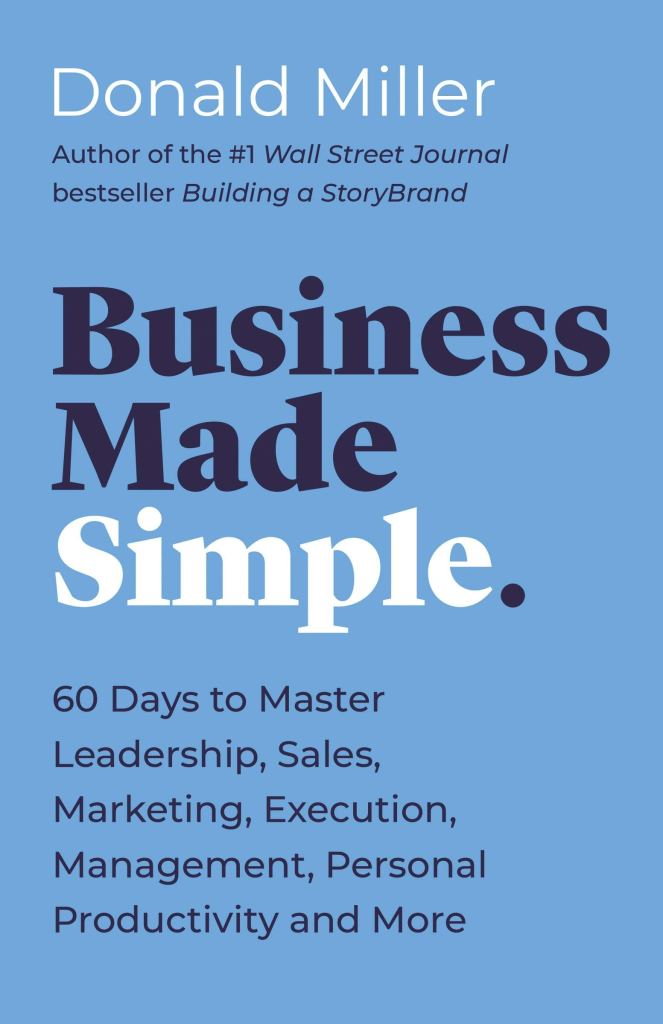
Buy the book. For just $20 bucks, you can get a better business education in 60 days than you would spending $50,000 on an MBA. And listen to the podcast—it’s absolutely free!

Learn practical skills you need to succeed like:

  • How to write a mission statement that drives and inspires you and your team.
  • How to create a clear message that drives customers to your products and services.
  • Sales processes that actually work.
  • Execution strategies that grow your business exponentially.

What If You’re Not A Business Owner?

Maybe you’re not an entrepreneur. Maybe you just want to have a successful career as a team member or employee. That’s okay!

Business Made Simple is for anyone who’s job it is to generate cash for a business. And guess what? That’s you! Whether you’re a salesperson, marketer, customer service agent, or a janitor, this book will help you succeed at work. 

If you’re looking to stand out in your job search, get promoted, or just contribute more in your work, you need check this stuff out. Get a business education that actually pays off.

Get a copy today!

Get daily insights on business, personal growth, and creativity.

Subscribe today.

Are You Buying What You’re Selling?

Zig Ziglar, the great motivator and sales trainer, found a mantra in the word “enthusiasm.” To him, the last four letters stood for “I am sold myself.”

Zig was a master salesman. He knew if you didn’t believe in what you were selling, that lack of enthusiasm would come across to the prospect.

But what about when you’re not selling a product? What if the thing you’re selling is yourself, and your customer is a potential employer?

This same idea holds true in the job hunt. If you’re trying to persuade an employer to hire you, you have to believe in the product. 

If you’re a freelancer trying to convince a company to use your freelance services, you’re selling a product you must believe in. 

If you’re not enthusiastic about what you have to offer, they won’t be either.

If you don’t believe in yourself, they won’t want to buy your product. And make no mistake: you are the product. 

Grow your enthusiasm. Know what you have to offer; understand what you do best; determine how you can best serve others. And believe that it will benefit another person.

Sell yourself on you.

“You can have everything in life you want, if you just help enough people get what they want.”—Zig Ziglar

Get a daily dose of inspiration. Subscribe below!

Should You Get Paid Every Time You Send an Email?

Wouldn’t it be great if you got paid every time you sent an email? I dunno about you, but I’d love to live in that world. 

I send hundreds each week. If I earned the price of a postage stamp on each one, I could make a pretty easy living.

Am I Devaluing Myself?

I’m an up-and-coming copywriter. To make a living, I spend several hours each week reaching out to potential clients, offering them my services as a writer and marketer. I do this because I’m a salesperson. And if you’re trying to make a living in a similar way, so are you. 

I recently came across a Twitter post telling me that I was devaluing my work by selling myself. To sum it up, the writer said I should either:

  1. Have clients beating a path to my door willing to pay me, OR 
  2. I should get paid every time I send an email, proposal, or pitch to a potential client before any work is done. 

I understand the author’s point. My time is valuable, and it stinks when I feel I’ve “wasted” my time pitching to someone who doesn’t buy. But I 100% disagree.

Sales Professionals Don’t Get Paid to Prospect

How do professional salespeople get paid? They sell a product and get paid a commission. They don’t get paid when they prospect or send proposals to customers. The only way they make money is by closing a sale. 

I sell a service, and I only get paid if I provide that service. And that service is not pitching ideas. If it was, I’d be a billionaire right now because I have a few thousand ideas each day, and most of them are awful.

Selling Your Service Is Like Applying for a Job

Each time I pitch a client, I’m putting in a job application. Think about all the jobs you’ve applied for in your adult life. What if you got paid for every job application you ever completed? Wouldn’t that make for an awesome career?

Often we don’t have a lot of experience for the jobs we are applying for, especially if we are new to the workforce or a field. When asked what a beginner should do, the Tweeter said, “get paid to pitch.”

We’ve all gotten those phone calls from sleazy salespeople. Does this sound familiar?

“I’ve got this great new system that will keep you from paying any taxes this year. But I can only tell you what it is if you sign a non-disclosure agreement and pay me $2,000 upfront.”

You know you’re losing money and going to jail if you get in bed with that guy. You don’t want to have anything to do with an idea you can only hear after signing an NDA and paying upfront.

How to ACTUALLY Get Paid to Pitch 

There are two parts to this tactic:

  1. Charge higher prices to compensate for the inevitable rejections you’ll get.
  2. Overdeliver to your clients and customers so it’s worth paying you higher prices!

One of my favorite phrases comes from the marketing genius Seth Godin:

“You’ll pay a lot, but you’ll get more than you paid for.”

That is the only way this guy’s Tweet works. 

Selling Is Tough

I get it. Creating proposals, pitching to customers, and facing possible rejection—it really stinks. It takes a lot of time and hard work. It’s frustrating. 

But let me be clear: THAT DOESN’T MEAN ANYONE OWES YOU ANYTHING!

The world doesn’t work that way. We are all in sales, and much of that involves reaching out to others. It means facing the very real possibility of rejection coupled with no monetary gain. 

So go ahead and pitch. And if you want to get paid for that, build the cost into your pricing structure. 

But make sure you overdeliver on that promise to your customer. 

Feeling inspired? Like, comment, and share so others can benefit! And subscribe below!

Fear Accompanies Us On All Our Exciting Adventures

Something I’ve been working on a lot during my deep dive into creativity and self-awareness is dealing with fear. It’s always there, and I don’t know about you, but I’ve never been able to find a way to get rid of it.

What I have learned, however, is simple: feel the fear…then act anyway. 

There Is No Danger…

Almost nothing we do in modern life is actually dangerous – it just feels dangerous, and our amygdala tells us to run as fast as we can in the other direction. Making a cold call, sending out batches of promo materials to prospective employers, sitting in an interview…none of these things are dangerous. They just feel dangerous.

Jumping out of a plane with no parachute is dangerous; driving while wearing a blindfold is dangerous.

Trying something new where you may be told no? That’s not dangerous.

Action Overcomes Fear

I’ve decided to feel the fear, and act anyway. First, it was making a phone call to get contact information for someone in charge of a job I desperately wanted to take. Then it was beginning the sales process of promoting myself to that person. Today, it was reaching out to an old contact – a professor at a local college – about working for her in her program.

Each time, I felt tremendous fear, then did the thing that scared me anyway Euphoria followed fear, then the fear melted away. 

And so far, 2 out of the 3 times, it has paid off. The person I called was incredibly kind and more than happy to give me the information I was seeking (why was I so scared?).

The contact at the college was very positive in her response (again, why was I so scared?).

And the third person? Well, I’m not done selling myself to him yet.

What is, and was, the worst that any of them could say? No? That’s not scary or dangerous. It just means I’ve got to try something else.

Win or Learn

But the best part of all this? If I act and succeed, then I win! If I act and fail, I STILL WIN! How? Because I did something that scared me, which makes it easier to do it again next time in a different situation. Because I’m exercising the muscle of action in the face of fear. Because I’m not basing my self-worth over how other people feel about me, what they say about me, or whether or not they say yes to my proposal. I don’t feel the need for that approval anymore – it’s just a happy bonus if I get it. 

I will quote Susan Jeffers at length here:

“We cannot escape fear. We can only transform it into a companion that accompanies us on all our exciting adventures…Take a risk a day – one small or bold stroke that will make you feel great once you have done it.”

Susan Jeffers

I’ve decided to make fear my companion on this adventure called life. I hope you will too.

Want more inspiration to embrace your creativity? Subscribe below!

Networking is terrible, but there is a better way.

Networking – the idea of surrounding yourself with lots of people who might be able to open doors for you and help you get jobs – is a terrible practice.

It sucks.

The premise is flawed; it goes against every notion and every principle of decency and humanity. To effectively network, it seems one must adopt the mindset of, “What can this person do for me? How can she connect me with the HR department at [insert famous company]? What resources can she offer me so that I can get better (more marketable and attractive to potential employers)?”

Take, take, take, take. It’s a very common practice in Social Networking – some will say, “Use [pick your Social Media poison] to grow as many potentially helpful connections as possible so that maybe one of them can help you get a job at a certain company.”

The selfish focus, the mindset of “me,” is horrid. What is worse: it often backfires and alienates those you are attempting to use for your own selfish gains.

You think these “connections” can’t read right through your message? You’re wrong.

A new way to network

I propose a new way to network – go on your LinkedIn profile and start going down the list of connections. For each one, ask yourself this question: “Can I make a contribution to this person today, and if so, how?”

One important note: this requires a paradigm shift – a genuine change in your way of thinking (here’s a post about paradigms). You cannot adopt this posture while thinking in the back of your mind, “How can I contribute in a way that will get me something later?” You haven’t actually changed anything about the process that way.

If you really want to test this out, find someone in your list of connections who truly cannot “do” anything for you, in the sense of making a connection, giving a recommendation, or helping you get a job. When you find this person, ask yourself what contribution you can make: maybe it’s a simple message of gratitude for something they posted; perhaps it’s asking how their business is performing during the current crisis.

It doesn’t have to be much – it only has to be genuine. Only you will know if your intentions are pure.

“Ask not what your country can do for you; ask what you can do for your country.”

–John F. Kennedy

JFK said it well, and the same message applies to networking.

Ask not what your connections can do for you; ask what you can do for your connections.

Join 904 other subscribers