How do values appear in your life?

What do you value? And how do you structure your life so that the things you value are apparent?

If you say you value thinking, how do you engage with that value on a daily basis?

  • No social media?
  • Embracing boredom?
  • Avoiding mindless TV binging?
  • Walking in silence?
  • Writing when ideas strike you?
  • Writing or thinking in public? (Publishing something)

If you say you value your health, how does that show up in your day?

  • Eating lots of fruits and vegetables?
  • Cooking more meals at home?
  • Intentional movement?
  • Finding ways to build more movement into your day so you don’t have to think about it?

Values are developed through action. They requires practice to become part of who you are.

Art hardens you against feedback

I spent years of my life being criticized (often brutally) by teachers and peers during my time as a musician.

It hurt—a lot. For a while, anyway.

Eventually you realize something:

It’s not about you. It’s about the work.

Even when the comments seem personal or exceedingly harsh.

You realize there’s this other thing you’re trying to bring into the world (in my case, a piece of music). And there are ways to do it that are creative and wonderful… And ways to do it that are just plain wrong.

At some point, the musician realizes that the people they’re making art with all have the same goal: to bring to life a beautiful piece of music in the way it needs to be.

And when you’re all working toward that shared goal, it makes the feedback easier to bear. You learn to separate the self from the art.

It’s not about you—it’s about the work.

For more daily musings like this, subscribe below:

Everything is a tool

When I was in marketing, I defined myself as a marketer. But I hated that title because of what people expected of me (sleaziness). And because of the jobs that were available—they contrasted with the type of marketing I wanted to do. 

When I was a musician, I defined myself as much. And I burned out. I got tired of the expectations placed on me because of how other people viewed the music world and careers within it.

As I’ve put some space between me and these fields, I’ve had a revelation.

They are just tools.

Marketing is a tool to make change happen. Music is a tool to create emotion in, and connection with, others. 

My fellows in both fields didn’t see it that way. Marketers told me that social media and spamming were the only ways to make things happen in business. 

Musicians told me, “you must focus only on percussion. If you try to play other instruments, you’ll be mediocre at best. No piano, guitar, or voice lessons for you.”

And I believed them. And missed out on some wonderful experiences in the process. And I eventually quit both.

The lesson here is to adopt the “tool” approach, so you see things for what they are. That way, they don’t become your identity. 

I know now that I focused on percussion in college because that area of music was a tool for me to use in that moment of life. To express what was inside of me at the time. It wasn’t who I was. 

And marketing is just a tool, like a hammer. You don’t have to “become” a marketer. You can simply use it as a means to make a change you want to see in the world. 

Separate yourself from the tools you use. 

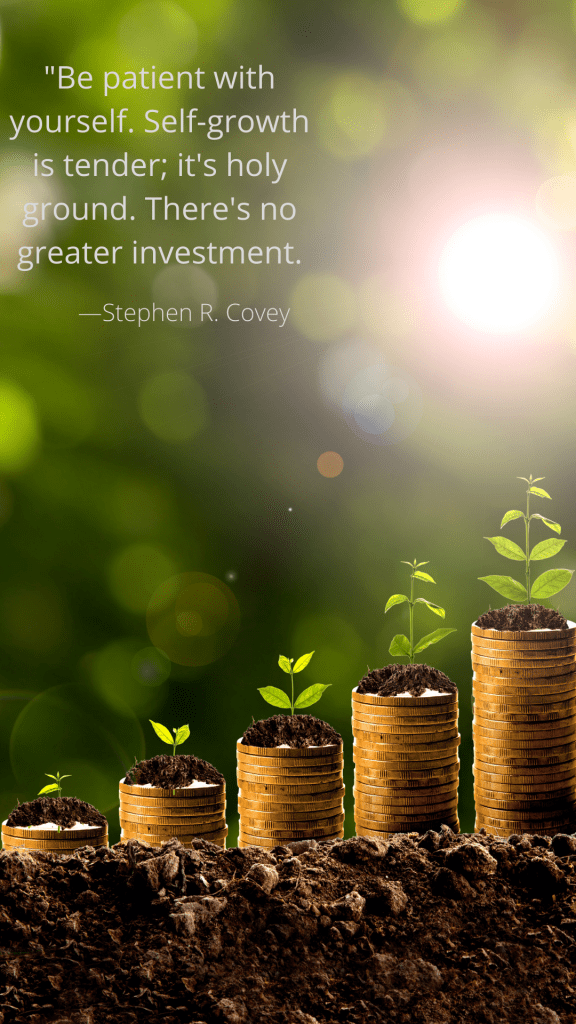
Self-growth is tender

You’re an imposter! (And so am I)

When you feel your imposter syndrome kick in, run towards it. Don’t run away from it.

That feeling means you’re doing something right—something worthwhile.

By definition, we are all imposters when we do something new. Because we’ve never done it before…

Of course we’re imposters!

A growth mindset requires us to embrace imposter syndrome. The only way we can grow is to put ourselves in situations that we’ve never been in.

But it hurts! A life full of growth will naturally have some pain points, just like the growing pains a child feels in her growing body.

It’ll hurt a little bit to reach our full potential. But there’s no better way to live.

If it’s worth doing, it’s worth doing poorly

You’ve been told your entire life you should do things well.

Perfectly.

Like an expert.

And if you can’t do it well, you might as well not even bother to do it at all.

That’s wrong. You can’t instantly be great at doing ANYTHING.

The only place to start is at the level we currently are.

The always relevant, and sometimes irreverent, Zig Ziglar said one of my favorite quotes of all time:

“If it’s worth doing, it’s worth doing poorly.”

What did he mean?

Simple: anything worthwhile requires that we start as a beginner.

Golfing, tennis, writing, painting, jazz improv… It doesn’t matter what it is.

If it’s worth pursuing, you owe it to yourself to be bad at it. And then get better at it every single day.

He uses the example of someone learning to play golf: if everyone could join the PGA Masters tour after a couple of lessons with the local pro, there’s no reason to do it.

Give yourself time to do things badly…

On the way to doing them well.

Subscribe

What does coaching mean to you?

I heard the best description of what a coach does this week on Michael Hyatt’s podcast, “Lead to Win”:

“I love developing people and helping [them] to see the best potential in them and call it out. And that is what coaching is all about.”

That quote is from Michele Cushatt, Chief Coaching Officer at Michael Hyatt & Company. (You can check out the episode here.)

Her definition of coaching leapt out at me… I had to listen to it at least three times. 

Most of us have an image in our head of a coach as a cheerleader… Maybe it’s someone who tells you “great job” when you finish a task or make a little progress. 

Or maybe “coach” conjures images of someone putting you through drills or practices to help you develop a skill. 

Coaches can and should do those things. But that’s not the essence of what coaching is…

A great coach sees the potential in another person and calls it out! That’s the key. They bring forth what’s already inside someone else. 

They help someone become the best person they can be. The person they are destined to become.

Do you have someone in your life doing that for you? If not, can you find someone?

Or is there someone you know who’s got tons of potential but can’t see it? Or hasn’t developed it? 

Why can’t you take the role of coach and call it out to them?

Subscribe below for daily insights, resources, and ideas delivered straight to your inbox.

Are you scared of failing? Or…

Are you afraid the path you’re walking is taking you somewhere you don’t want to go?

The former means you should probably keep going.

The latter is a warning from your inner self, your conscience, your child artist… Whatever you want to call that little voice that whispers truth in your ear.

But here’s the problem:

Often the two fears are hard to distinguish. To figure out which it is requires time for introspection, writing, silence… Sometimes even experimentation with what’s scaring you.

Often this fear manifests itself around our careers.

Are you afraid you might fail at being a salesperson? Or does the idea of selling this particular thing make your skin crawl?

Remember: one means you should try. The other means you should rethink your path.

Subscribe below for insights, resources, and guidance delivered directly to your inbox.

Blog in community (and grow your blog fast)

One of the most helpful things I’ve learned as a blogger came to me from David Meerman Scott. There are two parts, and the first is this:

Before you start your own blog, follow other blogs and bloggers and engage with the ones that matter to you.

I’ve been an avid blog consumer for years, reading from great thinkers and companies like Seth Godin, Michael Hyatt, HubSpot, and Mr. Scott himself of course. They’ve shaped my own thinking and helped me figure out my path forward as a marketer.

This first step lets you figure out how you can contribute to the discussions and the questions being asked on the internet. This is a great starting point for creating your own content.

But the second part of what David taught me was the most profound: engage with their content, leave comments, start discussions. And when you do that, include a link to your own blog.

We often forget the “engagement” step. Don’t just consume—engage! And almost no one links back to themselves for follow-up.

Bloggers like to support other bloggers. They like to talk, discuss, disagree in a civil manner, and try to make the world a better place. By engaging with their content and leaving behind a link as a calling card, you’re encouraging this type of civil discourse.

Now, if you don’t yet have your own blog, you can do the same thing by linking to your LinkedIn profile. Or better yet (since people won’t be able to see your whole profile or its content without connecting), create a free, public about.me page to leave behind.

Think of it as your digital business card, a way for people to learn who you are and follow up with you if they’re so inclined.

Try it the next time you comment on someone’s blog or social media post. I guarantee people will want to hear what you have to say. And they might follow up as well.

(If you want to learn more about David Meerman Scott’s blogging strategies, check out his book The New Rules of Marketing & PR (7th Edition) wherever books are sold.)

Don’t forget to subscribe! Get daily insights to level up your life delivered directly to your inbox.

What’s Your “Why”?

Some people see this and think I mean “What gets you out of bed in the morning?”

They’d be wrong. Plenty of us have very little that gets us out of bed in the morning.

Maybe we have jobs we hate. Or tough relationships that don’t fulfill us. Or life situations we can’t seem to escape.

If you don’t have that “something” yet, think about it this way:

“What would make you WANT to get out of bed in the morning?”

My “why” has everything to do with my own personal freedom.

  • The freedom to rule my daily schedule
  • The freedom to control my income (however high or low I want it)
  • Freedom from debt
  • Giving my wife freedom to pursue whatever work, career, project, or lifestyle she desires

But I also feel I have a purpose that involves helping other people find freedom, happiness, and joy in their lives. And I genuinely believe the best way to do that is to help them create and run successful businesses or freelance practices.

Why? Because it’s the best way for them to have the freedom to live life on their terms. To do what they love and help the people they want to help. To make the difference they seek to make in the world. 

And I feel like I can achieve that purpose as a copywriter and marketer. That work helps people serve their customers, grow their businesses, and achieve the kind of freedom I’m talking about.

What’s your “why”? Tell me in the comments below.

Don’t forget to subscribe!