Think and Grow Rich in 2021

CLICK HERE TO JOIN US (affiliate link)

What are you excited about for 2021? One of the things I’m really looking forward to is a study of Napoleon HIll’s Think and Grow Rich. I’ll be doing this with my 48 Days Eagles Community of entrepreneurs and its founder Dan Miller, author of the New York Times Bestseller 48 Days To the Work and Life You Love.

We’re kicking it off with a family movie night. We’ll all be watching the movie online together on January 19th. Then we’ll start our study on January 25th, focusing on one chapter a month. And we’ll be meeting the fourth Monday of each month to discuss our readings.

Join us! It will be life-changing for you and me.

CLICK HERE TO JOIN US (affiliate link)

Get daily riffs, resources, and reflections. Subscribe below!

Make Money Working In Your Sweet Spot (Free Masterclass)

CLICK HERE TO SAVE YOUR SPOT

If you’re hoping to begin living a fulfilled and meaningful life while still making a nice living for your family, you have to find your sweet spot.

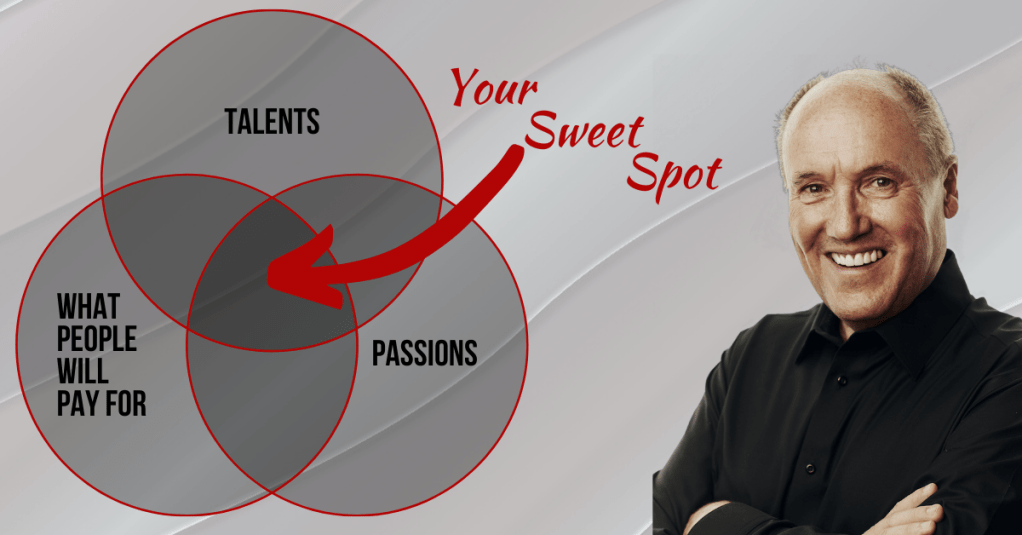
We all have one. It’s the place where our passions and talents meet the world’s willingness to pay us.

My friend and mentor Dan Miller, author of the New York Times Bestseller 48 Days To the Work and Life You Love, is hosting a webinar on Thursday, January 14th to take you through the steps of determining your own unique sweet spot.

There are two times to choose from: 1pm CST and 7pm CST.

CLICK HERE TO SAVE YOUR SPOT

Never miss a post! Subscribe below!

*Occasionally, I’ll create posts with affiliate links. These don’t cost you a penny but can result in a small commission for me if you purchase anything.

Are We Really “Born to Do” Anything?

It’s a question asked by lots of career counselors, coaches, and well-meaning advisors.

“What do you feel you were ‘born to do?'”

What if the honest answer is we aren’t born to do anything specific?

There is an entire area of philosophy dedicated to this idea that was first theorized by John Locke. (You can check out the basics here.) But I’m focusing on talents and passions today.

Was Van Gogh born to paint? Was Steve Jobs born to create the iPhone? Seth Godin would argue no. His answer to this question is simple. Here’s how I understand it:

No one is predetermined to use a certain medium for his or her art. We simply adopt the means and medium of whatever is available to us in our time.

In one of his podcast episodes, Seth says he doesn’t believe that Van Gogh would have painted with oils had he been born in the 20th century. Nor would Steve Jobs have created the iPhone had he been born in the 1700s (the resources and advancements in science were not available for that to have been possible).

And yet, each of us is genetically unique. You have never occurred before and will never occur again in this universe. Surely that means that we are born with innate talents and leanings.

Part of me thinks that’s true. And yet part of me also believes, as career coach Dan Miller says, “Passion is more developed than discovered.”

By this, he means we become passionate about things we engage with over and over again.

I find this idea incredibly liberating. Why? It means if we aren’t satisfied with what we are doing—if our passions are no longer feeding or fueling us—we can choose a new passion. We can develop it to something that feels like we were born to do it.

Maybe, in the end, it all comes down to choice and what’s available to us in our time.

What do you think? Were you born to do something? Leave a comment today!

Grow dandelions or develop software?

My mentor Dan Miller said something profound which I would like to share today:

(I’m paraphrasing) It is better to grow dandelions if that is what you are truly passionate about than it is to learn software development.

What does he mean? Instead of looking out there–into the world and the job market to see what jobs are there–look inward and find what you are both truly passionate about and skilled at doing. Then find a way to generate income with that passion and talent.

If you hate working with computers or can’t stand plugging in thousands of lines of code everyday, why would you spend time and money learning those skills? Simply to make a lot of money?

If you spend 1/3 of your day (and remember you also sleep 1/3) doing something you hate, will money really compensate you for your misery?

It is better to do something simple or common at an uncommonly high level of excellence, and find a way to generate income doing it, than it is to try to fit yourself into something you hate simply for money.

Join 904 other subscribers

Finding ideal work

“For 95% of people out there, finding something they pretty much like to do most of the time would be a 100% improvement. Shoot for that, and from there, fine-tune toward the ideal.”

–Peter Bowerman, The Well-Fed Writer

Each of us wants to find that dream job that hits every single point on our “ideal career cheat sheet.” So we read, listen, take tests, research, and obsess over and over again without actually ever stepping foot into a field or career to test it out for ourselves, especially if that career is freelancing, entrepreneurship, or any sort of work where you are your own boss.

Start with what you want

I’m learning each day what I want more than anything else is freedom and a better, more balanced lifestyle over some ideal dream job I can’t seem to figure out. That is why I’m exploring this freelance writing field. I’m a good writer (good enough), and I enjoy it well enough, and it would give me time and money to explore the other things I love in life–something my current situation doesn’t allow. I can’t say that I absolutely love every second of writing, every article I write, or every item I write about, but what I do love is the freedom.

My mentor, Dan Miller, has a saying: “passion is more developed than discovered.” Try something out and see if a passion for it, or some aspect of it, develops rather than waiting around for some ideal career to magically drop into your lap.

It’s a quest

I’m not saying “what the hell–just pick something,” but perhaps I am saying “MERELY pick something.” Take something you think you might enjoy well enough, try it out, and see if it gets you closer to your ideal situation. You won’t know until you actually experience it. Then it becomes a step on the ladder to your ideal “dream career.” It’s a process of discovery and exploration.

I don’t think this quest for dream work is a true-false test, and neither is life. Everything we do is more of an open-ended essay question you get to write yourself.

The trick is to start writing.

Join 904 other subscribers

Note: every now and then, I use affiliate links in my posts which gives me a small commission on anything purchased. This does not cost you a thing, but it does allow you to contribute and support the blog.

Are you as effective as you could be?

Here’s a story:

A man is walking through the woods alone when he comes upon a lumberjack hard at work. The lumberjack is sawing with all his might through a very large tree, and the man can tell this worker is exhausted.

“How long have you been at this one tree?” the man asks.

The lumberjack replies, “About 4 hours now, and I’m exhausted.”

The man watches for a few more moments and realizes the saw has become rather dull from overuse.

“Why don’t you stop to sharpen your saw?” the man suggests to the lumberjack. “You will probably finish in half the time it is taking you.”

“I can’t stop,” replies the lumberjack. “I’m too busy sawing.”

This story is where Dr. Stephen R. Covey got the name of his seventh habit “Sharpen the Saw®” in his monumental work, The 7 Habits of Highly Effective People.

In essence, most of us feel we are too busy to stop working long enough to revitalize ourselves in ways that would make us even more productive when we returned to work. We think the only solution to more results is more work. This, of course, leads to exhaustion, stagnation, and burn-out.

“The human organism needs an ample supply of good building material to repair the effects of daily wear and tear.”

–Indra Devi

What are you doing each day to supply that good building material you need? There are four dimensions to life–physical, mental, social/emotional, and spiritual–and each ones needs its own raw materials.

For the body: eat right and be active! This does not mean strict diets or multi-hour workouts 7 days a week. It means sensible eating and regular, quality movement throughout the day. I personally recommend Precision Nutrition for their quality (and free) resources, as well as their more expensive coaching options. Here is an article they released today on the benefits of small amounts of movement throughout the day rather than big workouts and nothing else each day.

For the mind: read. This is the simplest, smallest thing you can do each day to rejuvenate your mind and unleash your creativity. If you read only 10 minutes a day at an average speed, you will read approximately one book each month. 12 books a year will change who you are as a person. Start with this reading list here.

For the heart (social/emotional): read The 7 Habits of Highly Effective People. No other book will help you improve your relationships with others and develop the self-awareness needed to effectively conduct yourself in the world than this one.

For the soul: you don’t have to be religious or pick up a copy of religious text to rejuvenate your spirit, but you must invest in your soul somehow. Read inspirational literature or biographies by great thinkers and leaders who inspire you. Go for a walk outside (social distancing, of course) without music or podcasts or social media, and listen to the sounds around you. Let your mind wander when you do it.

Give yourself the right stuff today to keep your saw sharp.

Join 904 other subscribers

*Note: I do occasionally use affiliate links on this blog, which results in a small commission for me if you purchase something. However, I only recommend products in which I truly believe.

6 reasons why you should and should not go back to school

I wrote recently about why taking action is more important to your work and career goals than going back to school for more degrees. Today I’m going to give you 6 reasons why you should and should not go back to school.

Why Not?

  1. DON’T go back to school if you cannot afford it. No education, not even a medical or law degree is worth massive amounts of debt. You won’t make as much money as you think you will, and you may not even get the degree. Don’t go to school if you can’t afford it.
  2. DON’T go back to school if you don’t have a plan for what you want to try to do. No plan is full-proof anyway–you may change your mind halfway through and decide the field is not for you. Also, you may be able to get the knowledge and education you need without spending a fortune on a degree (which may be irrelevant by the time you finish).
  3. DON’T go back to school because you think the degree will get a job for you. It will not: your skills, abilities, projects, portfolio of work, and ability to sell yourself are the only things that will do that.

Why You Should

  1. DO go back to school if the field you’re entering is highly specialized and requires certain education or certifications, e.g., medicine, law, engineering, public school teaching or administration, etc. This also applies to those of you who wish to become higher education professors.
    • Keep in mind that the opportunities in higher education are limited. You will most likely spend years as an adjunct, competing with hundreds of other candidates who have the same credentials and publications as you, and there is no guarantee that college will be as it was when this pandemic is all said and done. Check out this video by Adam Grant on graduate education.
  2. DO go back to school because you love education and simply want to further develop yourself with an advanced degree (but only if you can pay for it. DO NOT GO INTO DEBT FOR EDUCATION).
  3. DO go to school if it is the only way to obtain the knowledge you seek. It is highly unlikely this reason is valid: with all the options available to you online, it’s easy to get an unoffical master’s degree in just about any field imaginable. It’s also easy and free to take real college classes online from Ivy League universities and other top institutions all over the country. (Click here if you want tips on how to get a useful education for almost no money. Dan Miller has another great article on the subject here.)

Learning is important. Well-educated individuals are in demand and in short supply in every industry in the United States and abroad. But well-educated does not mean letters behind your name or fancy degrees from famous colleges.

Well-educated means you have the real and practical knowledge, skills, abilities, and most importantly, the will and the desire to take initiative and execute on the work put in front of you.

You don’t have to go back to school, but you do have to continue your education.

Join 904 other subscribers

You probably don’t need more schooling. You DO need to take action.

You are stressed, frustrated, angry, bored, or perhaps feeling underutilized. Your job isn’t satisfying, you’re treated poorly, or maybe you’ve lost your job during this crisis.

A common solution to these problems seems to be more education: another degree in a different field, a higher-level degree like a master’s or doctorate, or some other very expensive piece of paper. But is more education going to get you that dream job? Probably not.

Going back to school might actually be a way to hide: you don’t know what you want to do so you hide from making a decision by doing the socially acceptable move of going back to school. You are looking only at job postings online that ask for master’s degrees and Ph.Ds (when in reality you don’t need either in truth–they are simply trying to weed out applicants so the don’t have to look at as many resumes).

Action, not education, is the key to better work

What you really need to do is take action! Start doing work that you actually care about whether or not you get paid for it.

Do you want to move into marketing? Raise $50,000 for your favorite charity, the local zoo, or a museum you love. Run social media for some small businesses and restaurants in your area. This is how you create a portfolio of work that proves you can do the work that someone who is looking for a marketer needs.

Do you want to start counseling people on how to better communicate with their spouses, coworkers or bosses? Read books, attend seminars, create free guides and send them out to friends and connections online. Start creating videos with tips. No one truly needs to have a Ph.D. in Psychology to help people with their personal problems.

Do you want to become a teacher? Start teaching! Read literature, history, business books, magazines, whatever material you can on whatever subject you want to teach. Be a lifelong student. Start tutoring. Private schools don’t require teaching licenses, but they do want to know that you know your subject and know how to teach.

Do you want to be a freelance writer? Start writing! Create a blog, write articles on LinkedIn, pick up a book on copywriting and start making fake promo materials for real companies you care about or fake companies you made up.

A portfolio of work is better than an expensive piece of paper

You need a portfolio, not an expensive degree, to find work you really care about. You need a body of work, examples of what you have done and can do in the future.

You need projects behind your name, not letters. Companies care less and less about degrees with each passing day–just look at Apple, Google, Amazon, or Tesla. They want to know if you can do the work and take initiative on your own. A portfolio of work and projects will show them both. You might need to learn how to code, but you can do that for $40 a month rather than $50,000 for a degree that will be outdated in 2 years.

Schooling rarely gives you what you need to thrive in a career. Actual work, practice, and personal development is the key.

Get an education that pays

If you want some ideas about how to develop yourself without spending a fortune on a soon-to-be useless degree, check out this post I created recently. Another great resource is this article here by my mentor Dan Miller.

While you’re at it, surround yourself with people who are trying to level up and find work that is meaningful, purposeful, and profitable. Check out the 48 Days Eagles group, and surround yourself with likeminded people. Click this link here and get 3 months for the price of 1!

Create a body of work you’re proud of, and you will never want for jobs or income.

Join 904 other subscribers

How to get an education that pays during your quarantine

When was the last time you learned something new?

It was probably a few minutes ago when you read an article on your favorite social media site, and you weren’t even aware you were learning. Why not do it intentionally?

Learning and education don’t cease when school ends. If it does, you’ve made a choice, and you will quickly find yourself becoming obsolete.

No one cares about the degree you got 10 years ago. They want to know if you are competent in the areas needed to accomplish the kind of work you want to do.

Learning and going to school are not the same thing. You might have hated school, but you definitely love learning. School requires that you do things you hate, but you aren’t in school anymore. You can learn whatever you want to learn right now.

Always wanted to learn how to draw? Do you want to redo math, not because you have to but because you want to? Maybe you want to learn calligraphy or tennis. Perhaps you want to get a new job, but you don’t have the marketing skills needed by the company. Now is the time, and now you HAVE time.

Learning anything new is part of your ongoing education. Why not do it intentionally? What are you doing right now to invest in your own education?

I’ll give you some ideas.

How to learn for free (or at least cheaply)

  1. Read The 7 Habits of Highly Effective People. If you only do one thing on this list, do this one. The $10 you spend on this book will be the best investment you ever make. It will change your outlook on life, it will improve your relationships with other people, and it will revolutionize how you act.
  2. Take online courses.
    • LinkedIn Learning
    • Udemy
    • Coursera – want a recommendation? Seth Godin has the absolute best courses on Udemy. Start there.
    • Khan Academy (retake high school absolutely free and enjoy it this time)
    • CreativeLive – learn how to draw, take stunning photographs, start your own creative freelancing business, and so much more.
    • Massachussetts Institute of Technology OCW (seriously, take actual courses from MIT absolutely free)
    • edX – Speaking of great schools, this website lets you take real, full courses from Ivy League schools from the comfort of your living room for free. No strings attached. If you want a certificate to hang on your wall or post on LinkedIn, you can pay a small fee and get proof that you completed Ivy League courses.
    • HubSpot Academy – become an expert in marketing for absolutely nothing.
  3. Read books.
    • Libraries still exist. Even if they aren’t open right now, you can download e-books for free from every library in the country. Go read books on subjects about which you are curious. It doesn’t cost you a dime.
    • Download the Kindle app for free on your phone. Then buy The 7 Habits of Highly Effective People. Seriously. You can buy books on every subject imaginable for less than $10 each. Most of the time you can get them for $5 or even $0.99. There is no excuse for failing to read. Swap 30 minutes a day of mindlessly scrolling Instagram, and you will become an expert on a subject in a matter of weeks or months.
  4. Subscribe to magazines.
    • Read the Harvard Business Review. It is well worth $18 a month. Get an entire master’s degree in business for what you spend on lunch.
    • Success Magazine and Inc. are two of my favorites. The former will inspire you to live your best life; the latter will give you much-needed insights on how to succeed in any work or business.
  5. Listen to podcasts – again, FREE.
    • “Akimbo” by Seth Godin
    • “48 Days to the Work You Love” by Dan Miller
    • “EntreLeadership” from Ramsey Solutions
    • “On Leadership with Scott Miller” from Franklin Covey
  6. Watch TED Talks and documentaries on Netflix or Amazon Prime Video.

There is no reason for you not to come out of this crisis with new skills, new knowledge, and an unofficial masters degree in one subject or another.

Be proactive. Take control of your education today.

Join 904 other subscribers

Note: a few of the links above are affiliate links. I get a small commission if a purchase is made. This does not affect you in any way.

The Weasleys: two sides of the passion coin

One of my all-time favorite literary creations is the Harry Potter series by J.K. Rowling. It is a story that grew up at the same time I did, and it still brings me great joy today. Because I know it so well, and because it doesn’t overstimulate my mind as I am trying to wind down, I tend to read it before bed. While reading Harry Potter and the Goblet of Fire, I was struck by the inadvertent focus on passions in the first few chapters.

Two different ideals on passion are illustrated in the book. Arthur Weasley, the father of all the red-headed Weasleys, is obsessed with all-things Muggles. He “collects plugs,” and his wife thinks him crazy for it. The Weasley twins, Fred and George, are known far and wide for creating mischief and mayhem wherever they go. I want to unpack this a bit more.

Arthur Weasley has followed his passion (non-magic people) and made an entire career out of it. He works for the Misuse of Muggle Artifacts Office in the Ministry of Magic, protecting the Muggles he loves from witches and wizards who would do them harm. His hobbies at home are all based around Muggle items, from cars to plugs and electricity. And yet, even though he has followed his passion, his family is impoverished.

Throughout the series, we are constantly reminded how little the Weasleys have because their father seemingly has no ambition. I don’t believe this is the case; he simply followed his passion down a deep rabbit hole without ever paying attention to how he could monetize his curiosity.

Career coach Dan Miller often talks about the three-legged stool model of work: for it to work well, there must be passion, talent, and a way to make money from it. Arthur has failed to build that third leg of the stool, and his family has suffered from it. This is by no means a warning against following your passions and talents; it is simply a reminder that you must pay attention to how you can make a living from them, or else you simply have a hobby.

Now let’s turn our attention to the Weasley twins. There is no doubt that they are brilliant witches and wizards. They hold their own plenty of times against other witches and wizards in combat. Not only that, but Hermione Granger herself comments at one point on how impressive and advanced their magic must be for their magical gag products to work.

They are obviously immensely creative and talented in their passions, which seem to be mischief-making and comedy. Yes, it gets them in trouble at school, but only because their school, like our own modern educational system, is a place to sit quietly, obey, and pass the end-of-year exams. Their mother, Molly, is constantly chastising them about not getting enough high exam marks, about causing too much trouble, about not being ambitious like their father and choosing comedy and invention over working for the Ministry.

How is that for irony? For one, government work, whether magical or not, has never been the most creative of workspaces, nor, in my experience, do many people in government tend to be overly ambitious and concerned with making a difference in, or leaving a mark on, the world. I find it fascinating how closely this relates to us in the real world. Our schools stifle creativity and individual differences among their students; we encourage them, not to pursue what they excel in, but to pursue what will pay well and be the “secure,” as if such a thing even exists anymore in the information age. We focus on improving everyone’s weaknesses to make everyone more like the average student, rather than focusing on strengths so that we can all stand out and achieve our unique purpose.

If the Weasley twins had followed their dad’s example, or their mother’s advice, they would never have lived up to their true potential. By book six, Harry Potter and the Half-Blood Prince, the twins succeeded in creating Weasley’s Wizard Wheezes, opening up a highly successful magical joke shop, and becoming fabulously wealthy in the process.

Let’s take a lesson from the Weasleys today. Have the focus of Arthur Weasley, but the ambition of Fred and George. I strongly encourage you to follow your curiosity wherever it leads. Ignore the naysayers, but keep in mind the idea of the three-legged stool; all three legs must be present or you only have a hobby, like Arthur Weasley. Find a way to monetize and maximize your obsession, and you will be successful beyond your wildest dreams.