
Blog in community (and grow your blog fast)

One of the most helpful things I’ve learned as a blogger came to me from David Meerman Scott. There are two parts, and the first is this:

Before you start your own blog, follow other blogs and bloggers and engage with the ones that matter to you.

I’ve been an avid blog consumer for years, reading from great thinkers and companies like Seth Godin, Michael Hyatt, HubSpot, and Mr. Scott himself of course. They’ve shaped my own thinking and helped me figure out my path forward as a marketer.

This first step lets you figure out how you can contribute to the discussions and the questions being asked on the internet. This is a great starting point for creating your own content.

But the second part of what David taught me was the most profound: engage with their content, leave comments, start discussions. And when you do that, include a link to your own blog.

We often forget the “engagement” step. Don’t just consume—engage! And almost no one links back to themselves for follow-up.

Bloggers like to support other bloggers. They like to talk, discuss, disagree in a civil manner, and try to make the world a better place. By engaging with their content and leaving behind a link as a calling card, you’re encouraging this type of civil discourse.

Now, if you don’t yet have your own blog, you can do the same thing by linking to your LinkedIn profile. Or better yet (since people won’t be able to see your whole profile or its content without connecting), create a free, public about.me page to leave behind.

Think of it as your digital business card, a way for people to learn who you are and follow up with you if they’re so inclined.

Try it the next time you comment on someone’s blog or social media post. I guarantee people will want to hear what you have to say. And they might follow up as well.

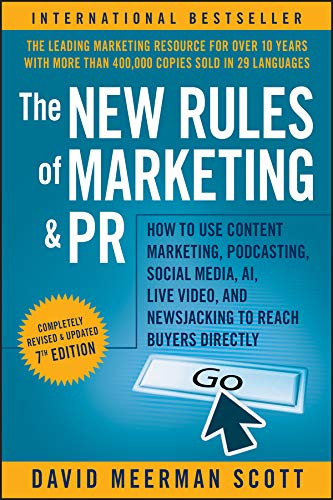
(If you want to learn more about David Meerman Scott’s blogging strategies, check out his book The New Rules of Marketing & PR (7th Edition) wherever books are sold.)

Don’t forget to subscribe! Get daily insights to level up your life delivered directly to your inbox.

The Transitive Property of Belief

Time for a math lesson! Bear with me—it matters.

The Transitive Property of Mathematics says this: for all real numbers x, y, and z, if x=y and y=z, then x=z also.

That makes sense, right?

Why am I telling you this? Because this same mathematical property affects all outcomes you experience in life.

Think about it: how you see an aspect of reality affects how you behave. How you behave affects the results you get. Therefore, how you see things affects the results you get. X=Y and Y=Z, so X=Z as well.

Dr. Stephen R. Covey called this the “See-Do-Get Continuum.” How we see the world affects what we do, which affects what we get in life. (You can learn all about it in his monumental work The 7 Habits of Highly Effective People.)

Covey likes to say, “How we see the problem is the problem.” In this case, “seeing” could also translate into “believing.”

Here’s an example:

Let’s say you’re a manager and you’ve recently had a few millennials added to your team. If you believe all millennials are lazy and entitled, you’re going to treat them as such. This will so alienate them and undermine your relationship that pretty soon, they’ll start acting out.

Most likely they’ll rebel against you by doing the bare minimum, scraping by because in their minds nothing they do will be good enough to please you anyway. Why should they put out more effort than necessary?

How you saw them affected your behavior towards them, which affected how they behaved (your results). It’s the Pygmalion Effect, a self-fulfilling prophecy.

Can you see how this continuum affects us when it come to things like race, gender, or religion? Our beliefs shape our actions; our actions shape our outcomes.

So what’s the bottom line?

If you want to change the world—or maybe just your situation in it—start first by changing your beliefs. Work first on how you see things.

Don’t forget to subscribe!

A childish sense of wonder

We have completely lost our sense of wonder. Everyone’s in such a hurry that we can’t take the time to appreciate the little things that surround us.

I was out for my daily Artist’s walk and passed a mom and her child. The child was taking tiny steps left and right into the grass, off the path, fascinated by every little thing that he saw. 

Meanwhile the dad was snapping impatiently at the son and the wife: “Hurry up, move faster! Come on, let’s go, let’s get out of here!” 

I was so pleased to see mom stand up for her little boy. She said, “But Daddy, there’s so much to see!“ There was, and he was adamant about exploring every bit of it.

  • What if we could once again find fulfillment from the grass between our toes?
  • How much nicer would life be if a special pinecone fascinated us?
  • Remember that feeling of finding an unusual leaf and wanting nothing more than to stick it in your pocket and take it home?

We could all use a little bit more of that childish wonder in our lives.

The correct thing? Or the right thing?

Sometimes we have a choice between what is correct and what is right.

What’s “correct” is often bureaucratic or compliant with rules and regulations. Often those same rules and regulations fly in the face of common sense, decency, and the dignity we owe others.

When a customer’s computer catches fire with no fault on their part, obviously due to a manufacturer’s defect, we have a choice. We can do the correct thing: quote the manual and say there’s nothing we can do. Or worse yet, we can say:

“You should have bought the warranty.”

Or we can do the right thing: acknowledge the problem and take responsibility. We can help the person who put her faith in us and our product or service.

Correct or right—it’s a choice.

We must improve our ability to make the proper choice when the time comes.

Don’t forget to subscribe!

What’s Your “Why”?

Some people see this and think I mean “What gets you out of bed in the morning?”

They’d be wrong. Plenty of us have very little that gets us out of bed in the morning.

Maybe we have jobs we hate. Or tough relationships that don’t fulfill us. Or life situations we can’t seem to escape.

If you don’t have that “something” yet, think about it this way:

“What would make you WANT to get out of bed in the morning?”

My “why” has everything to do with my own personal freedom.

  • The freedom to rule my daily schedule
  • The freedom to control my income (however high or low I want it)
  • Freedom from debt
  • Giving my wife freedom to pursue whatever work, career, project, or lifestyle she desires

But I also feel I have a purpose that involves helping other people find freedom, happiness, and joy in their lives. And I genuinely believe the best way to do that is to help them create and run successful businesses or freelance practices.

Why? Because it’s the best way for them to have the freedom to live life on their terms. To do what they love and help the people they want to help. To make the difference they seek to make in the world. 

And I feel like I can achieve that purpose as a copywriter and marketer. That work helps people serve their customers, grow their businesses, and achieve the kind of freedom I’m talking about.

What’s your “why”? Tell me in the comments below.

Don’t forget to subscribe!

Why Would You Intentionally Confuse Them?

If your goal is to get someone to buy from you (or trust, believe, understand, or empathize with you), why would you intentionally confuse them?

Why make it harder than necessary to get the information they need to make a decision?

Why use confusing phrases or vague points in an attempt to hide the cost of your product?

Do you think it makes them more likely to take action? Really it will frustrate them, damage any trust that’s already been built, and push them away.

“If you confuse, you lose.”

Donald Miller

Make things direct and clear, especially prices. Don’t hide the truth because you’re worried about sticker shock or how someone will react.

If you feel the need to hide it, you might need to rethink what you’re doing. That goes for everything you do, not just selling.

Get daily insights delivered directly to your inbox. Subscribe today!

Who’s It For?

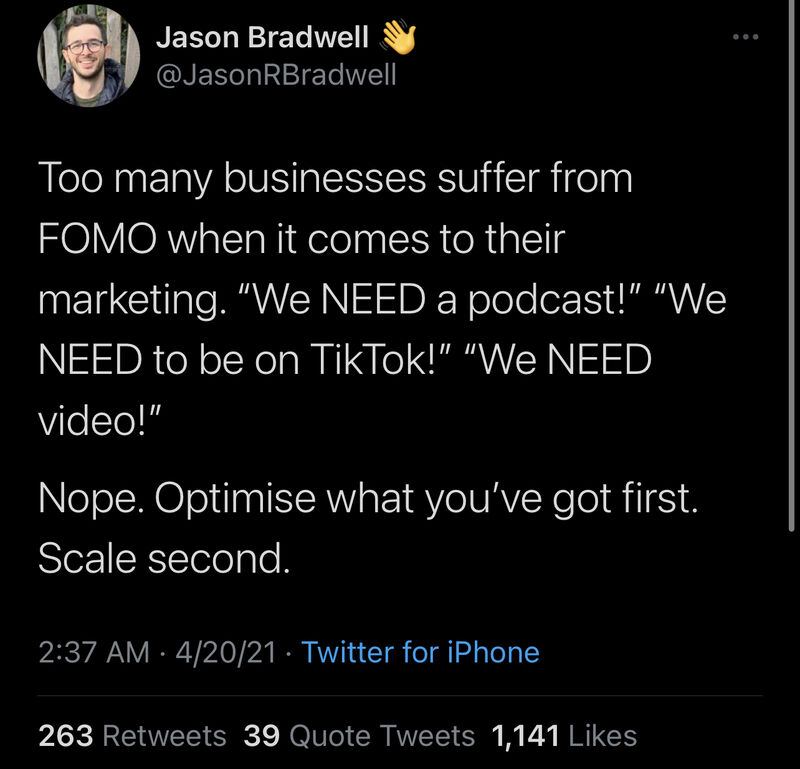
Jason Bradwell tweeted this a while back:

“Too many businesses suffer from FOMO [Fear of Missing Out] when it comes to their marketing. ‘We NEED a podcast!’ We NEED to be on TikTok!’

We’re all marketers now, trying to change the culture and influence others (hopefully for the better). But we have a problem: we get so caught up trying to figure out the tools and tactics, we stop focusing on the people!

What if your target audience isn’t ON TikTok?

What if your ideal customers don’t LISTEN to podcasts?

Why use those platforms if they aren’t helping you reach the right people?

“Who’s it for?” is the first question we should be asking.

H/t to Seth Godin for teaching me what’s most important in marketing.

(Here’s the original post if you’re interested.)

Learn how to make the world better. Subscribe today!

Are you using “someday” to procrastinate?

Seth Godin wrote a very short blog post today you need to read. (Click here to read it)

I taught a class on this very subject yesterday afternoon. 

The students all had these grand plans to accomplish big goals for their budding businesses. But I told them: without a deadline to meet, they wouldn’t succeed.

By the end of it, all 71 of my students had a date certain for when they’d accomplish their goals. And we worked together to develop daily action steps to get there, too. 

“Someday” isn’t a day on the calendar. Declare your date and make it happen. 

(It never ceases to amaze me how Seth’s shortest posts seem to be the most insightful and relevant.)

Make sure you read his post here. And subscribe to his newsletter—it’s the most insightful email you’ll read each day.

It’s Just a Simple Fear of Failing

Dan Miller sent out an email a couple of weeks ago entitled “Why Are You Stuck?” It struck a nerve in me, so I pinned that email to the top of my inbox and read it every day for the last two weeks.

Today, I finally took the time to craft a response and send it back to him. I thought I’d share it with you as well.

I’m a great writer—in fact, I do that in my day job. That, combined with my teaching experience, is why I was hired. Because I’m good at, and enjoy, writing, I keep thinking about, journaling about, and contemplating becoming a freelance copywriter as a 15-hour a week side business.

(Click here if you’d want to learn how YOU can start a business with only 15 hours per week)

I eventually want to become a full-time marketing consultant and a business coach for aspiring entrepreneurs and small business folks. I’m already doing the latter as part of my day job, just not as often as I’d like.

And…I keep getting cold feet, talking myself out of it. But today, I think I’ve finally been able to express what’s holding me back. It’s not a fear of cold-calling people or getting rejected…

I’m afraid I’m going to let them down! I’m afraid I’m going to fail to live up to my prices. Or write bad copy. Or that I’ll wireframe and write copy for a website, and it won’t work! I’m terrified of charging someone money for something and failing to deliver what I promised.

It seems disappointingly simple that my hold-ups come down to a simple fear of failure. But there it is. Dan asked me the question, and this morning I finally had an answer for him.

What’s holding you back? Maybe you’re thinking of starting a business or becoming a freelancer yourself. If so, I encourage you to click here and enter your email address.

You’ll instantly receive three free resources including 10 business ideas and how to start a business with only 15 hours per week!

Don’t miss a post! Subscribe today.

***Occasionally I include affiliate links in my posts for people and products in which I strongly believe. This is one of those posts.***

They’re Just Figuring It Out As They Go

What do you do when your parents die? When you become the adult?

Now you’re the spouse, the parent, the one who’s supposed to have all the answers.

When you’re young, your parents seem larger than life—superheroes who can swoop in and save the day. They’re wise sages who seem to have an answer to every problem in the world.

But as you grow up, you realize a poignant point: they’re just trying to figure things out as they go.

Just like you.

So what do you do when your parents finally leave this world?

You go on, just as they did, trying to figure things out as you go. And you make a lot of mistakes, just like they did.

But now things are just a little bit quieter, a little emptier. You feel just a bit…lonely.

Goodbye, Dad.