Same job, different pay

I saw a job posting’s salary description the other day that gave me pause.

The salary was dependent on three things:

  1. The number of courses taught (yeah, that makes sense. More work = more pay)
  2. The type of courses taught (More advanced courses = more difficulty = more pay. Also makes sense)
  3. The educational level held by the instructor…

That third item is the one that gave me pause. Here’s why:

If two people are doing the exact same type of work at the exact same level of quality, why should one with a higher-level degree be paid more than the person with a lower-level degree?

You might say, “Well, they went to school longer. They have more education. They’re more qualified.”

So what? Does that degree automatically mean that the person is more skilled at the job? No, not at all. 1

More education does not automatically confer a higher level of qualification or suitability for a job. The skill of the person, and nothing else, does that.

If the person with the higher degree actually delivers more or better work than the other, then I understand receiving more pay. They are arguably more valuable. But that has nothing to do with the degree and everything to do with the output of the worker.

Additional education might enable that higher quality, but then again, it might not. There are countless MBA graduates out there who are suitable for little more than responding to email or working in middle management. They would flounder trying to run a small business.

Perhaps changing the nature of the work in question would make this make more sense:

Let’s say Person A has a master’s degree in burger-flipping, and Person B has a bachelor’s degree in burger-flipping. But both workers flip the same number of burgers each hour at the same level of quality expected of anyone on the line.

Should Person A be paid more money simply because they got a master’s degree in the subject? I would argue no, because the quality of the output and the nature of the work are the same.

You might think I’m stretching this a bit, but I’m not. It’s the work that matters, the output, the results.

A person’s demonstrable skill determines their qualifications, not a piece of paper. That paper is often a false proxy for genuine qualification, a stand-in for real value.

But we buy into it because we’ve been trained to believe that more is better, higher is better. We must stop this.

We have to start measuring the proper targets and rewarding the right things appropriately.


  1. I’m aware that teachers are paid at different salary levels based on their educational levels (e.g., a master’s degree earns more income than a bachelor’s degree. However, just because that’s the case doesn’t make it right.

    Teachers should not be paid based on how much schooling they received, but on how good they are at schooling others. If someone with a master’s degree is educating students in a way that they outscore everyone else, then I can understand paying that teacher more (and she should share her secrets with everyone else so they can level up their students and make more money too!).

    Also, teachers should simply be paid substantially more than they currently earn, but that’s a topic for another day… ↩︎

The greater the risk, the greater the reward

I often ask (and I’m sure you do too) why all these brilliant “bad guys” in the world don’t put their skills to use for good?

Oddly enough, I found an answer in an unlikely (or, depending on your worldview, very likely) place: investing.

Scott Galloway, in his book The Algebra of Wealth, discusses the ratios of risk to reward in the stock market. For many high-risk investments, the reward is outrageous, but the risk is destructive.

So the obvious answer to the question is that bad guys make more money via crime than if they put those same skills to use for a legitimate employer.

They have massive potential upside, potentially millions of dollars.

But the downside is worse than what most are willing to pay: risking lengthy prison sentences isn’t appealing to most people who would also love to make $50 million in a few hours. But for a select few, it’s the lifestyle they want.

So, you probably already knew this, but some things are worth putting into words.

What to charge for & what to give away

Musicians are known for being asked to do work for free—possibly more than any other profession I’ve ever encountered.

For some reason—maybe because it’s intangible—people feel as though they shouldn’t have to pay for most things musically related. 

Maybe some of the blame could be put on the radio or Spotify, both of which have led to the idea that music is free (it isn’t). 

But this is especially true when it comes to paying for real musicians to play at events. 

In one recent instance I know of, a musician was hired to play at a wedding. But after getting the deposit and preparing for the service, this person was asked to create a personal recording of a specific song for the newly engaged couple. 

And they expected it for free.

Nowhere in the contract was that stipulated, and any sort of personalized experience of any kind costs money (think photography, art, software, or consulting service).

But they expected a freebie. 

This is a problem for a number of reasons: one of which, it isn’t as simple as turning on your iPhone camera and playing for 3 minutes. It takes a lot more time, work, and equipment to do that right. 

For another reason, there have been way too many instances where people have taken a recording from someone’s social media page or YouTube channel and played it over a speaker. Without the musician’s permission and without paying. 

In a number of instances I know of, they canceled the musicians and used the recorded music instead.

This is something that’s just not done. 

You also don’t expect a photographer to work your wedding for free. And if you want a sample, what do you do? You go to their social media page. It’s always there and always free. 

You also don’t ask potential employees to do a project for free before you decide whether or not to hire them. Give them a spec project, sure. But pay for the work. 

Imagine you were walking through an open food market. Would you walk up to a fruit vendor and demand to eat an entire apple for free to determine whether or not you wanted to buy a bushel from the stand? 

Absolutely not. You’d expect to pay for each piece of fruit consumed. 

So what to do about these expectations of free? The solution, I’ve found, is simple: 

  1. ALWAYS charge for what you charge for
  2. ALWAYS give away for free what you give away for free

And NEVER compromise on either. 

If you want free music, check out the artist’s Spotify channel, their YouTube videos, or their social media pages. You’ll find all sorts of free music there. And it’s ALWAYS free.

But if you want something personal and specific to you, that costs money—ALWAYS.

If you want free marketing advice from me, check out my blog, There are hundreds of articles to help you. 

But if you want a consultation or some copy written, that’s gonna cost you money. 

If you want a free email marketing service, sign up for HubSpot Free. You get everything you need to start building an email list. But know you only have a 500 subscriber limit before they start charging you massive amounts of money.

If you want free, you get the same generic, free stuff everyone else does. But if you want personalized, custom, special experiences, you’ve gotta pay for it. 

Accept this as the reality of a free market.

And for God’s sake — stop asking musicians to play for free! You don’t ask it of any other profession. Why do you still do it with musicians?

Would you do it for $10 million?

What would you do if you had $10 million dollars?

Would you really want to be the CEO of a major corporation?

Or a doctor? Lawyer? Or any of the other things we’re supposed to want to be when we grow up?

Because of our obsession with making and having more, we chase job opportunities and career paths that seem to “guarantee” a lot of money (even though there is no such guarantee). And often, that’s the sole purpose for pursuing such roles.

Not because we want to make hard decisions (that’s what the CEO does)…

Or because we want to spend countless hours expending the intense, exhausting, emotional labor required to help people survive and thrive (the doctor)…

We pursue them because of the ones and zeroes (supposedly) attached to the titles.

Now—making a living, on the other hand, is absolutely necessary. If you’re living on the verge of homelessness (or actually homeless), you might not have the luxury of saying no to “big money” opportunities.

But that’s not the conversation we’re having here.

When the wolves have backed away from the door—when your kids are fed and the light bill is paid—it’s a good idea to consider why you’re chasing whatever “big money” career you’re thinking of doing.

A great question to ask yourself when considering career paths, educational opportunities, certifications, or whatever else, is this:

“Would I still want to do this if I had $10 million dollars in the bank?”

Are you doing it because you want the money? Or are you doing it because you actually want to put in the time and effort to become a master at the craft?

If you wouldn’t do it if you already had $10 million in the bank, you might want to reconsider whether it’s worth doing at all.

Getting paid for what’s easy

It doesn’t happen. At least, not in the ways or amounts we want it to.

People don’t want to have to think for a living. They want to make money for easy work…

And thinking, making decisions, being creative—none of that is easy.

But those are precisely the things that people get paid the most for. They’re the only things that’ll help us survive in the modern economy.

The easy work is disappearing… We must embrace the hard work—the work that isn’t easy to measure.

Don’t Try to Be Famous—Solve Problems Instead

Controversial Opinion: Becoming a social media influencer is NOT the best way to thrive in today’s economy. 

Yes—there are people on TikTok, Instagram, and all the other platforms making a fortune. 

Social media influencing is the new Hollywood. Most of us only see the handful of big-name players making fortunes, and we assume we can easily do that too.

What we miss are the hundreds or thousands of actors making little to nothing in the entertainment industry or working odd jobs to pay the bills.

There isn’t anything wrong with that, but our culture is telling us we can all do this on social media now. 

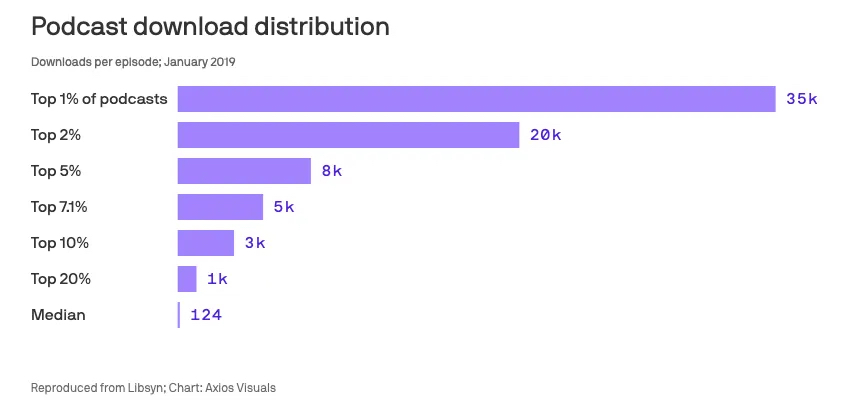
Ever heard of the long tail? Here’s an example (about podcasts):

50% or more of all podcasts have only been listened to by 124 people… Which is not a sustainable business model. 

This is a power-law curve, and it applies to just about everything.

If you solve problems for people by BEING one of those influencers, that’s a different story.

But measuring your success and hoping one of these companies will pay you a fortune for hits on your content is a bad way to live your life.

Commonsense, fundamental money principles combined with a steady income from solving problems for people over a long period of time.

This is the way to make a fortune. It’s just not slick or instant, so it isn’t sexy. 

Subscribe below for daily insights, resources, and content delivered directly to your inbox.

Your Job Is Making Money for Other People…Not Yourself

What I learned from Donald Miller this morning:

(I’m paraphrasing) The goal of any business professional is not to make a lot of money… The goal is to make a lot of money FOR OTHER PEOPLE!

How true this is for all of us in the business arena. It doesn’t matter if you’re an employee, a small business owner, or a serial entrepreneur.

Your job is to help other people make money. That’s the only reason you get paid.

As a copywriter and marketer, my sole purpose is to help my clients make more money from their products and services. It’s how the only way to measure how successful I am in my role.

Shift the focus away from yourself. Think about your employer, your customer, or your client. 

What are you doing to make them more money?

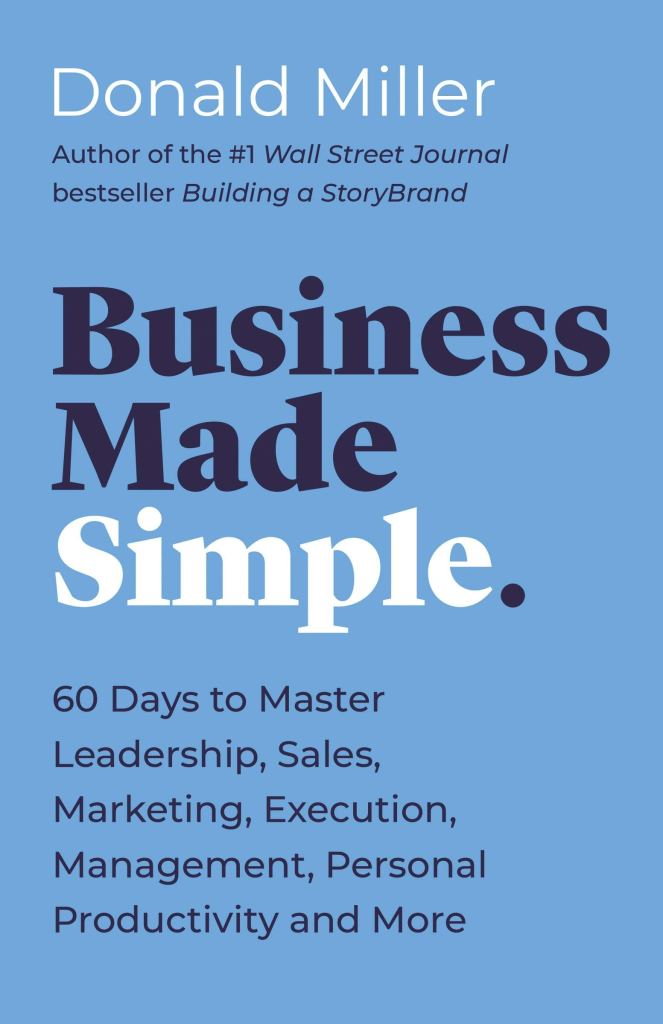
P.S. Donald Miller’s new book, Business Made Simple, launched today. If you’re ready to level up in your career or business, and become a value driven professional, grab a copy today. 

It might be the most valuable $20 you spend this year…

Get daily insights on life, business, and creativity. Subscribe today!

Only with Action Can You Hope to Make a Difference

No one ever got paid for an idea alone. Only those who came up with an idea, or took someone else’s, and acted upon it have made a difference worth anything.

“I have more respect for the fellow with a single idea who gets there than for the fellow with a thousand ideas who does nothing.”

—Thomas Edison

I have dozens of ideas pop into my head each day when I’m taking a shower, walking at the park, or driving in silence. Not one has generated anything for me or anyone else except those I showed to the world. 

Better to have one idea and the will to act upon it than 1,000 ideas and procrastinate.

Want more insights? Subscribe below!

Why is freelancing so terrifying?

We human beings like security – it encompasses the first two levels of Maslow’s “Hierarchy of Needs.” It’s fundamental.

To get that feeling of security, we work hourly wage jobs; we try to get hired at famous companies for regular, unchanging salaries with hopes for a 3% raise every year (which doesn’t outpace inflation).

Freelancing – being “a knight without a king” as Seth Godin likes to say – seemingly goes against that feeling of security. There is no guarantee; you don’t get paid simply for showing up somewhere for a specified amount of time.

But it’s better.

The illusion

There is no security in hourly rates; there is no security in working for a famous company. As the COVID-19 pandemic has shown us, the moment something bad or unexpected happens, your security is at risk.

The security is an illusion. No longer can we work at the same company for 20 years, slowly moving up a corporate ladder, waiting for that day when we call it quits and HR hands us a gold watch and the envelope containing our pension information.

There is no security anymore. There is only you.

“Security lies in our ability to produce.”

–General Douglas MacArthur

Make your own security

What do you already know or do well?

Can you write? Create websites? Draw and paint? Build things with your hands? Sell?

Maybe you’re a whiz at smoothing customers’ ruffled feathers. Perhaps you have a knack for motivating and encouraging other people.

There is something you already do, or something you already know about, that other people are willing to pay for. You simply have to muster the courage to offer it to them.

Each of us must explicitly state to ourselves what we know how to do and do well. That knowledge and the willingness to execute on it are the only things that give us any sort of real security in the workplace.

If you can find someone and offer them something they are willing to pay for, and do that over and over again, you are a freelancer. You have no boss, no one telling you what to do next, but also no one telling you, “I’m sorry but we have to let you go.”

You have no guarantee of income – in either direction! You can make as little or as much as you want, as long as people are willing to pay for it. But I’ll bet you got stopped on the phrase “no guarantee” or “as little…as you want” while glossing over the rest of it.

As a freelancer, you determine your job, the work you do, your hours, the people you serve. Perhaps it’s not the loss of security you fear: it’s the fear of complete and total responsibility for your success or failure.

We aren’t used to that, but it’s the only way we’ll survive.

Secure your own future today. Don’t wait for someone else to do it for you.

Join 904 other subscribers

You are self-employed

All of us, if we do work that causes us to get paid, are self-employed. It doesn’t matter who signs our paychecks–we work for ourselves.

What does it mean to be self-employed? It means you are your own boss. It means your income is based on your work.

If a freelancer or entrepreneur doesn’t show up for work–if they don’t create enough value for another person–they don’t get paid. This is obvious when you don’t work for a big company with payroll every two weeks.

What about the salesperson working on commission who does have someone who signs her paycheck? If she doesn’t contact the customer, provide value to that customer, and make a sale, she doesn’t get paid.

What about you? The hourly worker or the salaried cubicle-dweller (perhaps virtual cubicle-dweller is more accurate right now)? What happens if you don’t show up for work?

You don’t get paid.

What happens if you fail to create value for the company that employs you?

You get fired.

As soon as you realize you are self-employed–as soon as you realize that you are responsible for the value you create and the income you generate, regardless of how you get paid–you will secure your future.

Even if you are laid off, the attitude of self-employment will cause you to stand out from droves of people who want to know what a company can do for them rather than what they can do for their potential employer.

Adopt the self-employed mindset and you’ll rarely have to worry where your next paycheck comes from.

Join 904 other subscribers