Your Job Is Making Money for Other People…Not Yourself

What I learned from Donald Miller this morning:

(I’m paraphrasing) The goal of any business professional is not to make a lot of money… The goal is to make a lot of money FOR OTHER PEOPLE!

How true this is for all of us in the business arena. It doesn’t matter if you’re an employee, a small business owner, or a serial entrepreneur.

Your job is to help other people make money. That’s the only reason you get paid.

As a copywriter and marketer, my sole purpose is to help my clients make more money from their products and services. It’s how the only way to measure how successful I am in my role.

Shift the focus away from yourself. Think about your employer, your customer, or your client. 

What are you doing to make them more money?

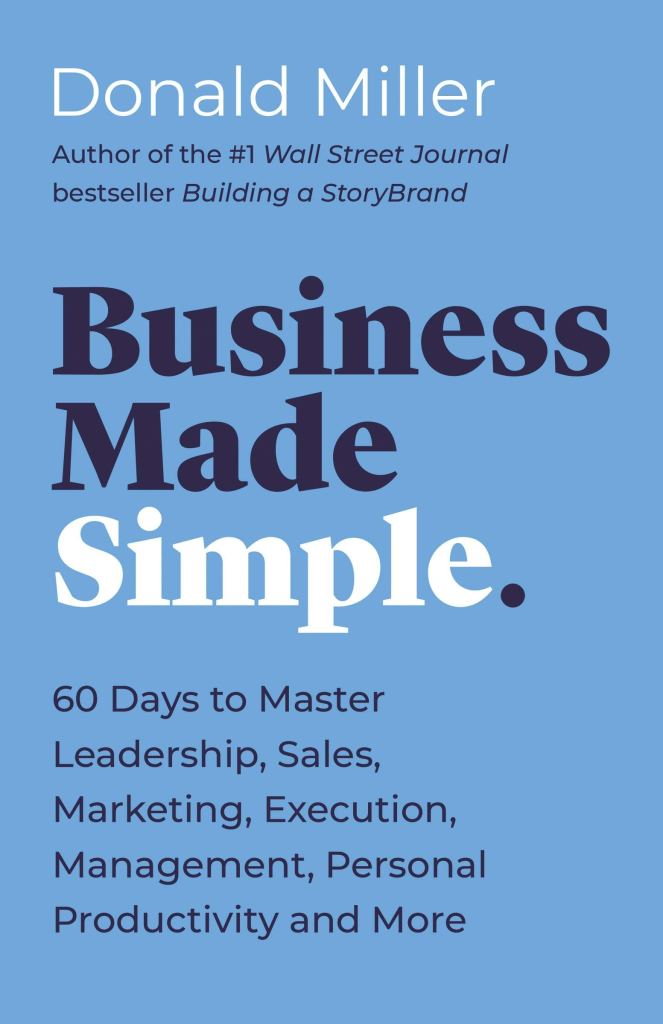
P.S. Donald Miller’s new book, Business Made Simple, launched today. If you’re ready to level up in your career or business, and become a value driven professional, grab a copy today. 

It might be the most valuable $20 you spend this year…

Get daily insights on life, business, and creativity. Subscribe today!

Speak Your Dreams Into Reality Today

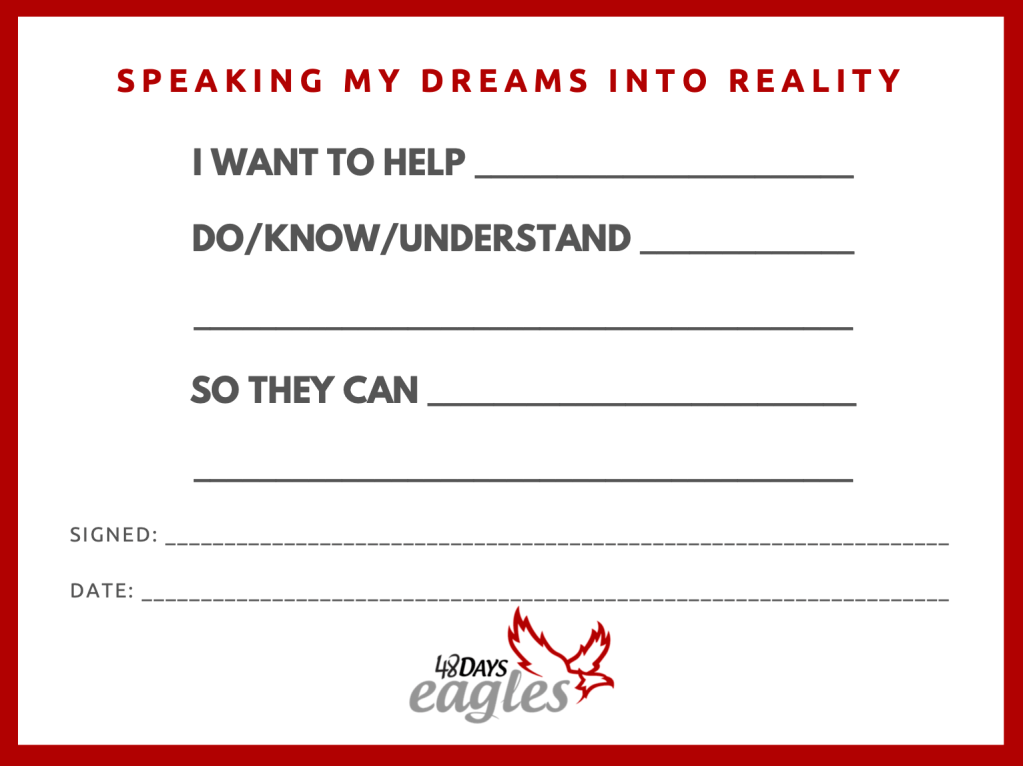
I got an email from the 48 Days Eagles (affiliate link) asking what my main business goal is for 2021. I thought I’d share it with you as well. So here goes:

“I want to help small businesses and entrepreneurs write better copy for their websites and marketing efforts so they can increase the sales of their products and services and grow their businesses.”

Why do I want to do this? Because if I can help others succeed in their business endeavors, they’ll be able to live out their hopes and dreams.

Now it’s your turn. Use this awesome layout to create your own business goal.

What’s your dream? Have you spoken it into reality yet?

And most importantly, can I help you with your dream or business?

Let me know in the comments!

Think and Grow Rich in 2021

CLICK HERE TO JOIN US (affiliate link)

What are you excited about for 2021? One of the things I’m really looking forward to is a study of Napoleon HIll’s Think and Grow Rich. I’ll be doing this with my 48 Days Eagles Community of entrepreneurs and its founder Dan Miller, author of the New York Times Bestseller 48 Days To the Work and Life You Love.

We’re kicking it off with a family movie night. We’ll all be watching the movie online together on January 19th. Then we’ll start our study on January 25th, focusing on one chapter a month. And we’ll be meeting the fourth Monday of each month to discuss our readings.

Join us! It will be life-changing for you and me.

CLICK HERE TO JOIN US (affiliate link)

Get daily riffs, resources, and reflections. Subscribe below!

Make Money Working In Your Sweet Spot (Free Masterclass)

CLICK HERE TO SAVE YOUR SPOT

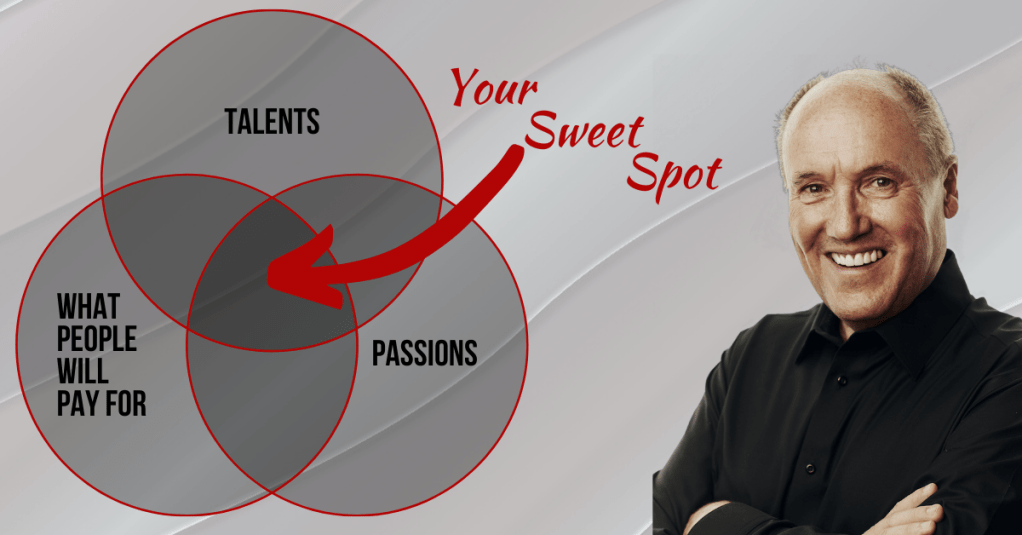
If you’re hoping to begin living a fulfilled and meaningful life while still making a nice living for your family, you have to find your sweet spot.

We all have one. It’s the place where our passions and talents meet the world’s willingness to pay us.

My friend and mentor Dan Miller, author of the New York Times Bestseller 48 Days To the Work and Life You Love, is hosting a webinar on Thursday, January 14th to take you through the steps of determining your own unique sweet spot.

There are two times to choose from: 1pm CST and 7pm CST.

CLICK HERE TO SAVE YOUR SPOT

Never miss a post! Subscribe below!

*Occasionally, I’ll create posts with affiliate links. These don’t cost you a penny but can result in a small commission for me if you purchase anything.

Are You Buying What You’re Selling?

Zig Ziglar, the great motivator and sales trainer, found a mantra in the word “enthusiasm.” To him, the last four letters stood for “I am sold myself.”

Zig was a master salesman. He knew if you didn’t believe in what you were selling, that lack of enthusiasm would come across to the prospect.

But what about when you’re not selling a product? What if the thing you’re selling is yourself, and your customer is a potential employer?

This same idea holds true in the job hunt. If you’re trying to persuade an employer to hire you, you have to believe in the product. 

If you’re a freelancer trying to convince a company to use your freelance services, you’re selling a product you must believe in. 

If you’re not enthusiastic about what you have to offer, they won’t be either.

If you don’t believe in yourself, they won’t want to buy your product. And make no mistake: you are the product. 

Grow your enthusiasm. Know what you have to offer; understand what you do best; determine how you can best serve others. And believe that it will benefit another person.

Sell yourself on you.

“You can have everything in life you want, if you just help enough people get what they want.”—Zig Ziglar

Get a daily dose of inspiration. Subscribe below!

Should You Get Paid Every Time You Send an Email?

Wouldn’t it be great if you got paid every time you sent an email? I dunno about you, but I’d love to live in that world. 

I send hundreds each week. If I earned the price of a postage stamp on each one, I could make a pretty easy living.

Am I Devaluing Myself?

I’m an up-and-coming copywriter. To make a living, I spend several hours each week reaching out to potential clients, offering them my services as a writer and marketer. I do this because I’m a salesperson. And if you’re trying to make a living in a similar way, so are you. 

I recently came across a Twitter post telling me that I was devaluing my work by selling myself. To sum it up, the writer said I should either:

  1. Have clients beating a path to my door willing to pay me, OR 
  2. I should get paid every time I send an email, proposal, or pitch to a potential client before any work is done. 

I understand the author’s point. My time is valuable, and it stinks when I feel I’ve “wasted” my time pitching to someone who doesn’t buy. But I 100% disagree.

Sales Professionals Don’t Get Paid to Prospect

How do professional salespeople get paid? They sell a product and get paid a commission. They don’t get paid when they prospect or send proposals to customers. The only way they make money is by closing a sale. 

I sell a service, and I only get paid if I provide that service. And that service is not pitching ideas. If it was, I’d be a billionaire right now because I have a few thousand ideas each day, and most of them are awful.

Selling Your Service Is Like Applying for a Job

Each time I pitch a client, I’m putting in a job application. Think about all the jobs you’ve applied for in your adult life. What if you got paid for every job application you ever completed? Wouldn’t that make for an awesome career?

Often we don’t have a lot of experience for the jobs we are applying for, especially if we are new to the workforce or a field. When asked what a beginner should do, the Tweeter said, “get paid to pitch.”

We’ve all gotten those phone calls from sleazy salespeople. Does this sound familiar?

“I’ve got this great new system that will keep you from paying any taxes this year. But I can only tell you what it is if you sign a non-disclosure agreement and pay me $2,000 upfront.”

You know you’re losing money and going to jail if you get in bed with that guy. You don’t want to have anything to do with an idea you can only hear after signing an NDA and paying upfront.

How to ACTUALLY Get Paid to Pitch 

There are two parts to this tactic:

  1. Charge higher prices to compensate for the inevitable rejections you’ll get.
  2. Overdeliver to your clients and customers so it’s worth paying you higher prices!

One of my favorite phrases comes from the marketing genius Seth Godin:

“You’ll pay a lot, but you’ll get more than you paid for.”

That is the only way this guy’s Tweet works. 

Selling Is Tough

I get it. Creating proposals, pitching to customers, and facing possible rejection—it really stinks. It takes a lot of time and hard work. It’s frustrating. 

But let me be clear: THAT DOESN’T MEAN ANYONE OWES YOU ANYTHING!

The world doesn’t work that way. We are all in sales, and much of that involves reaching out to others. It means facing the very real possibility of rejection coupled with no monetary gain. 

So go ahead and pitch. And if you want to get paid for that, build the cost into your pricing structure. 

But make sure you overdeliver on that promise to your customer. 

Feeling inspired? Like, comment, and share so others can benefit! And subscribe below!

Why is freelancing so terrifying?

We human beings like security – it encompasses the first two levels of Maslow’s “Hierarchy of Needs.” It’s fundamental.

To get that feeling of security, we work hourly wage jobs; we try to get hired at famous companies for regular, unchanging salaries with hopes for a 3% raise every year (which doesn’t outpace inflation).

Freelancing – being “a knight without a king” as Seth Godin likes to say – seemingly goes against that feeling of security. There is no guarantee; you don’t get paid simply for showing up somewhere for a specified amount of time.

But it’s better.

The illusion

There is no security in hourly rates; there is no security in working for a famous company. As the COVID-19 pandemic has shown us, the moment something bad or unexpected happens, your security is at risk.

The security is an illusion. No longer can we work at the same company for 20 years, slowly moving up a corporate ladder, waiting for that day when we call it quits and HR hands us a gold watch and the envelope containing our pension information.

There is no security anymore. There is only you.

“Security lies in our ability to produce.”

–General Douglas MacArthur

Make your own security

What do you already know or do well?

Can you write? Create websites? Draw and paint? Build things with your hands? Sell?

Maybe you’re a whiz at smoothing customers’ ruffled feathers. Perhaps you have a knack for motivating and encouraging other people.

There is something you already do, or something you already know about, that other people are willing to pay for. You simply have to muster the courage to offer it to them.

Each of us must explicitly state to ourselves what we know how to do and do well. That knowledge and the willingness to execute on it are the only things that give us any sort of real security in the workplace.

If you can find someone and offer them something they are willing to pay for, and do that over and over again, you are a freelancer. You have no boss, no one telling you what to do next, but also no one telling you, “I’m sorry but we have to let you go.”

You have no guarantee of income – in either direction! You can make as little or as much as you want, as long as people are willing to pay for it. But I’ll bet you got stopped on the phrase “no guarantee” or “as little…as you want” while glossing over the rest of it.

As a freelancer, you determine your job, the work you do, your hours, the people you serve. Perhaps it’s not the loss of security you fear: it’s the fear of complete and total responsibility for your success or failure.

We aren’t used to that, but it’s the only way we’ll survive.

Secure your own future today. Don’t wait for someone else to do it for you.

Join 904 other subscribers

You are self-employed

All of us, if we do work that causes us to get paid, are self-employed. It doesn’t matter who signs our paychecks–we work for ourselves.

What does it mean to be self-employed? It means you are your own boss. It means your income is based on your work.

If a freelancer or entrepreneur doesn’t show up for work–if they don’t create enough value for another person–they don’t get paid. This is obvious when you don’t work for a big company with payroll every two weeks.

What about the salesperson working on commission who does have someone who signs her paycheck? If she doesn’t contact the customer, provide value to that customer, and make a sale, she doesn’t get paid.

What about you? The hourly worker or the salaried cubicle-dweller (perhaps virtual cubicle-dweller is more accurate right now)? What happens if you don’t show up for work?

You don’t get paid.

What happens if you fail to create value for the company that employs you?

You get fired.

As soon as you realize you are self-employed–as soon as you realize that you are responsible for the value you create and the income you generate, regardless of how you get paid–you will secure your future.

Even if you are laid off, the attitude of self-employment will cause you to stand out from droves of people who want to know what a company can do for them rather than what they can do for their potential employer.

Adopt the self-employed mindset and you’ll rarely have to worry where your next paycheck comes from.

Join 904 other subscribers

Make a huge difference with one small behavior change

In his second great book, The 8th Habit: From Effectiveness to Greatness, relates the story of Muhammad Yunus, an economics professor who founded the Grameen Bank – an institution that makes microloans to the impoverished citizens of Bangledesh. His story deserves to be quoted at length, but I will not do that here. What follows is a summary.

Muhmmad Yunus Saw a Need

Muhammad Yunus earned a Ph.D. and began teaching economics at a university in Bangladesh. While he was inside lecturing on macroeconomic principles, the citizens of Bangladesh were struggling to survive in a life of abject poverty.

One day when Dr. Yunus walked out of class, he passed a woman making beautiful, handmade bamboo chairs. Upon further discussion, he determined the woman was making two pennies per day.

Why? Because she was in a terrible arrangement with her supplier who only allowed her to sell the chairs back to him. Dr. Yunus then discovered that the woman only needed $0.20-0.25 cents to buy the materials herself, then she would no longer be in bonded labor to the supplier.

He discovered that other citizens were struggling in much the same way. His assistant went around asking how much money different people in his neighborhood needed to make a living: he reported back that all together they needed $27.

TWENTY-SEVEN DOLLARS! Dr. Yunus took that money out of his wallet, gave it to his assistant, and told him to tell those who were receiving the money simply to pay him back whenever they could (which they all did, eagerly and quickly).

Dr. Yunus Met a Need

There is much more to the story than that, including a long battle with banks in the area who did not believe anyone would pay back the money that was loaned to them (which they did). Dr. Yunus discovered, simply by opening his eyes and talking to people around him, that while he might not be changing the world with a $27 loan, he was changing someone’s world.

Dr. Yunus went on to create and found his own financial institution, Grameen Bank, which specializes in making small loans to people all over Bangladesh so they can create businesses, making a living, and pull themselves out of poverty. To this day it has loaned billions of dollars in microcredit to hundreds of millions of citizens, and it changed their lives.

Why am I telling you this story?

What You Need to Do

Change how you move through the world. Today, and each day for the rest of your life, when you drive around town, walk outside, or even scroll through social media, pay attention to the people.

What are they doing? What are they posting on social media? Can you identify a need in what they are saying? Are they struggling to accomplish a task or project?

Are they asking a question to which you know the answer or have a solution?

Assume, as Dr. Yunus says, “a worm’s-eye view” of the world. Don’t look for huge problems to solve: look for small, everyday problems. Find someone in need, ask yourself if you have the will and the skill to meet that need, and then do something about it. Show up, solve a problem, and keep doing that over and over again.

Ask yourself if you have the will and skill to meet someone’s need today.

You may not change the world, but you will change that person’s world. Do that enough times, solve enough problems for people, and you might begin to see a greater need that can be met by a business, service, or non-profit.

Find a need, meet the need, and make a difference today.

Join 904 other subscribers

*Note: some links on my site are affiliate links which means I make a small commission for purchases made. This does not affect you in any way.

Stop telling people to avoid the arts

How many of us have told someone that she should choose a real major, one that is applicable in today’s job market, rather than pursue something creative like art, music, or literature?

(RAISES HAND)

Why do we do this? It is well-meaning enough, I suppose: we don’t want them to struggle financially, we don’t want them to fail, we don’t want them to get hurt because it is so hard to live as an artist…

Let’s just stop, shall we?

What if the person to whom you gave this advice is actually quite talented as a writer? What if she has spent so much of her free time drawing, painting, and sculpting that she has become a fantastic artist? Do you really feel comfortable telling her that she should go get her MBA, work in middle management, collect her benefits, get the 401(k) match, and just worry about “all that artsy stuff” in her off hours, because she can’t make real money in the arts? Why is that good advice (especially when that last claim is bogus)?

Handle Money. Fail often.

Why don’t we teach her instead? Let’s make sure that we are teaching our children how to handle their finances, how to live on a budget, spend less than they make, save money, make money, and how to avoid debt at all cost (this is the real reason so many of us starve these days). We should most definitely teach her not to go $100,000 in student loan debt for her MFA in painting, but that does not mean we should tell her not to pursue her passion – those are not the same thing.

At the same time, we should also be teaching her to fail and fail often. Have her start trying to sell her art online. That doesn’t work? Should we tell her that she should quit and go get a real job? No! You don’t tell a child to stop trying to ride a bike because she fell off and scraped her knee; you tell her to get up and encourage her to try again.

Do the same thing with your creative child or friend. Encourage her start teaching other people what it is that she knows. She can make online videos of her work so that others can see it and her ideas will spread. Find whatever avenue works for her.

Encourage

There has never been a better time to be an artist than today – the market is wide open, the possibilities are limitless. You can be an artist in anything at which you are talented; it does not have to be a traditional “art”. Let’s focus on teaching our family and friends the right skills they need to survive and thrive – let’s teach creativity, leadership, personal finance, marketing and storytelling. Then let’s send them forth to pursue that which they most truly enjoy.

If we can teach them to handle money well, and to learn and grow from failure, they will all be fine.

We will all be just fine.