Ruining a business is simple

It amazes me how one person can have such a tremendous effect on a business’s success or failure.

I’m talking, of course, about the experience someone has when they interact with any one individual employee of a business.

If the customer has a bad experience, the obvious thing that’ll happen is they’ll swear off the company completely.

“Well, I’m never going back to that place…”

And the funny thing is this: after a few months, or even a few years, that person who delivered the horrible experience is probably long gone…

Yet you STILL never go back. 

They don’t just ruin things in the moment – they ruin them long-term… Possibly forever. 

And let’s not forget the fact that if the employee threw a tantrum in front of lots of other customers, they probably won’t come back either.

But it goes even further than that.

Do you know what people love to talk about even more than a great experience?

The worst experience they’ve ever had!

That’s why all the reviews for every single business you’ll ever read are 90% one-stars. 

Nobody ever writes about a decent, 3-star experience they had… And we rarely take the time to write about the great experiences – it’s too much work.

But when we’re angry, fuming, and vengeful, nothing gives us more satisfaction than to feel like we’re ruining a business.

So we tell the others. And word spreads. And those people who’ve never had a bad experience with the business decide not to patronize it… For fear of having a bad experience. 

Here’s a simple idea for all of us in business: adopt the ideas of Victor Krulak, the former commandant of the US Marine Corps. 

He wrote about the “strategic corporal” which insists that the entire outcome of a war rests solely on the lowest paid, most beaten-down, hardest working Marine on the frontline. 

That Marine bears the brunt of the fighting. And if they do something terrible, they ruin the image of an entire nation… Especially now that everything is seen by everybody.

The solution is to treat your lowest paid, frontline employees as the most important part of your organization. Because they absolutely are!

Those who deal with customers on a daily basis are the strongest marketing force you have, aside from the customers themselves through word-of-mouth.

Treat them as the most important people in your company, compensate them well, and train them to represent the brand you want your business to embody.


Start with a rough draft

It’s much easier to make your work better if you have something to work with.

You can’t edit your blog post if you haven’t written it yet.

You can’t make your new song swing if you don’t record the demo.

You can’t grow your business if you don’t start by landing one paying customer.

Trying to make things perfect before you put the work down on paper is futile.

Get the rough draft finished. Then go back and make it better.

Rockstars are rare (and they probably aren’t you)

The idea of being a “rockstar” is a relatively new phenomenon. Flying around in a jet, playing music in packed out stadiums for millions of dollars a year—that really only started in the 1960s. 

For most of human history, artists created simply to create. They weren’t seeking fame or fortune. The cavemen who painted the walls at Lascaux didn’t get paid for it…

As time went by, certain arts became trades—skills performed in exchange for money or goods. 

J.S. Bach was a musician, a brilliant and talented one at that. But he was a musician because his father was a musician. He went into the family business. 

Leonardo da Vinci—magnificent genius though he was—was a tradesman. He was NOT our idea of a superstar artist.

These artists were creating to create. It was their day job, but it was also what they wanted to do.

I think the “Rockstar Era” warped our understanding of what being an artist is like for most people… And what it’s supposed to be about.

And that same “Rockstar Era” has fast come to an end. It’s harder and harder for someone to become Taylor Swift or Ye. There was a window to make that happen, and it looks like it’s over. 

There will always be outliers—the artist who sells 10 million records or the TikTok influencer with 1 billion followers.

But it probably won’t happen to you. 

That doesn’t mean you shouldn’t create art. It just means you need to focus your efforts on the act of creation and on service, rather than seeking fame and fortune.

Begging to pay you

Instead of relying on third-party sponsors for your work or your art, why not rely on the people who benefit from it instead?

Rather than having advertisers on your podcasts…

Or big publishers for your book…

Or a major label for your music…

…you instead did work that people loved, needed, and wanted so much that they begged you to let them pay you for it?

What would your work look like if you took that approach?

What if you HAD to start your own business?

I clicked the “Random” button on Seth Godin’s blog yesterday and landed on an old post from 2002.

One passage punched me so hard in the gut that I had to share it with you today in its entirety. 

“Imagine for a second that you just lost your job. Further, imagine that the industry in which you’ve been trained and are working in has just disappeared.

What are you going to do? Are you going to go out and look for another job?

What if there were no choice… what if you had to start something? Anything. What would it be?

Here’s the thing: your current job is crazy, risky, and unstable, probably more so than any entrepreneurial venture you might start. Why? 

Because you could be fired at any time and lose your sole source of income.

He continues:

“Is it scary? Well, just for a second, consider the alternative. You could work for Motorola or Adelphia or even AT&T, always wondering when the company was going to downsize you at the same time you were busy doing whatever the boss asked just to be sure you’d be the last to be fired…

Sounds to me like running a tiny business is totally safe in comparison.”

You don’t have to mortgage your house or get $500,000 in venture capital to start a small business… 

You can build a tiny business, one that makes a difference for a small group of customers or clients at the same time it secures your income. You don’t even have to quit your job today to get started.

So I repeat the question:

What would you start if you had to?

You have more than one shot

50 years ago, you had to stage a grand opening to the masses to your event or business. 

If you wanted to open a store, you banked a lot of money (usually borrowed), on the fact that you had to get a lot of customers right away, or you’d go bust.

So you’d hype everyone up. You’d send out mailers, run TV commercials, tell everyone you knew to spread the word to your friends. 

Hype, hype, hype!

Then you’d hold the grand opening with those big scissors and red tape (metaphorical or otherwise). And it would either succeed—you’d make the money you needed to stay afloat.

Or it would fail, and you’d potentially go bankrupt. 

We still have that “one-shot” mentality today. Whether it’s starting a business, writing a song, publishing a book, whatever—we still feel like we’ve got one shot to succeed. 

That everything hinges on one big moment where either everyone hears about it…or they don’t and you fail. 

The reality is, the internet has made the grand opening both unnecessary and obsolete. 

If you write something that doesn’t perform well, so what?! You can show up and do it again tomorrow… and do it better. 

If you start a business, but don’t get any traction, so what? The stakes for failing in a digital business are minuscule compared to what it used to be. 

You don’t need grand openings anymore. You don’t need hundreds or thousands of customers and followers right away to be successful. 

You now have unlimited chances to attract the people you want to serve. Failing is often free. 

Start small, serve well, and let it grow over time. That’s the key to succeeding in the modern age. 

Are you an innovator… or one of the others?

Here’s one of the most enlightening things I’ve heard this week (and it’s 30+ years old).

It’s a quote by Denis Waitley from his audio program “The Psychology of Winning“:

“Victims are inactive, waiting and dreading… the survivors are reacting, and hanging in there… the dreamers are in the shower, active but nonproductive… [but] the innovators are out of the shower, dressed, ready, and proactive in the market. 

The innovator for the 21st century has the visionary’s ability to look ahead…

The philosopher’s ability to learn from history…

The inventor’s ability to employ breakthrough concepts…

And the entrepreneur’s ability to deliver those concepts profitably and effectively to the marketplace.”

Right now, if I’m honest, I’d say I’m somewhere between dreamer and innovator. What’s holding me back? My failure to take action when I think I should.

What about you? Where do you fall within these categories?

Subscribe

First, put wood on the fire

Here’s one of my favorite quotes from Earl Nightingale:

“It’s foolish to sit in front of the fireplace and tell it ‘first give me some heat. Then I’ll give you some wood.’“

Of course, it’s a little foolish to talk to your fireplace at all. But that’s not the point.

Why would you expect the fire to warm you up with no wood? That’s as foolish as thinking people will buy from you before you’ve created value for them.

You have to help people before they’ll give you money…

You can’t get warm if you don’t put wood on the fire.

Subscribe below to get daily insights, resources, and ideas delivered straight to your inbox.

Don’t Try to Be Famous—Solve Problems Instead

Controversial Opinion: Becoming a social media influencer is NOT the best way to thrive in today’s economy. 

Yes—there are people on TikTok, Instagram, and all the other platforms making a fortune. 

Social media influencing is the new Hollywood. Most of us only see the handful of big-name players making fortunes, and we assume we can easily do that too.

What we miss are the hundreds or thousands of actors making little to nothing in the entertainment industry or working odd jobs to pay the bills.

There isn’t anything wrong with that, but our culture is telling us we can all do this on social media now. 

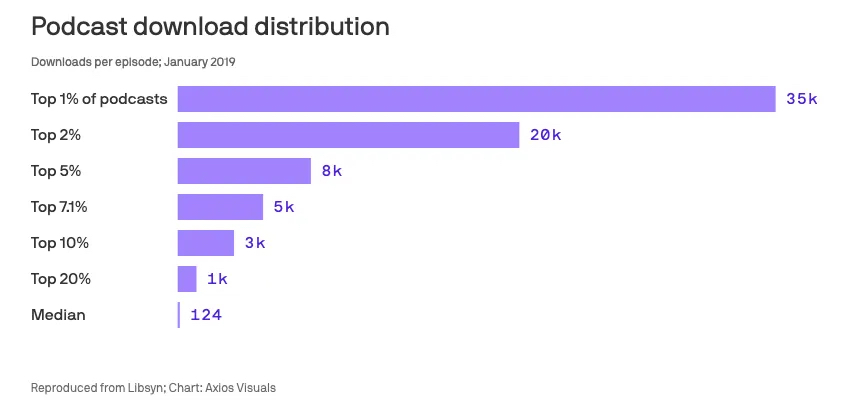
Ever heard of the long tail? Here’s an example (about podcasts):

50% or more of all podcasts have only been listened to by 124 people… Which is not a sustainable business model. 

This is a power-law curve, and it applies to just about everything.

If you solve problems for people by BEING one of those influencers, that’s a different story.

But measuring your success and hoping one of these companies will pay you a fortune for hits on your content is a bad way to live your life.

Commonsense, fundamental money principles combined with a steady income from solving problems for people over a long period of time.

This is the way to make a fortune. It’s just not slick or instant, so it isn’t sexy. 

Subscribe below for daily insights, resources, and content delivered directly to your inbox.

3 Easy Tips to Help You Get Unstuck

Being stuck is rough. It can leave you with feelings of hopelessness, frustration, or even anger.

Maybe you’re in a dead-end job you can’t stand…

Or your money situation is quickly moving from bad to worse…

Maybe you don’t even know why you’re feeling stuck. All you know is you are.

So how do you break the logjam?

The good news is there are a few things you can do now that’ll help you get unstuck:

  1. Learn Something New: This might be a new skill, a new way of doing the same thing, or just a new piece of information that helps you change your mindset. Pick up a book from the library or Amazon. Type your problem into YouTube and find 100 videos that’ll give you a new approach. Or listen to a really insightful podcast or TED talk. I wrote up an entire blog post on how you can get a free (or nearly so) education WITHOUT having to go back to school. Check it out here.
  2. Take a Break: One thing many folks do is bang their head against the problem over and over without seeing any new results. Sometimes the best thing you can do is stop and walk away from the problem. This could be as simple as going for a 20-minute walk outside. Or it could be even more extreme: a weeklong vacation to leave all your troubles behind. Regardless of how you choose to take a break, you’ll come back to the problem with fresh eyes and a fresh perspective.
  3. Find a Teacher or Mentor: This tip is the one that’s helped me the most. Coaches, mentors, and teachers have a way of looking at the same problem you’re dealing with and seeing it in a whole new light. I was stuck in my career, hating every single moment I was at work, but I thought there was no other way to live. “That’s just how work is…” Then I had a coach show me that work could be a part of my life’s purpose AND enjoyable. Now I’m in a job I love and doing work that matters. All thanks to an outsider’s perspective.

Speaking of mentors, my coach Dan Miller is hosting a free masterclass today at two different times: 1pm CDT and 7pm CDT.

And the best part? The whole thing is about getting you unstuck no matter your problem.

“5 Reasons Big Dreamers Get Stuck And How To Blast Through Them To Success”

You can register for your seat here.

If you’re tired of going it alone and want an outside perspective on your problem, I strongly encourage you to sign up.

You’ll come away with fresh ideas, a renewed sense of hope, and strategies for moving forward on your most important goals.

There’s still time to register, but it’s happening TODAY. So make sure you sign up before it’s too late.

Save your spot now by clicking here!

I’ll be there too. I hope to see you this afternoon.