
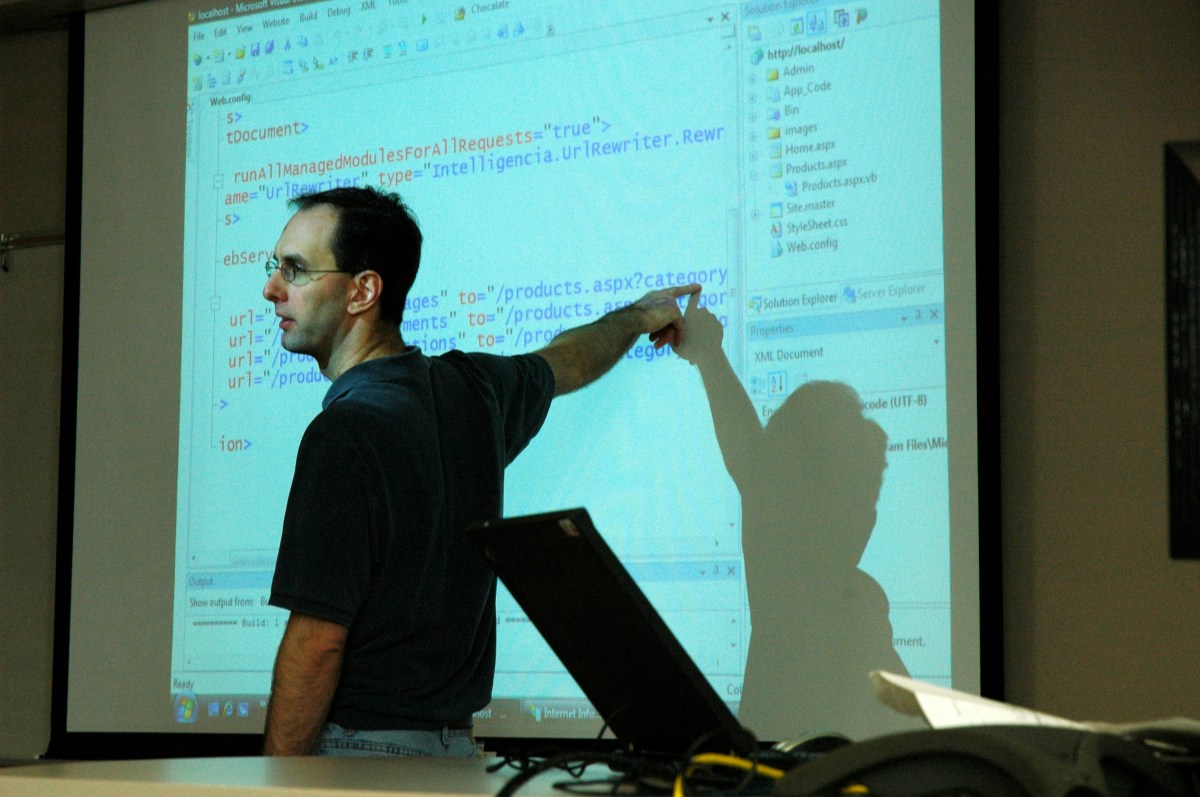
Man teaching pointing to a projector screen.

Talking yourself into learning

I’ve been reviewing some coding skills in my spare time to improve the content and coursework I create for my day job.

As part of my practice, I’ve been talking to myself.

Here’s one example:

“I need to turn this text into a link, so [as I’m typing out the code] I need to wrap this header element in an anchor tag and add the hypertext reference attribute to it and set it equal to the hyperlink I need to direct my audience to. Oh, don’t forget to add the target attribute and set it equal to blank so it’ll open in a new tab.”1

It’s more tedious and time-consuming than simply typing out the code. But the point is to understand the concepts behind what I’m doing, not just to write functional code as quickly as possible. (If I wanted to do that, I’d just have Claude do it for me…)

Teaching someone else—even if you’re teaching yourself by talking out loud—is one of the best ways to prove you know something. When you force yourself to explain something out loud, you learn where the gaps in your knowledge are, which then signals what you need to review. Then, when you come to the same scenario again, you can see if you’ve acquired the necessary ability to explain your former knowledge gap.2

This is active recall: talking or writing out something you’ve learned in your own words, and it’s how I’ve been approaching certain aspects of training at work. Rather than having everyone watch videos or read through course SCORM files, we’re testing employees’ abilities to talk through features.

It starts with review, of course—you still need content they can reference at the beginning of the learning process. But that’s where L&D often falls short. We equate content delivery with learning. And, obviously, that’s not true.3

But the proof of learning comes when they’re forced to talk it out and get graded on their delivery.

There’s no punishment for getting things wrong. But we know for certain where the gaps in understanding are, what needs review and further study. Or we learn that we, the L&D practitioners, missed something in the initial teaching and have to fill it in.

Talk out what you’re learning. If you can explain it to someone else (or yourself)—out loud—there’s a good chance you’ve grasped the concept.


  1. I’m aware that this is extraordinarily basic HTML code for all you web developers out there. But the point is the practice of talking it out, not how advanced the code is. ↩︎
  2. My favorite book on this topic was actually written to help college students improve test scores. Check out Cal Newport’s How to Become a Straight-A Student. It’s not just for undergrads. ↩︎
  3. Again, I have to point out that this is why most online learning (e.g., MasterClass, Udemy, and most corporate training) doesn’t work. Consuming information isn’t learning. It’s part of it, sure, but only the retention and understanding of that information actually matter. And the only truly effective way to test this is through active recall, which is exactly what I’m doing when I talk out my code. And it’s what we’re doing when we have people talk through our product. ↩︎

Self-education is great. Self-education is limiting.

When I was 18, I auditioned to become a jazz studies major in the percussion department at the University of Southern Mississippi.

I’d been a musician for most of my life, taking my first lessons at the age of seven and attending one of the state’s best arts schools for a significant portion of my education.

But… I’d studied violin, piano, and voice. I was a completely self-taught drummer. I’d learned everything I knew from playing along to my favorite CDs and watching videos of my favorite drummers, trying to emulate them.

The audition did not go well. Dr. Wooton, the head of the department, asked me to play a ratamacue; I had no idea what that was.1

He asked me to play a G Major scale on his marimba. I remember exactly what I said: “Is it laid out like a piano keyboard?” He chuckled. “Yes, just like a piano.” I picked up a marimba mallet (I’d never held one) and slowly, painfully, pecked out a G Major scale with one hand.

Finally, he asked to see my drum set skills. Dread gave way to excitement… Until he asked me to play a Songo. I had no clue what that was. He asked for a Samba, a 2nd-Line… I just shook my head.

Finally, he asked for a bossa nova. “THAT ONE I KNOW!” I shouted. And I proceeded to demolish his drums like a metalhead on PCP playing the worst bossa nova ever attempted by a drummer.

“NO!” He said. “It’s a light and airy dance music. You play it like this.” And he sat behind the drums and tapped out something a Brazilian native would have happily danced along with.

Dr. Wooton, eventually and probably grudgingly, told me that he would take me into his studio, but that I desperately needed lessons. I decided to delay my entrance to USM by a year while I studied snare drum, drum set, and xylophone with a local private teacher (Jeff Mills, drummer for the blues musician you see in “O, Brother Where Art Thou”).

My skills under Jeff’s tutelage, buoyed by my preexisting musical knowledge, grew exponentially in just a year. I was able to audition again and even pass an audition to join the lower-level jazz band at the university, where I eventually earned a degree.

Why does this story come up now?

Well, I realized a couple of days ago that I’m once again back in the exact same place, but this time in my corporate career.

I work in learning and development for a moderate-sized corporation. And I genuinely feel like I have no idea what I’m doing.

There’s even a term for people like me in the industry: “Accidental trainer.” It’s someone who was really good at teaching, who moved into the corporate world and began implementing those same skills as a trainer… With no formal training.

L&D is its own beast, its own field with tons of nuance. And you need skills ranging from business strategy and project management to adult learning theory, instructional design, and cognitive psychology… Not to mention a penchant for being able to cajole, persuade, and sell to people above you.

Everything I’ve learned has been through on-the-job self-education to accomplish a project or do a task assigned to me. However, I’ve reached a point, much like in my audition, where the cracks in my education (or lack thereof) are starting to show.

It’s getting harder and harder to do my work well because everything is more complex than ever before. More is expected of me, and I worry I’m not up to it where I am today.

So the solution is education: actual education by people who know what they’re doing… Not random readings and YouTube videos. I need a new Jeff Mills for my learning and development career (and don’t worry—I have found something.)

At some point, I think we all discover that self-education and learning on the job aren’t enough to accomplish what’s being asked of us. We need a teacher, a mentor, a master to show us the way. Something, or someone, that knows the ins and outs of the field of study and can help us master it.

If you’ve reached this point, I hope you’ll try to find someone like that to help you level up.


  1. I later found out it was one of his favorite rudiments (sort of a “word” in the language of drumming), and it quickly became mine. If you want to see a master using them, check out this video. ↩︎