Fear = excitement

The physiological reactions we experience when we’re afraid (racing pulse, sweaty palms, lightheadedness) are the same as those we feel when we’re excited.

Fear, therefore, can be reframed as a form of excitement.

How might you act differently if you told yourself you were excited about this new possibility rather than frightened by it?


H/t to Peter Shepherd and Jen Waldman for this idea.

Who I learned from this week (July 23, 2021)

https://michaelhyatt.com/shave/

Michael Hyatt put together a crazy in-depth guide with four big parts. If you’re looking to up your productive and get more done while working less, I highly recommend you download this ebook.

An absolutely fascinating post by Seth Godin about reaching your audience organically.

Serve a handful of people well, be remarkable, and they’ll tell a few others. It starts small, but the results are exponential.

https://podcasts.apple.com/us/podcast/marketing-made-simple/id1569923210?i=1000526591946

Donald Miller’s “StoryBrand Framework” is the gold standard in effective marketing, especially for creatives, solopreneurs, and small business folks.

His team recently came out with a new podcast called “Marketing Made Simple” which I’m absolutely DEVOURING. Not only are the hosts incredibly engaging and funny, they give practical advice and step-by-step instructions on how to market your business from beginning to end.

There are five episodes so far, each with a call-to-action to fill out your very own StoryBrand Brandscript (which you can start for free right here).

A great article by Ryan Holiday that makes a compelling argument for anger being a primary cause of the Confederacy’s failure in the American Civil War.
I’d like to specifically draw your attention to his 3rd idea in this newsletter.

What’s the single tiny step you can do to move the needle on your project or goal? Even if it feels microscopic?

https://www.calnewport.com/blog/2021/07/21/on-pace-and-productivity/

Last, but not least, this article from Cal Newport shows us that how much time we look at collectively has a big impact on whether or not we look productive.

Scientists like Galileo and Newton had seemingly slow, unproductive days when looked at individually. But when you look at their accomplishments over the span of years, it’s mind-boggling what they did…

Subscribe below for daily insights, resources, and great content delivered directly to your inbox.

Who’s It For?

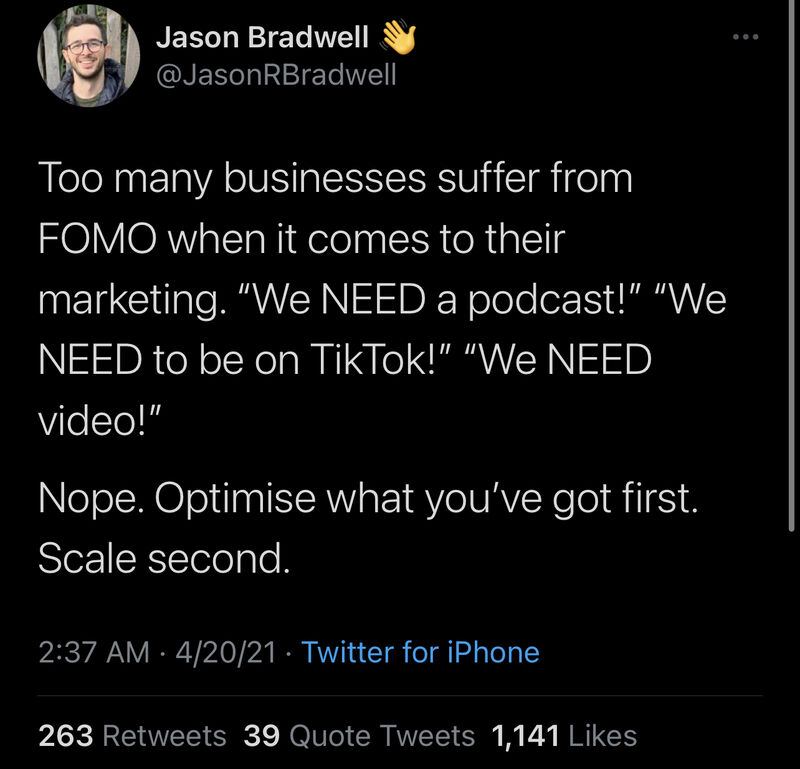
Jason Bradwell tweeted this a while back:

“Too many businesses suffer from FOMO [Fear of Missing Out] when it comes to their marketing. ‘We NEED a podcast!’ We NEED to be on TikTok!’

We’re all marketers now, trying to change the culture and influence others (hopefully for the better). But we have a problem: we get so caught up trying to figure out the tools and tactics, we stop focusing on the people!

What if your target audience isn’t ON TikTok?

What if your ideal customers don’t LISTEN to podcasts?

Why use those platforms if they aren’t helping you reach the right people?

“Who’s it for?” is the first question we should be asking.

H/t to Seth Godin for teaching me what’s most important in marketing.

(Here’s the original post if you’re interested.)

Learn how to make the world better. Subscribe today!

School can ruin a passion

It amazes me how much I used to enjoy certain things until I went to college. School ruined a lot of it for me.

Let me explain:

I have always had a passion for music and history. I loved them both so much I couldn’t decide between the two when I went to college, so I double-majored. I did all of my research on different historical periods and figures in music.

Interestingly enough I hated every second of it.

When I graduated, I quit researching history, and I quit researching music. I think in the back of my mind, the thought was if that’s what I was gonna have to do for a living, I wanted nothing to do with it.

I graduated five years ago and have been struggling to find my fit in a career ever since. I have had a lot of time to think, and I believe I’ve figured out the problem.

I didn’t hate the work: I hated having my hands tied.

College assignments are unrealistic

“You can’t write about or research anything you want – you are required to tie it back to this particular point and make an argument about how it conforms to this idea.”

“It doesn’t matter that your subject has very little source material – you have to make it 30 pages (rather than making it as long as it needs to be and no longer).”

How many of you went into college to study something you had a deep passion for, only to come out the other end hating what you once loved?

I don’t think you suddenly realized you hated the subject: I think you hated being boxed into unrealistic parameters and expectations.

Nowadays, if you want to do research on a topic outside of school, you can, and you can make it as long or as short as it needs to be. Also, it can be about whatever you want it to be.

Do you want to turn it into a podcast instead of writing? GO FOR IT! Do you want to interview people and draw conclusions from their ideas? Do that.

As long as you aren’t making stuff up and deliberately lying to the rest of the world, you can do whatever it is you want to do in whatever subject you choose.

You don’t hate learning – you hate school

You will never have your hands tied, parameters set, or asinine expectations to meet like you had in school. You don’t hate your subject, and you don’t hate the work you thought you wanted to do. You hated being boxed in, required to do things that bored you to death or robbed you of the joy of what you once loved.

Don’t throw the baby out with the bathwater. If there was something you used to love doing, something about which you were insanely curious, I encourage you to pick it up again.

I don’t think you lost your love for it – I think you just got the wrong idea of what you were expected to do in the real world in your field of study.

Join 904 other subscribers