The thing you want to learn how to do? Start doing it.
Start writing. Start playing the drums. Start drawing. Start reading the classics. Start creating a podcast.
How do you learn how to speak another language? Any teacher worth her salt will tell you that you have to immerse yourself in the language and start speaking it. All the books and college courses in the world won’t help you if you don’t do it.
This is scary, isn’t it? The resistance in your head is telling you that you don’t know where to start or that you can’t possibly learn how to do this or that without a rigorous amount of study. If you don’t know where to start, then yes – go and pick up a book. Watch a YouTube video or download an app. Hire a teacher. But all the reading about it, watching videos about it, being lectured to about it – that won’t get you anywhere until you take action. Once you have a grip on the basics, you just have to start doing.
Learning is easy once you start doing it. Taking action is what’s difficult.
There will be days, inexplicable days, where nothing seems pleasant, your mind heavy, restless, and frustrated. Your ideas won’t click; your hopes and dreams will seem frivolous or impossible…the words don’t come or the music sounds wrong.
On these rainy days, acknowledge them for what they are. They suck, but they happen to everyone. So take the day and do whatever it is you need to do.
Some of you may have read my post the other day about “Trump Straws.” This is a short follow-up to that particular post, so I hope you’ll forgive me as the historian comes out to write.
There was a time in the United States where concern over waste was of the utmost importance. Granted, plastic wasn’t the issue of the time – the United States was fighting a horrid war against the Empire of Japan and Nazi Germany. This fight required ammunition, tanks, vehicles, guns, and food. It was a time of total war, and the American citizenry was asked to help fight that war by…can you guess?
Reducing waste!
The US government called on its people to hold drives for scrap metal, to grow their own food in “Victory Gardens,” to live on ration cards which severely limited what one could buy at the grocery store. Even bacon grease was of vital importance – (save the bacon grease to help make ammunition)! These were the days when Coca-Cola bottles could be recycled for a few cents, when the milk man picked up your old glass bottles rather than having them broken and discarded in a trash heap.
We are not in a state of total war today; the government is not asking us to help fight anyone or anything by recycling and reducing waste. I simply wanted to point out in this post that at one point, it was quite an American thing to do. So let’s stop labeling things as “liberal” and “conservative” simply to inflame people who we see as “the others.” Let us bring civil discussion and disagreement back to our society.
We need civility and open communication more than we need anything else. Quit letting mass media and politicians pull us apart.
Sometimes the progress you get isn’t necessarily the progress you wanted or expected.
You might be trying to lose inches around your waist, only to get to measurement day and discover that result didn’t happen, but your shoulders, arms, and legs grew slightly bigger and more muscular.
Progress.
A really challenging exercise or song being learned on the guitar doesn’t sound any better, but you notice your fingers don’t hurt anymore from the biting of the strings, and your wrist technique has improved.
Progress.
Progress is change in a forward direction. Look for it everywhere, not just in the one thing on which you happen to be focusing.
Progress: notice it everywhere, celebrate it often, and keep trying to create it.
Human beings are notoriously bad at two things: thinking about the future…and adapting to change.
Now before I go on, this article references something that was sent to me about President Trump’s campaign, but I am not trying to write a political post. This is simply an observation of how people are are being set against one another because of change.
We have scientific proof that there is more carbon in the air today than there was 50 years ago (which causes the Earth to retain more heat). We have documented, scientific evidence that our oceans are becoming cesspits overflowing with plastic and other waste which is harmful to the creatures that inhabit them.
So the culture is experiencing a change: companies all over are adding links to their “About Us” sections to show their customers how they interact with the environment. Start-ups and entrepreneurs are creating delivery boxes to help people go greener. Local businesses are trying to source their goods from local people with minimal or no packaging. And individual Americans (and humans in general) are making efforts to lower their footprint by using less plastic or finding alternative ways to commute.
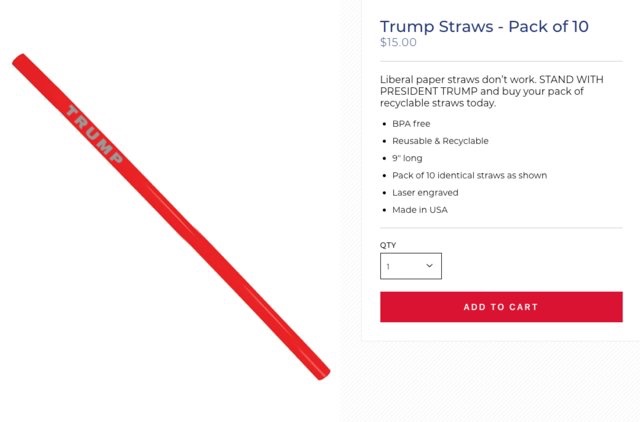
Then you have something like this:
You can find more information about the item here if you want to look more into it.
A small idea like a biodegradable paper straw, innocent of anything except trying to save a turtle here or there, is politicized and given the label of “liberal”.
What purpose does this serve except to divide us Americans even further? Why take an idea like the paper straw, something that harms no one and has long-term benefits for everyone, and use it as fuel on a fire to incense one group of citizens against another?
Change is happening; change is inevitable and has been occurring as long as there have been people. And people have fought against change as long as we have existed.
Yet change is still happening. People are attempting to think long-term about some of the behaviors we have practiced over the past century and are trying to do something about it. We can either accept it, or attempt to fix it later when it’s too late to prevent it. Either way, change will occur.
In the meantime, we must stop politicizing EVERYTHING and making every single issue in our culture an issue of belief, of us pitted against them. And we must stop letting people drive wedges between us regardless of our own thoughts and beliefs. We must be able to have a civil discourse about issues that affect the future – perhaps not your future, but that of your children and grandchildren.
Change is going to happen whether we want it or not, but we can affect the sort of change that we want if we can only stop working against each other and ask questions, then listen
In the meantime, I will continue to take my own cup to restaurants and politely refuse plastic straws when offered. If you wish to ask me about it, I would be delighted to have a civil discussion with you.
Our choices seem unlimited, the resources at our disposal infinite (at least compared to other countries), and our interests are wide and varied. It’s no wonder so many of us still don’t know what we want to do when we grow up. We have too many choices, too many roads we could take.
I’m slowly coming to the realization that I cannot do it all. The many passions I have, the countless skills I want to learn, the dozens of projects I want to start and complete…there isn’t enough time in the day. My choices are either pick something, or a few things, or stop working and do a dozen things. Even then, I still wouldn’t have time to do everything (and unless one of them made money, I’d have a whole mess of problems to deal with).
At some point we have to start focusing on something. It might be the wrong choice – but you won’t know until you try. It’s that fear, the fear of making the wrong choice, that keeps us paralyzed; it keeps us from making any significant progress. We are so caught up in the future, that if we take this one path, we might fail. We might not enjoy it. Or worse…
We might get so far along the path and succeed that all the other things fall by the wayside. All those other things you wanted to do don’t happen. How horrible!
If you had all the money in the world, or if money was not an issue, what would do all day?
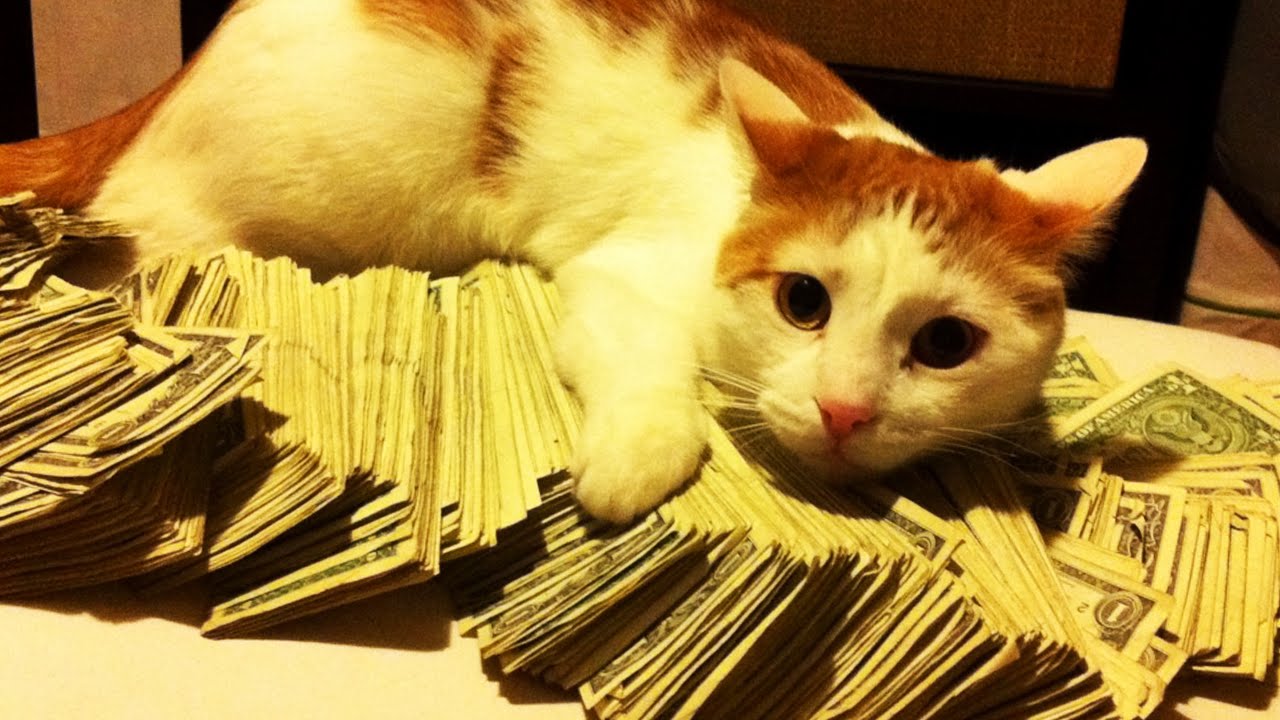
Cats on stacks on stacks!
In the search for a meaningful career, most everyone has been asked the question, “What would you do if money was not a factor in your decision?” I have been wrestling with that question ever since I had to declare a major in college.
For the past year, I have been struggling not to define a career, but to understand my vocation, my calling in life. This question was one I asked of myself over and over again, with rather disappointing results. The answers are always the same: read books, learn new skills such as jiu-jitsu or computer programming, study history, play music, increase my education, spend time exercising…countless other hobbies and passions could be added to this list, so I will not bore you with them. The problem I have with that question is that money is a factor in this sort of decision, so I have never really been able to take money out of the equation.
This idea took on new life for me when somebody added a twist to the question. A friend of mine named Lindsey Strahan, who is a fantastic artist and up-and-coming graphic designer, had this same discussion with me. However, she added something to the question: if money was not an issue, what would you do all day long to help other people? The moment that she asked the question a switch flipped in my brain.
Serving other people is what a person does with his or her calling; we cannot work or exist in a vacuum without others. We live in an interdependent world, to take a word from Dr. Stephen R. Covey and his 7 Habits of Highly Effective People. Therefore, our callings, and by extension our careers and jobs, must serve other people in some way. I am not saying that we must all be involved in customer service, but to be viable in the market, our ideas and passions must help another person.
With that in mind, I started brainstorming about what I would do all day. I realized that while on the surface all of the ideas I listed above seemed unrelated, they had a common thread weaving through them: I would spend all day learning and researching new things, new ideas, and new passions. My DISC personality profile, my StrengthsFinder 2.0 assessment, and every other aptitude or personality test I had ever taken all become much clearer. I already knew my strengths, and I have always known my passions, and so I had a clearer answer than I had ever had before: I am called to be a fountain of knowledge for other people.
This simple statement could be satisfied by so many different careers – I could be a teacher, a professor, a researcher, a librarian, an information broker, a consultant for people who need to learn how to combine this skill with that area…the possibilities are seemingly endless. There is no need to be tied down by a specific job title or role. I now know “who I want to be” instead of “what I want to be,” an idea presented to me in Dan Miller’s 48 Days to the Work You Love. Now I can make decisions on how I will make money based on my newly refined idea of my own vocation.
I hope that my struggle to answer this seemingly easy question will help others to find their vocation. So I will pose the same question to you, the reader: if money were not an issue, what would you spend your time doing to help other people? Think on that, write it down, and please feel free to let me know. I would love to hear what you’re called to do in this world.
Until next time, keep digging!
P.S. If you would like more help finding your calling, I highly recommend Dan Miller’s book 48 Days to the Work You Love as further reading. One of my college professors referred it to me, and it has radically changed my life! It’s one of the best things I have ever purchased. Also, I really encourage all of you to follow Lindsey Strahan on Instagram @very.lindsey. She is a great artist and a wonderful friend. You will love her work!


 Nathan's Blog