Who I learned from this week (July 23, 2021)

https://michaelhyatt.com/shave/

Michael Hyatt put together a crazy in-depth guide with four big parts. If you’re looking to up your productive and get more done while working less, I highly recommend you download this ebook.

An absolutely fascinating post by Seth Godin about reaching your audience organically.

Serve a handful of people well, be remarkable, and they’ll tell a few others. It starts small, but the results are exponential.

https://podcasts.apple.com/us/podcast/marketing-made-simple/id1569923210?i=1000526591946

Donald Miller’s “StoryBrand Framework” is the gold standard in effective marketing, especially for creatives, solopreneurs, and small business folks.

His team recently came out with a new podcast called “Marketing Made Simple” which I’m absolutely DEVOURING. Not only are the hosts incredibly engaging and funny, they give practical advice and step-by-step instructions on how to market your business from beginning to end.

There are five episodes so far, each with a call-to-action to fill out your very own StoryBrand Brandscript (which you can start for free right here).

A great article by Ryan Holiday that makes a compelling argument for anger being a primary cause of the Confederacy’s failure in the American Civil War.
I’d like to specifically draw your attention to his 3rd idea in this newsletter.

What’s the single tiny step you can do to move the needle on your project or goal? Even if it feels microscopic?

https://www.calnewport.com/blog/2021/07/21/on-pace-and-productivity/

Last, but not least, this article from Cal Newport shows us that how much time we look at collectively has a big impact on whether or not we look productive.

Scientists like Galileo and Newton had seemingly slow, unproductive days when looked at individually. But when you look at their accomplishments over the span of years, it’s mind-boggling what they did…

Subscribe below for daily insights, resources, and great content delivered directly to your inbox.

The messy middle

Any worthwhile pursuit has a messy middle. In his book A Million Miles in a Thousand Years, Donald Miller talks about what it’s like to cross a stretch of water. We leave the shore and eventually arrive on the opposite side.

But in between those two points, we have “the hard work of the middle.” That’s where the journey becomes a slog, the motions seem repetitive, and the effort seems useless.

Pursuing a goal, starting a business, losing weight… All of these pursuits have that same hard work to be done in the middle.

In almost every case, we start strong and make decent, even quick, progress. But soon after we hit a point where we lose focus and motivation.

“Why am I at the gym for the third time this week? I just want to go home…”

“I really just want to pig out on pizza, beer, and ice cream. I don’t feel like cooking…”

We get frustrated, hit plateaus, and our motivation wanes.

It’s when we hit that point we have to rely on our “why”.

Our reason for pursuing whatever it is has to be strong enough to get us through the messy middle. Seth Godin calls this “the dip” in his book of the same name.

Without a strong why, without a reason to keep pushing through, we burn out and quit.

Not only does our motivation have to be strong, but we have to revisit it every day. Zig Ziglar had a saying about this rule:

“Motivation doesn’t last. Well, neither does bathing. That’s why we recommend it every day.”

First, identify a strong reason why you want to pursue something.

Then make time every day to review it. Keep your motivation front of mind.

Subscribe below for daily insights and resources delivered straight to your inbox.

What IS a Business—Really?

Here’s a simple definition from Donald Miller to help you understand what a business really is:

A business is a for-profit entity that solves problems for paying customers.

Let’s break this down:

For-Profit Entity

Without profit, a business can’t survive. Yet we’ve tied some evil stigma to the idea of a business making a profit. If they don’t make a profit, they can’t do the thing for which they are created. And what’s that?

They Solve Problems

THIS is the purpose of a business: to solve problems for people. And is that really such a bad thing? Wouldn’t you be happy to pay someone to solve one (or several) of your problems? Of course you would.

Now, there are numerous businesses out there that don’t solve problems for their customers, yet they still make a profit. Those exist only to get as much money from people as possible without providing any real value. That’s theft, and it’s both unethical and immoral.

The good news is those businesses tend not to last very long. How often did you do business with a company that gave you no return on your investment?

PAYING Customers

Paying customers… This is the hard part for a lot of us. We’d all love to be non-profits, helping as many people we can without them paying us a dime. But you can’t fill someone else’s cup if yours is empty.

Customers need to pay for what you’re offering them. Here’s why:

  • It lets you help more people because you have money to grow.
  • It incentivizes the customer to use what they paid for.

That last point is important. When someone pays for something, they are more likely to follow through with it. Whether you offer education, a service, or sell a product, the thinking goes, “I paid for this, so I might as well get my money’s worth.”

This simple definition of business has a lot of meat in it. It definitely helped me overcome my own issues with making money, because in the end we’re helping people.

We’re just doing it in a way that lets us keep the lights on. And lets us grow so we can help even more people.

If you want more insight on successful living and meaningful work, do just one thing…

Subscribe now!

Conflict Is Inevitable. How Do You Handle It?

“If you avoid conflict you will not achieve success.”

Donald Miller, Business Made Simple, p. 17

I have to admit: conflict scares me.

This is how I imagine it’ll end in all situations:

Photo by yang miao on Unsplash

I avoided conflict like the plague (or COVID-19 😩) most of my life. As a child and a young adult. And every time I did, I missed out on something.

A chance to connect with someone on a deeper level.

A chance to fix a situation in desperate need of repair.

A chance to understand someone else’s point of view.

But every time I embraced the inevitability of conflict and put on my brave face, I made a difference.

Conflict is going to happen if you’re making progress towards something great.

Will you run from it? Or will you tackle it head-on with empathy and understanding?

If you made it this far, subscribe today!

I hate getting feedback… Don’t you?

I hate getting feedback…

It hurts. It stings. It can crush your soul—especially if you think you’re already kicking butt. 

But it’s also the best way to figure out where you can grow to hit your goals.

That’s why I actively seek it out in everything I do. 

Musicians Are Brutal

This practice came from my time in university. I was studying to be (and working as) a professional musician. 

Every week, I had multiple lessons, rehearsals, and performances. And after each one, my teachers, bandmates, and mentors had feedback for me.

It was brutal (to put it mildly). But it made me a better musician. 

These people were better than me, more experienced, and knew what needed to be done to succeed. 

I’ve carried this practice with me into every job I’ve had. It’s made me a better leader, writer, and marketer.

“A mark of a competent adult is their ability to accept feedback. The mark of a child is their expectation of praise without merit.”

—Donald Miller, Business Made Simple, p. 15

Surround yourself with people who want you to improve and succeed in your roles. Actively seek out feedback. 

The more you do it, the better you’ll get. But I can’t promise it won’t sting.

How do you feel about feedback? Are you actively seeking it out?

Get daily insights on business, personal growth, and creativity.

Subscribe today.

Is This Book Better Than an MBA?

Colleges don’t teach you how to succeed in the business world. Business schools teach theory, case studies, and lots of accounting and finance. But what they don’t teach you is how to run a profitable, cash-positive business. 

Sadly, they don’t even teach you how to work in a business. At least not in a way that makes money for your employer.

That’s a problem. Why? Because that’s what business owners, managers, and leaders want: value-driven professionals who generate cash.

Here’s the Solution

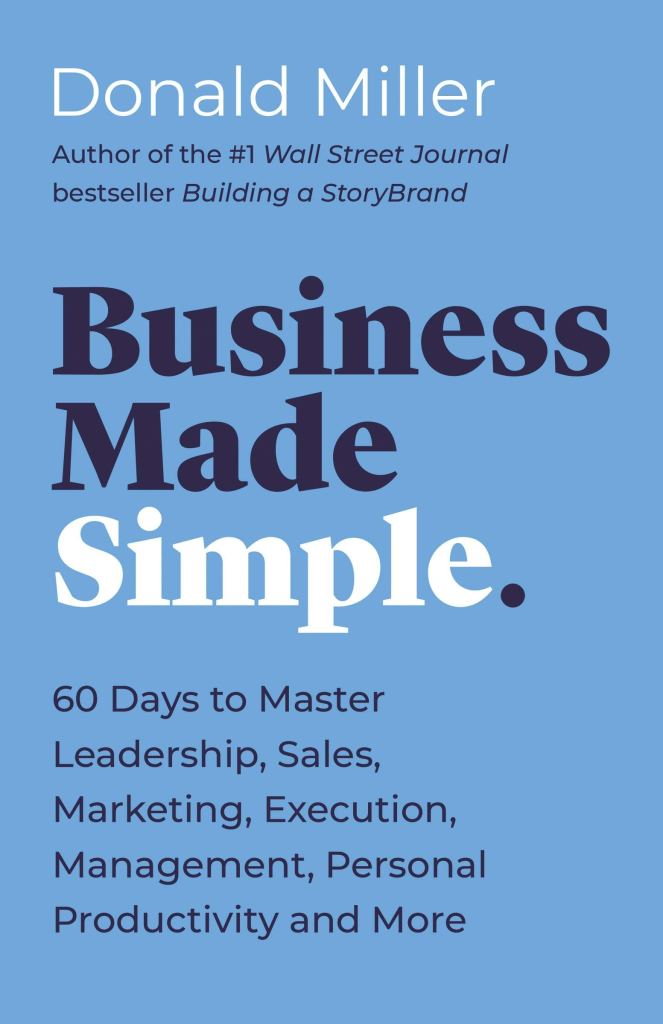
Donald Miller has done it. He’s created a book and podcast that teach you exactly what you need to know to run a profitable business. If you haven’t yet checked out Business Made Simple, do it today!

Buy the book. For just $20 bucks, you can get a better business education in 60 days than you would spending $50,000 on an MBA. And listen to the podcast—it’s absolutely free!

Learn practical skills you need to succeed like:

  • How to write a mission statement that drives and inspires you and your team.
  • How to create a clear message that drives customers to your products and services.
  • Sales processes that actually work.
  • Execution strategies that grow your business exponentially.

What If You’re Not A Business Owner?

Maybe you’re not an entrepreneur. Maybe you just want to have a successful career as a team member or employee. That’s okay!

Business Made Simple is for anyone who’s job it is to generate cash for a business. And guess what? That’s you! Whether you’re a salesperson, marketer, customer service agent, or a janitor, this book will help you succeed at work. 

If you’re looking to stand out in your job search, get promoted, or just contribute more in your work, you need check this stuff out. Get a business education that actually pays off.

Get a copy today!

Get daily insights on business, personal growth, and creativity.

Subscribe today.

Your Job Is Making Money for Other People…Not Yourself

What I learned from Donald Miller this morning:

(I’m paraphrasing) The goal of any business professional is not to make a lot of money… The goal is to make a lot of money FOR OTHER PEOPLE!

How true this is for all of us in the business arena. It doesn’t matter if you’re an employee, a small business owner, or a serial entrepreneur.

Your job is to help other people make money. That’s the only reason you get paid.

As a copywriter and marketer, my sole purpose is to help my clients make more money from their products and services. It’s how the only way to measure how successful I am in my role.

Shift the focus away from yourself. Think about your employer, your customer, or your client. 

What are you doing to make them more money?

P.S. Donald Miller’s new book, Business Made Simple, launched today. If you’re ready to level up in your career or business, and become a value driven professional, grab a copy today. 

It might be the most valuable $20 you spend this year…

Get daily insights on life, business, and creativity. Subscribe today!

College isn’t the only option

A common theme today is the thought of going back to college in order to change careers or move up the ladder.

“Man, I really hate my job. I think if I went and got a degree in [insert field], I would be able to get a better job.”

“I want to change careers, but I will have to go get a master’s degree to make that happen.”

“The only way that I’ll move up in this company is if I go get my MBA.”

I’m sure you’ve heard dozens of similar comments. While this may be the prevailing idea on how to get ahead, it is wrong.

If you hate your job and want to change fields, or if you want to move up the corporate ladder, you may actually need to increase your knowledge, skills, and abilities to do so. However, a college degree does not necessarily equal increased knowledge, more skills, or higher-level abilities.

One reason is that our culture is changing so quickly; businesses are rising and falling at unparalleled rates; technology is moving so fast that the information you learn over 18 months in getting an MBA is often obsolete by the time you finish the degree. Another reason is that sitting through lectures on subjects day after day doesn’t prepare you to do the work required in the job you hope to take.

A Modern Education

So what to do instead? Well, lucky for you, there are a number of new tools at your disposal:

  1. You have books.
  2. You have the internet.
  3. You have a mouse, keyboard, and screen.

We live in a time of unlimited information – if you want to learn how to do something, a quick Google search will return more information than you could possibly consume in a lifetime.

So, if you want to level up your skills and abilities, or learn about a new field of knowledge, read five quality books on the subject. Take notes; talk with others about what you are learning, face-to-face, over Skype or FaceTime, or even through email. Doing this, you will quickly become an expert on the subject. At the same time, you can go on Udemy, CreativeLive, LinkedIn Learning, or any other online learning site and take free or low-cost courses at any time, on any subject, at your own pace! Many of these courses rival those on a university campus. Now that I think of it, you can also take a lot of free courses from reputable universities online if you really want to go that route.

What is education for?

I am by no means discounting the value of a college education. I just want it to be known that it is not the end-all, be-all for finding a better job or leveling up your career. There are so many ways to get the education that you need; it would be shameful not to look at all your options.

The purpose of furthering your education is not to get another degree; it is to develop the skills, abilities, and knowledge to do the work. If getting another degree gets you there, then go that route (and don’t borrow money to do it). But I must emphasize this: you do not need to spend 18 months without working, sitting through a lecture on soon-to-be outdated information, all to get a piece of paper that tells people you are qualified in something. Employers don’t care – they want to see projects, portfolios, and results that you have created.

So, if you want to step into graphic design, start reading books on the subject, learning web design at Codecademy, taking art lessons, and buy some online courses on the subject. If you want to get into marketing, start marketing for someone or something you believe in on a volunteer basis while you read books by Seth Godin and Donald Miller. Then, sign up for an Akimbo workshop and learn as much as you can with other people. You will spend less time, substantially less money, and learn as much, or more, than you would sitting through years of lectures.

Learning how to do the work is what’s important; how you do it is not. Let’s stop thinking that another college degree is the only way to get where you want to be. If you can show someone that you can do the job, you are qualified.

Go learn something.