First, put wood on the fire

Here’s one of my favorite quotes from Earl Nightingale:

“It’s foolish to sit in front of the fireplace and tell it ‘first give me some heat. Then I’ll give you some wood.’“

Of course, it’s a little foolish to talk to your fireplace at all. But that’s not the point.

Why would you expect the fire to warm you up with no wood? That’s as foolish as thinking people will buy from you before you’ve created value for them.

You have to help people before they’ll give you money…

You can’t get warm if you don’t put wood on the fire.

Subscribe below to get daily insights, resources, and ideas delivered straight to your inbox.

Who’s It For?

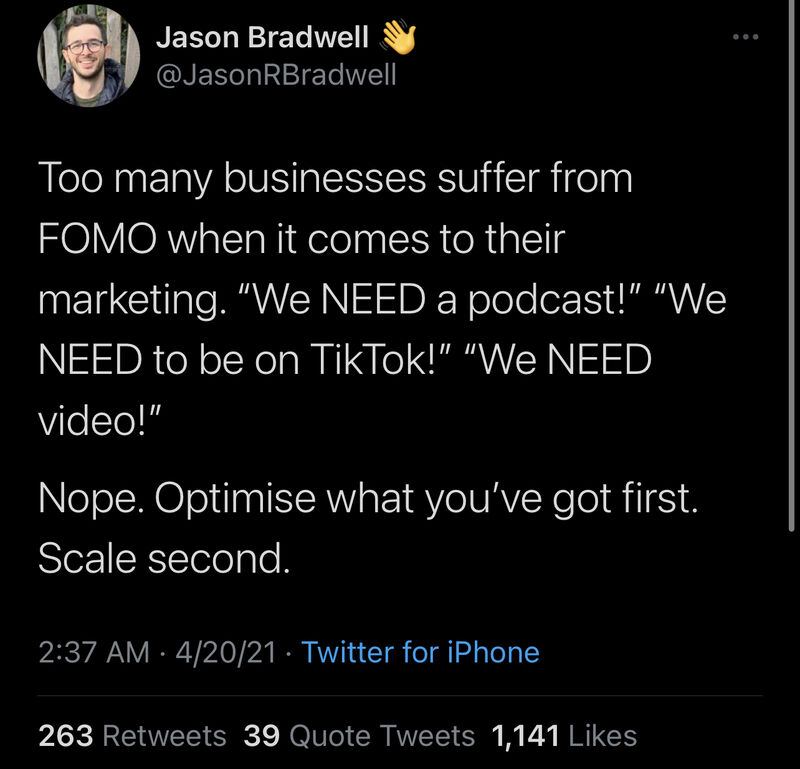
Jason Bradwell tweeted this a while back:

“Too many businesses suffer from FOMO [Fear of Missing Out] when it comes to their marketing. ‘We NEED a podcast!’ We NEED to be on TikTok!’

We’re all marketers now, trying to change the culture and influence others (hopefully for the better). But we have a problem: we get so caught up trying to figure out the tools and tactics, we stop focusing on the people!

What if your target audience isn’t ON TikTok?

What if your ideal customers don’t LISTEN to podcasts?

Why use those platforms if they aren’t helping you reach the right people?

“Who’s it for?” is the first question we should be asking.

H/t to Seth Godin for teaching me what’s most important in marketing.

(Here’s the original post if you’re interested.)

Learn how to make the world better. Subscribe today!

Is This Book Better Than an MBA?

Colleges don’t teach you how to succeed in the business world. Business schools teach theory, case studies, and lots of accounting and finance. But what they don’t teach you is how to run a profitable, cash-positive business. 

Sadly, they don’t even teach you how to work in a business. At least not in a way that makes money for your employer.

That’s a problem. Why? Because that’s what business owners, managers, and leaders want: value-driven professionals who generate cash.

Here’s the Solution

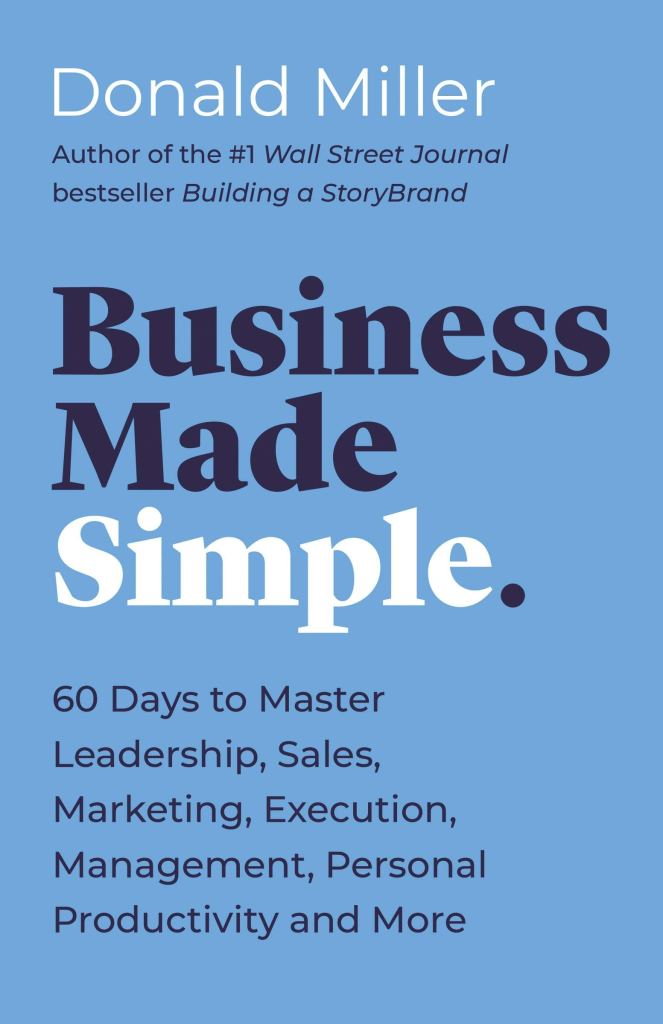
Donald Miller has done it. He’s created a book and podcast that teach you exactly what you need to know to run a profitable business. If you haven’t yet checked out Business Made Simple, do it today!

Buy the book. For just $20 bucks, you can get a better business education in 60 days than you would spending $50,000 on an MBA. And listen to the podcast—it’s absolutely free!

Learn practical skills you need to succeed like:

  • How to write a mission statement that drives and inspires you and your team.
  • How to create a clear message that drives customers to your products and services.
  • Sales processes that actually work.
  • Execution strategies that grow your business exponentially.

What If You’re Not A Business Owner?

Maybe you’re not an entrepreneur. Maybe you just want to have a successful career as a team member or employee. That’s okay!

Business Made Simple is for anyone who’s job it is to generate cash for a business. And guess what? That’s you! Whether you’re a salesperson, marketer, customer service agent, or a janitor, this book will help you succeed at work. 

If you’re looking to stand out in your job search, get promoted, or just contribute more in your work, you need check this stuff out. Get a business education that actually pays off.

Get a copy today!

Get daily insights on business, personal growth, and creativity.

Subscribe today.

If you build it, they (probably) won’t come.

The key in any endeavor from which you hope to profit, whether it’s creating a new product, learning a new skill, or starting a new service, is to first identify whether other people want what you are selling.

Contrary to the message in “Field of Dreams” (sorry, Kevin Costner), if you build or create something without first determining whether or not people want it, you probably won’t have anyone knocking down your door to get it.

Learning to be the best Fortran coding expert in the world is useless in today’s workplace because no one uses that coding language anymore. And don’t get upset if you spend 4 years learning puppetry only to find no one wants to pay you for it.

To make a living, you must serve other people. To serve other other people, you must find what people need.

You must determine what problems other people have and how you can solve them. Perhaps the need is to be entertained (in which case learning puppetry might actually be profitable for you, if you can find a way to market it). Perhaps the problem is a lack of clean water to drink.

Regardless of what you do, the key is to first identify what others want, then create something that serves that purpose. The customer must come first if you desire to profit.

Join 904 other subscribers

“But why is no one listening to me?”

You are having an argument with your spouse, and she doesn’t understand your point of view, no matter how much you push it.

Your children won’t do anything that you ask them to do. They won’t engage or communicate with you; they shut down every time you try to talk to them.

You are writing blogs and posts, but no one is reading or responding to them.

You’ve created a product that will change lives, but no one is buying it.

Naturally, you ask the question:

“Why is no one listening to me?”

You feel you are doing everything right. You have the right ideas or the right argument; you know more than your children; this product is truly amazing and has revolutionized the way you see and do things. And yet, no one is listening. No one is engaging. No one is buying.

Why?

Because you aren’t listening to them.

The only way to get others to listen to you, to engage with you, to buy from you, is to listen to them and understand their points of view, their wants, and their needs.

If you bludgeon people over the head with your arguments and ideas, they won’t accept them; they don’t have the same ideas, the same noise inside their heads. They are telling themselves different stories. The key to being listened to, to making an impact, is to understand those other stories.

You don’t have to agree with them, but you do have to listen to and understand them. When people feel understand, when they feel heard, when they know that you see them and their side of things, they feel more open to hearing what you have to say.

“Seek first to understand, then be understood.”

–Stephen R. Covey, The 7 Habits of Highly Effective People

No one is listening to you because you aren’t listening to them.

Your spouse won’t listen to your side of the argument because all you are thinking of is your side of the argument.

Your children won’t listen to your advice and guidance – even though you probably do know more and understand more than they do – because they don’t feel like you understand them, how they feel, or the narrative in their heads.

No one is buying your stuff because as awesome as it is, they don’t get how it will benefit them or how it will make them feel once they use it. Why? Because you didn’t take the time to understand what they want or how they want to feel.

Understand

To influence someone, you must open yourself to the possibility of being influenced by the other person. This means creating a feeling of understanding in the other person. This is not meant to be manipulative: you must genuinely want to understand the other person. Also, people can tell if you are simply trying to manipulate them rather than understand them.

Listen to what your spouse wants; listen to how your children feel; listen to the needs and frustrations of your customers.

Understanding must always come first; otherwise you’ll fail.

Join the others in creating change the world needs. Subscribe below.

Join 904 other subscribers

*Some of my posts contain affiliate links, which means I make a small commission on any purchases.

We are all volunteers

Everyone you interact with on a daily basis is a volunteer in your life.

Don’t believe it? Try an experiment:

If you have children, a spouse, or any sort of significant other, order them around, withhold affection, neglect the small kindnesses and courtesies that make relationships so strong and fun.

If you do it long enough and often enough, they will quit.

(Please don’t actually try that experiment.)

The same is true in any organization: simply because someone is employed by another does not mean that person is not a volunteer. You would never neglect the needs and wants of a customer or disrespect her. Why not? Because a customer is a volunteer – she is choosing to do business with you, and that choice can be revoked at any time.

There seems to be some disconnect when money is involved – because the person is paid, she does not deserve the same level of care and dignity given to a customer. This could not be further from the truth.

The employee might be reliant on that money; she might need it for her survival, but she is still a volunteer.

Your friends and family members are volunteers; they are customers. They are choosing to do “business” with you, and at any time, that choice can be revoked. Your employees are volunteers; they just happen to be paid.

Treat everyone with whom you interact as a volunteer customer, and you will seldom be disappointed.

Don’t miss a thing! Subscribe below to receive updates as soon as they post.

Join 904 other subscribers