Do you do what you THINK you do?

If you’re a business owner or freelancer, what problem would you say you solve for your customers? (Hint: it’s probably not the same as what they think.)

If you’re an employee, do you know what problem your company was created to solve? What its original purpose was? Do you know why customers hire your employer?

Odds are, what you think you do and the reason your customers actually buy from you are quite different. 

But if you want to increase your levels of success and sales, you have to align those two things.

Whether you’re starting a business or building a musical group, there are two marketing questions you must ask first: 

  • Who’s it for? 

And

  • What’s it for?

And if you work with others, you must also ensure they know the answers to these questions. If they don’t know, they won’t care, nor can they truly help you succeed.

“No involvement, no commitment.”

—Stephen R. Covey

In fact, it’s a good idea to solicit answers to these questions from your people. You might get closer to the truth of what it is you’re trying to do.

For more daily musings like this, subscribe below:

If I do nothing else…

I hope that I can inspire other people to find their voice and make the impact they were born to make on the world. 

There are few ideas I’ve come across that have resonated more with me than Stephen Covey’s 8th Habit:

“Find your voice and inspire others to find theirs.”

I want to help make people better. That is all. 

The mark of an educated mind

“It is the mark of an educated mind to be able to entertain a thought without accepting it.”

—Aristotle

We have the ability to see and understand each others’ points of view, even if we disagree with them. 

But until we actually begin to practice this—to entertain their thoughts—we will be unable to influence anyone. 

Deeply important

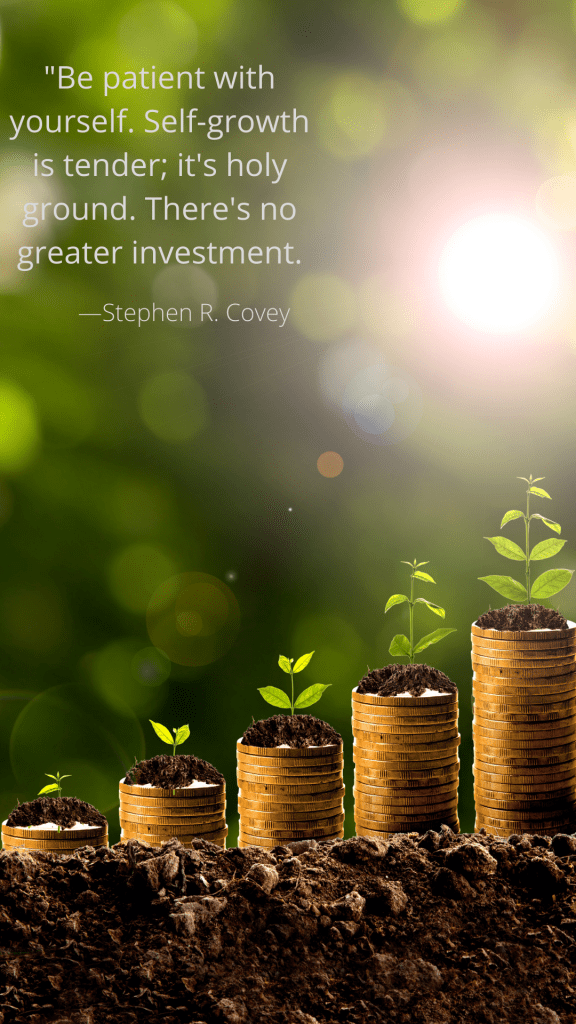
Self-growth is tender

A person of character

Character is an unchanging foundation that supports everything else. 

It’s much more important to be a person of character than it is to be successful.

(And the latter is more likely if you are the former…)

Choices

Almost everything that’s ever happened in your life has been the result of a choice.

A lot of it has happened because of your own personal choices.

But even those things that have happened to you completely and totally outside of your control have usually resulted from a choice…

Someone else’s choice in that case. And it created circumstances, good or bad, that affected you.

Interesting, and quite sad, to think about.

Subscribe

The Transitive Property of Belief

Time for a math lesson! Bear with me—it matters.

The Transitive Property of Mathematics says this: for all real numbers x, y, and z, if x=y and y=z, then x=z also.

That makes sense, right?

Why am I telling you this? Because this same mathematical property affects all outcomes you experience in life.

Think about it: how you see an aspect of reality affects how you behave. How you behave affects the results you get. Therefore, how you see things affects the results you get. X=Y and Y=Z, so X=Z as well.

Dr. Stephen R. Covey called this the “See-Do-Get Continuum.” How we see the world affects what we do, which affects what we get in life. (You can learn all about it in his monumental work The 7 Habits of Highly Effective People.)

Covey likes to say, “How we see the problem is the problem.” In this case, “seeing” could also translate into “believing.”

Here’s an example:

Let’s say you’re a manager and you’ve recently had a few millennials added to your team. If you believe all millennials are lazy and entitled, you’re going to treat them as such. This will so alienate them and undermine your relationship that pretty soon, they’ll start acting out.

Most likely they’ll rebel against you by doing the bare minimum, scraping by because in their minds nothing they do will be good enough to please you anyway. Why should they put out more effort than necessary?

How you saw them affected your behavior towards them, which affected how they behaved (your results). It’s the Pygmalion Effect, a self-fulfilling prophecy.

Can you see how this continuum affects us when it come to things like race, gender, or religion? Our beliefs shape our actions; our actions shape our outcomes.

So what’s the bottom line?

If you want to change the world—or maybe just your situation in it—start first by changing your beliefs. Work first on how you see things.

Don’t forget to subscribe!

It Might Not All Work Out…

We have the definition of optimism wrong.

We think optimism means believing that everything will work out for the best. Over time and on its own.

That’s not true. Plenty of awful things happen whether we’re optimistic or not.

“Well geez, Nathan! You’re obviously a pessimist with that outlook.”

No, actually, I’m quite optimistic. Because I realize that I’m the creative force in my life. I’m the driver of my own destiny.

As long as I’m alive, I have the chance to make something good happen.

Optimism isn’t simply believing that everything is going to be alright: it’s believing that whatever happens, you can make the best of it.

So if you’re reading this, you’re still breathing. And that means you can make the best out of whatever situation you’re in.

That is true optimism.

Get a daily dose of inspiration each morning.

SUBSCRIBE TODAY!

What Happens When We Don’t Think Win-Win?

Until we can believe that there is enough to go around, that each of us has the possibility to win alongside others, we cannot live effectively in an interdependent world.

Instead, we will see the world through the paradigm of scarcity. Everything becomes a competition rather than a chance for cooperation and mutual benefit.

Get more insights delivered directly to your inbox. Subscribe below!