
It’s Just a Simple Fear of Failing

Dan Miller sent out an email a couple of weeks ago entitled “Why Are You Stuck?” It struck a nerve in me, so I pinned that email to the top of my inbox and read it every day for the last two weeks.

Today, I finally took the time to craft a response and send it back to him. I thought I’d share it with you as well.

I’m a great writer—in fact, I do that in my day job. That, combined with my teaching experience, is why I was hired. Because I’m good at, and enjoy, writing, I keep thinking about, journaling about, and contemplating becoming a freelance copywriter as a 15-hour a week side business.

(Click here if you’d want to learn how YOU can start a business with only 15 hours per week)

I eventually want to become a full-time marketing consultant and a business coach for aspiring entrepreneurs and small business folks. I’m already doing the latter as part of my day job, just not as often as I’d like.

And…I keep getting cold feet, talking myself out of it. But today, I think I’ve finally been able to express what’s holding me back. It’s not a fear of cold-calling people or getting rejected…

I’m afraid I’m going to let them down! I’m afraid I’m going to fail to live up to my prices. Or write bad copy. Or that I’ll wireframe and write copy for a website, and it won’t work! I’m terrified of charging someone money for something and failing to deliver what I promised.

It seems disappointingly simple that my hold-ups come down to a simple fear of failure. But there it is. Dan asked me the question, and this morning I finally had an answer for him.

What’s holding you back? Maybe you’re thinking of starting a business or becoming a freelancer yourself. If so, I encourage you to click here and enter your email address.

You’ll instantly receive three free resources including 10 business ideas and how to start a business with only 15 hours per week!

Don’t miss a post! Subscribe today.

***Occasionally I include affiliate links in my posts for people and products in which I strongly believe. This is one of those posts.***
You Are EXACTLY Where You Are Supposed to Be

“Know that wherever you are in your life right now is both temporary, and exactly where you are supposed to be. You have arrived at this moment to learn what you must learn, so you can become the person you need to be to create the life you truly want.”

—Hal Elrod, The Miracle Morning, p. xxxi

Get a daily doses of inspiration.

Subscribe now!

Your Job Is Making Money for Other People…Not Yourself

What I learned from Donald Miller this morning:

(I’m paraphrasing) The goal of any business professional is not to make a lot of money… The goal is to make a lot of money FOR OTHER PEOPLE!

How true this is for all of us in the business arena. It doesn’t matter if you’re an employee, a small business owner, or a serial entrepreneur.

Your job is to help other people make money. That’s the only reason you get paid.

As a copywriter and marketer, my sole purpose is to help my clients make more money from their products and services. It’s how the only way to measure how successful I am in my role.

Shift the focus away from yourself. Think about your employer, your customer, or your client. 

What are you doing to make them more money?

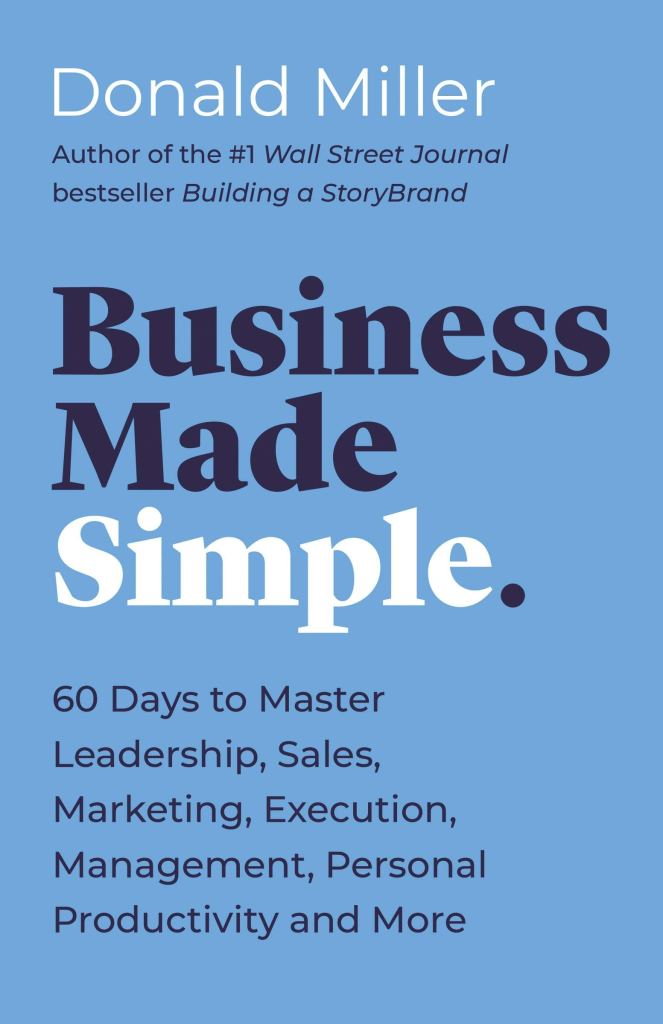
P.S. Donald Miller’s new book, Business Made Simple, launched today. If you’re ready to level up in your career or business, and become a value driven professional, grab a copy today. 

It might be the most valuable $20 you spend this year…

Get daily insights on life, business, and creativity. Subscribe today!

Are You Afraid of Being Told “Yes”?

Fear of rejection is normal. As a new freelancer, businessperson, or job-hunter, the thought of being rejected is terrifying. It’ll stop you in your tracks.

You don’t even have to try hard to imagine the feeling. You reach out, make cold contacts, and have (metaphorical) doors slammed in your face over and over. It’s enough to keep anyone from trying.

But there may be another reason you’re hesitating. A seemingly ridiculous reason you haven’t sent that email or finished that application.

You’re worried they might say yes…

Why would anyone worry about that? Isn’t hearing “yes” the best news possible?

And yet this fear is universal. Because if they say yes, you’re on the hook. You’re now responsible.

If you take on a freelance project, it’s all on you to deliver. If you take on a new job or move into a new career field, you have to perform.

And maybe…just maybe…you’re afraid you won’t be able to live up to the expectations. Maybe you’re worried you won’t deliver on the promise you made.

It’s not always fear of rejection that paralyzes us.

Often, we’re worried we’ll get exactly what we ask for.

Don’t leave just yet—you’ll miss out on future ideas! Subscribe below.

Failure and Success Are the Same Thing (Eventually)

The best teacher in the world is failure. Nothing teaches us more or faster than trying and failing at something.

It’s how we learn to walk. It’s how we learn to speak.

What keeps failure from becoming success is a lack of perseverance. We fail once and assume we’ll fail if we try again.

Thomas Edison failed more than 10,000 times in creating the incandescent lightbulb. But he failed differently each time.

When asked about this by a reporter, Edison said, “I have not failed 10,000 times. I have found 10,000 ways that don’t work.” He implied that each failure got him closer to his eventual success.

Had he tried making his lightbulb the same way 10,000 times, he would have been living out Einstein’s definition of insanity. But he didn’t. Instead he chose to keep trying 10,000 different ways.

Failure is a reality, but it’s also a choice. We can choose to learn from it, change things up, and try again. That option will eventually lead to success.

Or we can choose to fail and accept it as a permanent part of our lives.

You’ll find life is much better when you look at failure and success as learning experiences.

Learn more ways you can succeed every day. Subscribe below!

How to Make Revolutionary Change in Your Personal Life and Career

Dr. Covey taught me perhaps the most important and fundamental life lesson of all. It’s the idea of paradigms and the See-Do-Get formula.

What Are Paradigms?

Paradigms are our ways of seeing the world. As Dr. Covey describes it, they are maps of the territory we are navigating. As we know, maps are a representation of the world but not the world itself. These “maps” affect every aspect of our daily lives.

See-Do-Get

Our paradigms put us into a cycle known as “See-Do-Get”. How we see something (our paradigm) affects our behavior (what we do). Our behavior affects the results we get. These results then reinforce our viewpoint. They become a never-ending cycle that can only be short-circuited by changing how we “see”. We must examine the map.

A Story to Illustrate the Point

I once knew a teacher whose students approached him about putting on a short play for the school. They saw this as a way to put the English literature they were studying into a fun and creative context. But this teacher saw his students as an uncreative bunch of hooligans with no talent. He did not believe them capable of staging anything worthwhile.

Grudgingly, he let the students “try” to put something together. Because of his mindset, he failed to encourage them, coach them, or help them in any way. His only offering was scathing criticism because he saw no possible positive outcome. The students became increasingly frustrated and unhappy with their efforts. They began to believe their teacher correct in his views and quit the project after a few weeks. Their “failure” further reinforced the teacher’s own paradigm.

I felt devastated when I found out about the situation from the students. Why did it happen that way? Because he saw them as uncreative, incapable, and without talent, he treated them as such. He failed to help or encourage his students and did nothing but criticize and condemn. This behavior led to the results he expected all along.

The Root of Any Problem

How we see a problem (or person, political party, or random happenstance) is a problem itself. It affects our behavior and the results we get, leading to a self-fulfilling prophecy.

Design thinking teaches us to reframe problems in ways that allow us to take positive action on them. Only by changing how we see something can we get to the root of the issue. If you want to make positive change in any area of your life, first examine how you see the problem.

What would have happened had this teacher been aware of the way he saw his students? What if he had taken a step back and seen them as young, curious, and full of potential? Maybe he would have treated them as budding thespians and offered encouragement. This change in behavior might have led to a fun, engaging, and successful student project. And who knows? It might have had lasting effects on all the students, even the ones who came to watch.

Instead, his negative mindset destroyed all hope of having any success at all.

I’ll leave the final word on this subject to Dr. Covey himself:

“If you want to make minor improvements, change your behavior. But if you want to make quantum improvements, change your paradigm.”

—Dr. Stephen R. Covey

What more advice for living an effective life? Subscribe below.

What Successful People Do Differently

You’ve probably looked at someone who was in great shape and thought to yourself, “Man, I wish I could be like him.” 

Maybe this thought crossed your mind soon after: “If I really enjoyed hours at the gym and grilled chicken and broccoli every night for dinner, I’d be fit too.”

Here’s the thing – fit people don’t necessarily enjoy spending 3-4 hours a week at the gym or eating simple, similar meals over and over again. It’s not a matter of enjoyment. 

What they do is subordinate their cravings, emotions, and desires to a higher value system they establish for themselves. 

People who are successful at anything do the same thing. Albert E. Gray said it best when he wrote:

“The successful person has the habit of doing the things failures don’t like to do. They don’t like doing them either necessarily. But their disliking is subordinated to the strength of their purpose.”

–Albert E. Gray

“Whoever said this was going to be easy?”

One of the most important lessons I learned from Dr. John Berardi of Precision Nutrition is that when making change for your health and fitness goals, you are going to be tired; you are going to be hungry sometimes; you are going to be in a crabby mood and not want to do what is good for you. His response: “whoever said this was going to be easy?”

Successful people, whether they are successful in health or fitness, or successful in their families and careers, are just like you and me. They have the same cravings, the same desire to say “screw it all” or “I don’t want to do that” or “I’m scared I might fail/they might laugh at me/they might say no.” The only difference is they make the choice to act anyway. 

They are able to do this because they want something more than the resistance is telling them they want in this very moment. They begin with the end in mind and act proactively, rather than living in and for the moment, reacting to whatever whim, craving, or feeling comes their way during any given moment. 

This way of living–of choosing to do things that failures don’t want to do–can all be traced back to fundamental principles of effective living. They are embodied clearly and coherently in The 7 Habits of Highly Effective People by Stephen R. Covey. Successful people subordinate their fears and momentary desires to values, principles, and a desired end-goal. They “begin with the end in mind” as Dr. Covey writes in the chapter about Habit 2. 

They don’t WANT to do it either.

A successful sales person probably doesn’t want to make another cold call and face the very real possibility of rejection. But she does it anyway because the end she has in mind might be a full sales pipeline, a good income to support her family, or the growth of her business (perhaps all three and more). She’s just as scared as anyone else; she still feels the butterflies in her stomach when she dials the number; but she chooses to act rather than react to the feelings of the moment. 

You are a successful person already because you have the ability to do this with every task, project, and goal in your life. Realize that it’s all a matter of choice based on the end-result you desire. Envision the end you want to achieve, hold it in your mind in the moment of choice, and make decisions based on which outcomes get you closer to the end you want.

Want more inspiration to pursue your creative endeavors? Subscribe below!

How to get into the Hall of Fame

What does it take for a Major League Baseball player to earn a spot in the MLB Hall of Fame?

It takes failure.

Not a little bit of failure – it requires failing almost two-thirds of the time.

The best baseball players who’ve ever played the sport only average a hit 3 out of 10 times they come up to bat. That means they fail at their job 7 out of 10 times. And yet we still regard them as the best.

Why then, in our own lives, do we strive so hard to avoid failure at any cost? What if the avoidance of failure is preventing us from succeeding at a level that would cause us to stand out from the pack?

We don’t learn how to succeed through books, lectures, or seminars – we learn through failure, the greatest teacher of all. The books and seminars can help us avoid mistakes committed by others who’ve walked the path before us, but we have to fail on our own, in our own way, to find what works and what doesn’t.

To paraphrase Seth Godin in his webinar a few days ago: success requires time and failure.

Failing not only teaches you lessons from which you can improve, it also makes you more resilient to future failures. Each time you fail, you build a reserve for the future, which grows your confidence and allows you to try bigger and better things the next time. It’s a cycle that only spirals up.

What could you do in your life where you would consider batting .300 to be Hall of Fame-worthy success?

Don’t fear failure – fear never taking the chance of doing something great.

Join 904 other subscribers