What are we measuring?
How are we measuring it?
Should we be measuring this?
And, most importantly, are we sure we measuring the right things?
Ignore Goodhart’s Law at your own peril.
What are we measuring?
How are we measuring it?
Should we be measuring this?
And, most importantly, are we sure we measuring the right things?
Ignore Goodhart’s Law at your own peril.
A new company wants to break into an existing market, open five new stores, generate $10 million in new revenue in the next year, and capture 2% of the market share.
Can they do it?
Well, yes. Possibly, but… Only one of those things is within their direct control.
They can open the five new stores – that’s an action over which they have direct control.
Everything else is an outcome – something that they want to happen but can only be controlled indirectly through specific and defined actions.
To get the outcome, they must focus on and develop actions.
Here’s a (possibly) more relatable example:
Someone wants to bench press 300 pounds. That’s an outcome goal, something that’s dependent on a lot of factors:
It’s possible to hit that goal, but not by focusing on the outcome. Instead, the lifter should focus on actions that will lead to the outcome she wants:
The thing is, she may still never reach that goal. But by focusing on the actions that lead to the outcome instead of the outcome itself, she has a much greater chance.
The same principle applies to our business example. Hitting $10 million in revenue or capturing 2% of the market share is great. But what actions, done consistently day after day, will lead to those outcomes?
That’s the question.
Benjamin Franklin knew how to make things happen.
He founded the first post office in the (future) United States, its first subscription library, and even established the first fire departments and police force.
He created what eventually became the University of Pennsylvania and the nation’s first learned society (The American Philosophical Society) to promote useful knowledge for the good of the citizenry.
He was able to do this by constantly asking, “What does this community need?”
It might seem like this question is harder than ever to answer. So many of the things we need have already been created.
But even in the digital age, humans need new creations.
Maybe the community isn’t the one you live in, like it was for Franklin. Maybe it’s one you can create online.
Maybe the needs are less tangible than they were for Franklin. We have fire departments and schools, so what do we need now?
Perhaps it’s connection. Or understanding. Or a group. Perhaps it’s a new tool or process.
The needs may be less obvious than they were, but they still exist. And remember, the needs Franklin solved were probably not obvious in his time either, even if they are now in hindsight.
In his book, The 7 Habits of Highly Effective People, Dr. Stephen R. Covey discusses the concept of paradigms—ways of looking at the world or a field of study.
His argument is that these paradigms are like maps of places in the real world. If we have the wrong map, then we are looking at the “place” incorrectly.
An example:
If you’re trying to navigate Chicago but have a map of New York City, nothing you do with that map will help you achieve your goal of navigating Chicago.
Another example:
In Ancient Greece, physicians believed that all medical issues stem from an imbalance of the four humors (blood, yellow bile, black bile, and phlegm). If this is your “map” of the world of medicine, you’ll end up with a lot of dead people on your conscience.
You’d be working from an incorrect map—an incorrect set of assumptions and paradigms of how the human body and medicine work.
We are dealing with a lot of this today in numerous fields. And that’s why the study of philosophy—the activity of working out the right way of thinking about things—is vital.
Seth Godin wrote on Medium that knowing what the weather forecast is give us the illusion of being able to control it.
Of course that’s not true.
We seek control in our lives and settle for these illusions without actually being able to do anything about it.
You can’t control whether or not it’ll snow, but you can prepare by putting on coats and boots.
You can’t control whether or not it’ll rain, but you can stick an umbrella in the car just in case.
You can’t control whether or not a post you write will go viral. But you can write the post and ship it. And if it doesn’t, you can write another one tomorrow.
In short, if you want to control something, you can control yourself. Your actions, reactions, words.
But that’s all you can control.
For more daily musings like this, subscribe below:
If you spend any time coding, you’ll quickly discover that you don’t know, can’t remember, or never learned something you need to make your project work.
Enter Google (or whatever search engine you prefer*).
All you have to do is type in a few words related to the problem you’re trying to solve and voila! You’ve got your solution.
Seth Godin says in his great talk, “Stop Stealing Dreams,” that there’s no longer any need to memorize stuff. And this is exactly why—if you need something, you can just look it up.
I would agree with him, but I’d also take that idea a step farther.
As you look things up and implement them in your projects (and not just coding projects either), they will eventually become muscle memory.
The important thing is implementation—put what you look up to use immediately so that it slowly becomes a part of your vocabulary.
I think there are two points to this post:
*Instead of using Google, I’d highly recommend you check out Ecosia as your new search engine. Here’s why:
While you’re developing your “Googling” skills, consider switching to Ecosia today.
Imagine a web designer sitting at her desk.
There’s this nasty problem plaguing her current project. For the life of her, she can’t figure it out…
What does she do? She sits and thinks and thinks and thinks until she comes up with a solution.
Right?
Wrong!
She’s a designer—she builds her way forward.
She writes a line of code and runs it. Does that fix the problem? No. Did she fail? NO! She just learned something about her code.
So she writes another line and tries again. She builds her way past the problem one line of code at a time.
Maybe we should approach more of our problems like designers.
Instead of trying to think our way forward, we build.
Denis Waitley was wildly optimistic about the future when he recorded “The Psychology of Winning” in the 1990s.
Here are just some of those predictions:
Denis also predicted that by the year 2000, women would have equal pay with men and be equally represented in business schools, law schools, and entrepreneurial startups.
Like I said, wildly optimistic. It might even seem laughable, like something out of a futuristic 80s movie.
And yet…
We are so busy trying to get back to normal after this pandemic, we’ve somehow lost all the opportunity to actually make these happen.
Because of COVID-19, we already did 100% online, virtual education for a year and a half. It wasn’t perfect (far from it). But it worked. It’s been shown to be possible.
But we were so busy being focused on “getting back to normal,” we seemed to have missed the opportunity to push it further and make it better.
I don’t know the first thing about hydrogen scrubbing and powered cars. But I do know we have the technology for all-electric vehicles that don’t pump pollution and toxins into the air on a daily basis (multiple companies have this tech).
But instead, we’re buying bigger, badder, less efficient, gas-guzzling, pollution-admitting, tank-like vehicles, all in an effort to make a statement about our political views or our masculinity.
And here we are, 22 past after the year 2000… And women are still fighting for equal pay, equal representation, and control over their own bodies, not to mention all the other genders and races fighting for the same things.
So yes, Dennis was wildly optimistic. But it’s understandable why.
Because even back then the technology was coming online, the possibilities were there, and he saw them and thought, “Surely the world will embrace all of this—right?”
Yet here we are. Rejecting all of it out of hand.
Yes—some of these wonderful possibilities were forced on us by a horrible situation… Yet they were still wonderful opportunities.
But we were so desperate to go back to normal that we looked them in the face and said, “No thank you.”
We’re operating with 21st-century technology and possibilities while trying to stay in a 20th-century world. Why?
Because it’s the world we know. It’s the status quo. It’s “the regular kind.”
I feel like we missed a big opportunity here. And now I’m worried it may be years or decades before what’s possible actually comes to fruition.
How do we discourage the plastics companies—and all of the companies that use their products—from creating and using MORE plastic? Without the burden of cost ending up on the consumer?
Seth Godin mentions that the only real change will come through collective action on the part of us as citizens or via the government through taxation. (Check out his great podcast episode on the topic here.)
It worked for cigarettes; I assume it would work for plastic reduction as well.
But I feel that, in the short run, it would hurt all of us as consumers… because we really don’t have a choice. And you’d better believe that the people with money invested in plastic will make sure WE feel it before they do…
A couple of years ago, my wife and I went on a no-plastic, “reduce our waste” crusade.
We stopped buying drinks in plastic bottles…
We only used reusable grocery bags at the store…
We severely cut back on food and packaged goods…
We went to a more whole-foods diet (good for our health AND for the environment)…
We started using compostable garbage bags that we could compost ourselves.
My wife even persuaded a local restaurant to start selling glass bottles for to-go sauces that people could bring in and refill for a reduced price.
This is only a smattering of what we did to reduce waste…
The problem that we ran into was no matter what we did, we couldn’t get most of our food without massive amounts of plastic.
Our stores didn’t sell eggs in cardboard cartons. Nor did any of the local farmers we knew.
Every single piece of meat that we bought was wrapped in a pound of plastic. They wouldn’t allow us to bring in containers of our own… Or even follow our request for it to be wrapped in paper instead.
We couldn’t even go vegetarian—getting our protein through beans, yogurt, and other non-meat sources—without having it packaged in plastic bags or plastic cartons. All our stores had also gotten rid of the giant dispensers for grains and such… So we couldn’t bring our own bags for that either.
The futility of it all became clear when I saw what a major corporation (which will remain nameless) was doing with plastic.
They were shipping tiny pieces of hardware—each of which was about the size of a pencil tip…
Each wrapped in plastic… Each sealed in its own plastic, Ziplock bag…
Mailed in its own bubble-wrap-lined mailing envelope.
And they were shipping hundreds of these to hundreds of locations around the world… On a regular basis.
I knew then and there that our individual action wouldn’t make even the tiniest of dents in the waste problem we faced.
We’ve continued our personal waste-free crusade, simply because it makes US feel better about our actions. But the discouragement is real.
I don’t really have any answers today. Because taking individual action to solve systemic problems doesn’t make much of a difference…
So I pose the question again: how do we dissuade these companies from using plastic without the burden of the cost—and all the work—ending up on consumers?
We aren’t creating the waste—those are the massive corporations who save money by using it. And who are doing it without thinking of the second- and third-order consequences of their actions.
There aren’t many alternatives for individual consumers… And the plastic is being created ANYWAY. So it feels like we don’t have a choice.
And when we have no choice, there’s nothing that we can do, and it doesn’t look like there will be better choices for quite a while.
Controversial Opinion: Becoming a social media influencer is NOT the best way to thrive in today’s economy.
Yes—there are people on TikTok, Instagram, and all the other platforms making a fortune.
Social media influencing is the new Hollywood. Most of us only see the handful of big-name players making fortunes, and we assume we can easily do that too.
What we miss are the hundreds or thousands of actors making little to nothing in the entertainment industry or working odd jobs to pay the bills.
There isn’t anything wrong with that, but our culture is telling us we can all do this on social media now.
Ever heard of the long tail? Here’s an example (about podcasts):
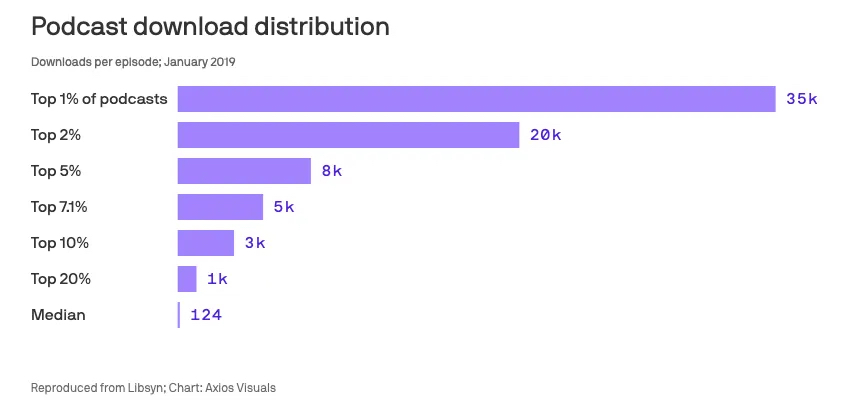
50% or more of all podcasts have only been listened to by 124 people… Which is not a sustainable business model.
This is a power-law curve, and it applies to just about everything.
If you solve problems for people by BEING one of those influencers, that’s a different story.
But measuring your success and hoping one of these companies will pay you a fortune for hits on your content is a bad way to live your life.
Commonsense, fundamental money principles combined with a steady income from solving problems for people over a long period of time.
This is the way to make a fortune. It’s just not slick or instant, so it isn’t sexy.
Subscribe below for daily insights, resources, and content delivered directly to your inbox.
 Nathan's Blog