Are You a Professional Artist?

You have a problem with perfection.

You don’t have writer’s block or artist’s block; you’re worried what you create isn’t very good. 

But once you stop worrying about whether something is good or bad, you can get to the business of creating. 

Professionals

To be a professional is to show up and do your work regardless of how you feel. To be a professional artist, then, is to create works of art every day no matter what.

If you’re trying to make a living doing something artistic or creative, you’re a professional. Or at least, you should act like one. 

Even if you don’t feel that you have any good ideas. Even if you’re “just an artist.”

An amateur artist only creates when he feels like it, or when the muse speaks to him. Or, God forbid, after getting inebriated so he can “loosen up” and go with the flow. 

If You Build It, They Will Come…

Remember Field of Dreams? Being an artist is a lot like Kevin Costner building that baseball field.

You don’t wait for the muse to show up before you start creating. If you start creating, the Muse shows up like a curious child. She asks “Ooooo! What’s that? Can I help? Can I do that with you?” 

Waiting for a child to do something you want her to do doesn’t work. But if you just start doing it, she’ll immediately perk up and join you because she wants to be a part of your world. The mythical “Muse” acts the same way.

Some days you might have incredible days full of flow and creative ideas, but I’ve found those to be few and far between. Creation comes before inspiration almost every day. It’s why I show up to my morning pages each day after I wake. 

I don’t write them because I feel inspired: I write them to BECOME inspired. That’s what a professional artist does–indeed, that’s what any professional does.

Act Like a Professional

A lawyer doesn’t wait to become inspired before writing a brief or rehearsing an opening statement. She’s a professional and shows up because that’s her job. 

A surgeon doesn’t wait for the muse to speak to her before operating on a patient. She trains for years so each and every time a patient is wheeled into the operating room, she’s ready to perform. 

What if you approached your art the same way? As your job. What if you showed up every day ready to create whether or not you’re in the mood?

Do the work. Go make the Muse curious today.

Get a daily dose of creative inspiration. Subscribe today!
Are We Really “Born to Do” Anything?

It’s a question asked by lots of career counselors, coaches, and well-meaning advisors.

“What do you feel you were ‘born to do?'”

What if the honest answer is we aren’t born to do anything specific?

There is an entire area of philosophy dedicated to this idea that was first theorized by John Locke. (You can check out the basics here.) But I’m focusing on talents and passions today.

Was Van Gogh born to paint? Was Steve Jobs born to create the iPhone? Seth Godin would argue no. His answer to this question is simple. Here’s how I understand it:

No one is predetermined to use a certain medium for his or her art. We simply adopt the means and medium of whatever is available to us in our time.

In one of his podcast episodes, Seth says he doesn’t believe that Van Gogh would have painted with oils had he been born in the 20th century. Nor would Steve Jobs have created the iPhone had he been born in the 1700s (the resources and advancements in science were not available for that to have been possible).

And yet, each of us is genetically unique. You have never occurred before and will never occur again in this universe. Surely that means that we are born with innate talents and leanings.

Part of me thinks that’s true. And yet part of me also believes, as career coach Dan Miller says, “Passion is more developed than discovered.”

By this, he means we become passionate about things we engage with over and over again.

I find this idea incredibly liberating. Why? It means if we aren’t satisfied with what we are doing—if our passions are no longer feeding or fueling us—we can choose a new passion. We can develop it to something that feels like we were born to do it.

Maybe, in the end, it all comes down to choice and what’s available to us in our time.

What do you think? Were you born to do something? Leave a comment today!

Artists Pay Attention. Are You an Artist?

What does an artist do? What makes her an artist? It’s simple: she pays attention.

I think I’ve been overwhelming myself with ideas, people, information, podcasts, audiobooks— too many different inputs to count. If we want to be creative, we have to shut out the noise, turn off the devices, and start paying attention to the world around us.

Paying attention might be something as simple as going for a walk outside. Head to the park, and be fully present in the moment. 

Paying attention means smiling at the people that walk past you and watching their entire demeanor change. They walk a little taller; they smile back; they pick up their pace. A smile generates energy.

Pay attention when you walk past two women speaking to each other in Spanish. What happens when you say in their native tongue, “Hello! How are you?” They chuckle, both pleased with your willingness to try and humored by your pained accent. 

Paying attention is noticing the difference in sound a few dozen yards can make. One side of a park is dead quiet, while the other—less than a football field’s length away and located close to a busy road—is roaring with the cacophony of motorcycles and sports cars. 

When you pay attention over a few weeks’ time, you notice the subtle change in attire worn by those walking around you as social and health issues become more prevalent. 

Perhaps you’ll notice two small children, obviously strangers and of wildly different cultures, run towards each other on the playground to touch hands, embrace, and play together as if they weren’t the least bit different. Afterwards, you might realize that it’s all invented, the differences we’ve created that cause such terrible strife in our world. 

If you listen closely, you’ll notice the gurgling, deep-throated rumbling of a large vehicle puttering past behind you. You’ll hear the sounds of leaves underfoot and voices across the fence. 

So this is what it’s like to pay attention. This is what we miss with our headphones in and our phones out, heads down and eyes fixed, always distracted and never present. 

We miss the face of a Star Wars alien created by a fortuitous arrangement of knots on a pine tree. 

We miss the sheer exuberance of a child as she first lays eyes on the playground and sprints past. We miss her zigging and zagging and the father’s apology for her child’s excitement. Why does Dad feels guilty? Why should he apologize for his child doing exactly what a child should do?

This is what we miss when we fail to pay attention.

Never miss an update. Subscribe below!

Egrets and Snakes

I went on a walk at the park near the huge water reservoir where I live. There is something especially soothing for me about walking near water.

While there I saw a young woman doing yoga in the shade of some trees right on the edge of the water. Shortly after I passed her, she strapped on some rollerblades and rolled, danced, and sang over every inch of the the park. It was both beautiful and entertaining.

As I started my walk back to the car, I saw a little girl walking near her mother who was pushing a stroller. I moved closer to pass them on the left, and I noticed the little girl holding a red marker and a piece of paper with pictures on it. Her mother had created a scavenger hunt based on nature items, and the little girl seemed to be making great progress.

After spotting and crossing off her list a certain tree, the little girl said, “Okay, now it’s time to find a SNAKE!”

A snake?!” the mother exclaimed.

“Oh yeah,” the little girl replied, “but don’t worry, mom—it’ll be easy to find out here!” Needless to say, the mother was horrified. Apparently she did not realize a snake was part of the hunt!

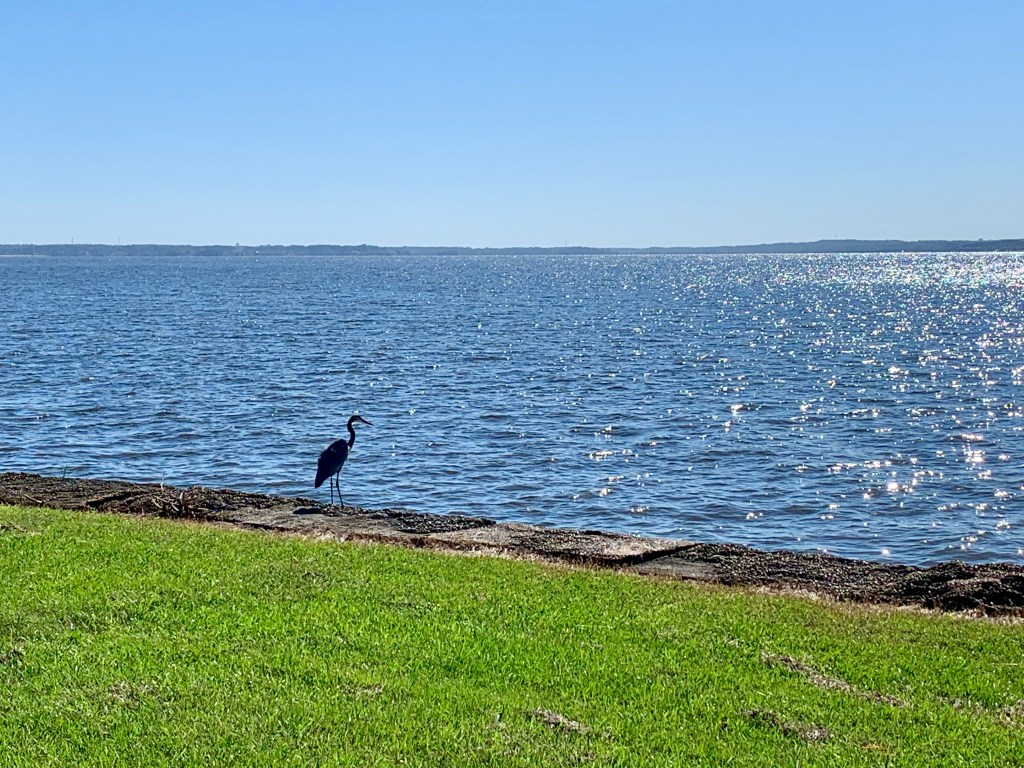
I also saw a beautiful egret on the water’s edge. They are one of my favorite birds: quiet, steady, and precise. They remind me of my mother, a great lover of birds who brought me up to love them too.

Synchronicity and serendipity abound when we ask the universe for things: I thought to myself, I’d really like a walking stick. Lo and behold! I found the most perfect walking stick not 10 steps away from where I had the thought.

As so often happens with long, undistracted walks outside, I had a small personal revelation: I would absolutely love to live somewhere close to the beach or a secluded body of water. Perhaps a quiet lake…

Walk outside today, with no distractions, no headphones, no noise. You’d be amazed at what the world has waiting for you.

Want more creative inspiration? Subscribe below.

There Will Never Be Another Time Like Now

If you’re reading this, you have an electronic device with access to the internet.

With that access you have the ability to reach upwards of 2 billion people on earth – a reach unheard of in human history.

Use that ability – in the form of blogging, video, photography, or some other medium – to create a voice that makes things better. 

You won’t reach all 2 billion people (you might not even reach 2), but if you reach one person, you’ve made a difference. And maybe that one person will tell the others.

This freedom may not last; the open systems, those that have allowed anyone with internet access the ability to speak up, are closing to us as quickly as they opened 20 years ago. 

You’ll never have a better opportunity than today.

We Are Our Own Worst Critics

Artists tend to have little faith in themselves or their work. They prejudge, rewrite, and scrap work without ever letting the work just “be.” 

We don’t feel it’s good enough, so we don’t hit “Publish” or “Post”. We fail to contact that company or that prospective client with a work proposal because we don’t feel we are good enough to get the job. 

I’ll let you in on a little secret:

Your work isn’t good enough.

It isn’t good enough by your own definition of “good enough to ship,” which in all likelihood is actually the definition of “perfect.” It’s not good enough for your impossibly high standards. 

That doesn’t mean it isn’t good. It might even be great. 

If your definition of “good enough” is actually “perfect,” you will fail. Nothing you ever make will be perfect. Nothing will ever be “finished” with that mindset. 

Ship your work anyway. 

“Art is never finished, only abandoned.”

Leonardo da Vinci

It is when we decide to abandon our work that it’s good enough to ship. Some work will be better than others; some days you will struggle.

But you are an artist, and artists create.

You will never feel that what you produce is good enough. It’s called “The Resistance”. Your amygdala – the “fight or flight” part of your brain – is telling you to run and hide to avoid being criticized or judged. 

It is wrong. Don’t listen to it. Ship your work anyway. Don’t procrastinate because you don’t think it’s perfect (it never will be). 

Don’t let the definition of “perfection” become your definition of “good enough.” That way leads only to frustration and regret. 

Want more inspiration to embrace your creativity? Subscribe below!

Note: occasionally I include affiliate links for products that have helped me along the way. I receive a small commission from the affiliate on any purchase you might make. You do not pay anything extra for this.

Artist-of-All-Arts

I don’t think I’ve ever met a single artist who was not a jack-of-all-trades in the arts and humanities–an “artist-of-all-arts” if you will.

It seems every artist is not only attracted to multiple forms of art but develops skill in multiple areas as well.

My late friend Michael McNally was a brilliant cellist and a gifted, passionate actor. My friend Lindsey is a skilled artist, photographer, designer, and also a singer with a beautiful voice. (You can see some of her work here and here.) Another friend of mine, Alden, is one of the best photographers I know as well as a talented artist and connoisseur of music.

It seems to me that anyone attracted to the arts and humanities is attracted to all of them. It’s as if once the right brain is fully engaged, it looks for beauty everywhere. 

Such is the life of an artist, and why, I suppose we can seem to others to be so scattered in our work and interests–and perhaps feel that way about ourselves. 

An artist is a lover of beauty no matter its form, so we chase it everywhere.

What about you? What forms of art are you attracted to or skilled in? Let me know in comments below!

Want more inspiration to pursue your creativity? Subscribe below!